I never liked my uncle when I was growing up. He was severe, impatient, and able to find a fault in almost anything I did. Family gatherings left me bracing for his next criticism, and as soon as I became old enough to choose, I kept my distance. I assumed he disliked me as much as I disliked him.
Years passed with little contact. Then my mother told me that my uncle had cancer and was seriously ill. I felt sympathy, but it was mixed with memories I had worked hard to leave behind. I did not visit at first. Only when my mother explained that he had repeatedly asked to see me did obligation overcome my resistance.
The man in the hospital bed looked smaller than the uncle I remembered. His voice was weak, and the sharp certainty that once filled every conversation had disappeared. Neither of us knew how to bridge the years between us. We spoke awkwardly about ordinary things while machines hummed around us.
Beside him was an old photograph showing him with his children. He held it as if it carried a private weight, but I did not ask why. I stayed longer than I intended, then left feeling confused. It was the only visit I made before he died several weeks later.
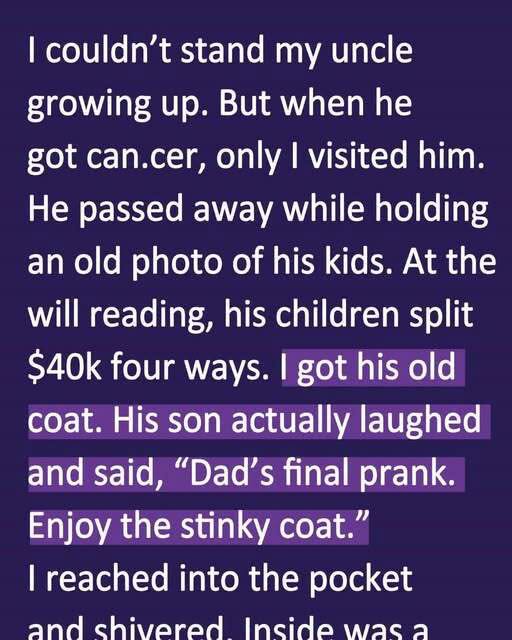
At the reading of his will, his children gathered expecting to divide whatever he had left. The lawyer announced that the four of them would share forty thousand dollars. Each would receive ten thousand, a modest inheritance that immediately became the focus of their attention.
Then the lawyer called my name. My uncle had left me an old coat. It was heavy, worn, and carried a stale odor from years of storage. One of his sons laughed and described it as his father’s final prank. The others joined in, amused that I had been singled out for something that appeared worthless.
I accepted the coat because refusing it in the lawyer’s office felt even more embarrassing. At home, I hung it away from my other clothes. For two days I considered throwing it out. Every time I saw it, I heard the family’s laughter and remembered the criticism that had shaped my childhood.
Curiosity eventually won. Before discarding the coat, I searched its pockets. My fingers touched a sealed envelope with my name written across it in my uncle’s unmistakable handwriting. Inside were a letter and a small key. The discovery turned the coat from an insult into a question.
My uncle wrote that he knew his children would fight over money. He had left them an amount that could be divided clearly, hoping to prevent a larger conflict. The key belonged to a safety deposit box reserved for me. He explained that I had visited him when I believed there was nothing to gain, and that simple choice mattered more than I understood.
At the bank, I opened the box and found legally executed documents, including a deed to property worth about six hundred thousand dollars. The papers named me as the owner. I sat in silence, reading the same lines repeatedly because the reality felt impossible. The old coat had carried a life-changing inheritance past everyone who mocked it.
The money and property were astonishing, but the letter affected me more deeply. My uncle had been a difficult man, and one generous act did not erase the way he treated people. Yet the gift showed that his inner life was more complicated than the harsh personality I knew. He had noticed my visit, understood the motives around him, and chosen a final way to express gratitude.
I cried for him for the first time. My grief included anger, regret, relief, and questions that could no longer be answered. I wondered whether he had always cared but lacked the ability to show it, or whether illness had changed him. The truth was probably less simple than either love or resentment alone.
The coat still hangs in my closet. I have never washed it, and I cannot bring myself to discard it. Its odor, once a source of humiliation, now connects me to the moment everything changed. It reminds me that value is not always displayed openly, that complicated people can leave complicated gifts, and that the things others overlook may carry the greatest meaning.