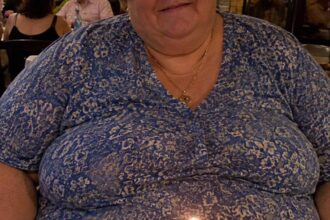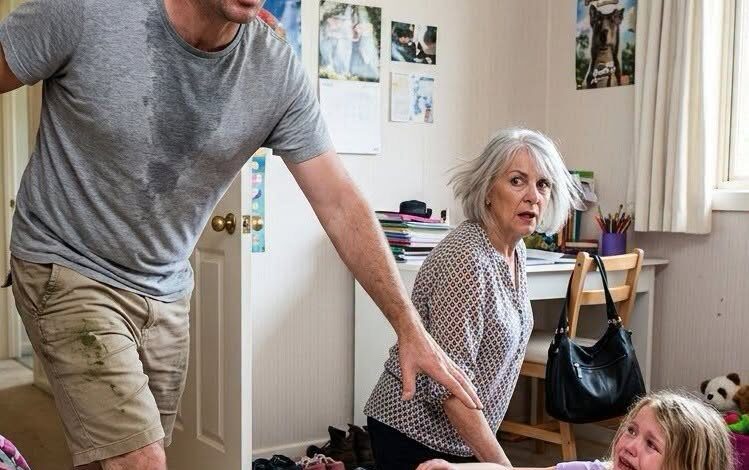
When my daughter Lily begged me to look inside her grandmother Marlene’s purse, I almost dismissed the request as the product of a frightened imagination. Minutes later, I found Marlene leaning over Lily and insisting that she had seen nothing. That was when I opened the purse and discovered a folded hospital document.
I read the page twice because anger made the words blur. A hospital stamp showed 10:14 that morning. Beneath it was my wife Anna’s medication schedule, written in Marlene’s careful handwriting—the same writing that appeared on birthday cards, shopping lists and notes left on our refrigerator.
Lily had not imagined the scene. Marlene knew I understood that now.
“Give me the paper,” she said.
I folded it and kept it in my hand. “No.”
Her eyes shifted toward Lily, but I stepped between them. I told Marlene that she would not speak for my daughter, call her dramatic or decide what Lily had witnessed. For the first time, Marlene had no quick explanation.
Lily explains what she saw
I held out my hand to Lily and asked her to tell me only what she had actually seen. She said Marlene had arrived while Anna was resting after taking her medication. Marlene entered the bedroom, photographed the prescription labels and copied the dosing times onto the hospital sheet. Then she placed several tablets into a small plastic envelope and hid it beneath the lining of her purse.
When Lily asked what she was doing, Marlene grabbed her wrist and warned her not to tell anyone. Lily ran to find me. The fear in her voice now made complete sense.
I asked Marlene to empty the purse herself. She refused, insisting that the document concerned a private family matter. I told her privacy stopped being an excuse the moment she frightened my child and removed medicine from my home.
Finally, she opened the bag. Beneath the lining was the envelope Lily had described. The tablets matched Anna’s prescription.
A secret plan built around fear
Marlene’s confidence collapsed. She admitted that she had become convinced Anna’s medication was making her too tired to care for Lily. Rather than speaking to us or contacting Anna’s doctor, she had begun building a file. The hospital page, photographs and missing pills were intended as “evidence” that she could use to challenge us for custody if Anna’s condition worsened.
Her explanation stunned me. Anna had recently undergone treatment and followed a carefully supervised plan. Fatigue was an expected side effect, not proof of neglect. Marlene had transformed her fear into surveillance and had placed Lily in the middle of it.
I told her that concern did not justify stealing medication, intimidating a child or secretly documenting a patient. If she truly believed Lily was unsafe, she should have spoken openly and involved the appropriate professionals. Instead, she had tried to manufacture a case while pretending to help.
Marlene began crying. She said she had already lost one daughter years earlier and could not bear the possibility of losing Anna. Her fear was real, but it did not erase what she had done.
Protecting my daughter came first
I photographed every page and the envelope before placing the medication somewhere secure. Then I called Anna’s medical team to explain that several tablets had been removed. They confirmed that her treatment record showed no misuse and advised us on replacing the medication safely.
I also documented the marks on Lily’s wrist. Marlene protested that she had not meant to hurt her. Lily moved closer to me, and that small movement ended the argument. Intent did not change the fact that my daughter was frightened in her own home.
I told Marlene she had to leave. Until we had spoken with a family counselor and established strict boundaries, she would have no unsupervised contact with Lily. She handed me her key without another word.
After the door closed, Lily asked whether she had caused the family to break apart. I knelt beside her and told her the truth: she had protected her mother by speaking up. Adults were responsible for their own choices, and none of Marlene’s decisions belonged on Lily’s shoulders.
That evening, Anna and I explained everything to her in language she could understand. We thanked her for trusting us even when an adult told her to remain silent.
Marlene’s fear had begun with love, but fear without honesty had become control. The hospital document did not expose Anna as an unfit mother. It exposed how far Marlene had gone without giving any of us the chance to answer her concerns.
Our family did not heal immediately. Trust rarely returns on command. But one rule became permanent: no child in our home would ever be punished for telling the truth, no matter how uncomfortable that truth made the adults around her.