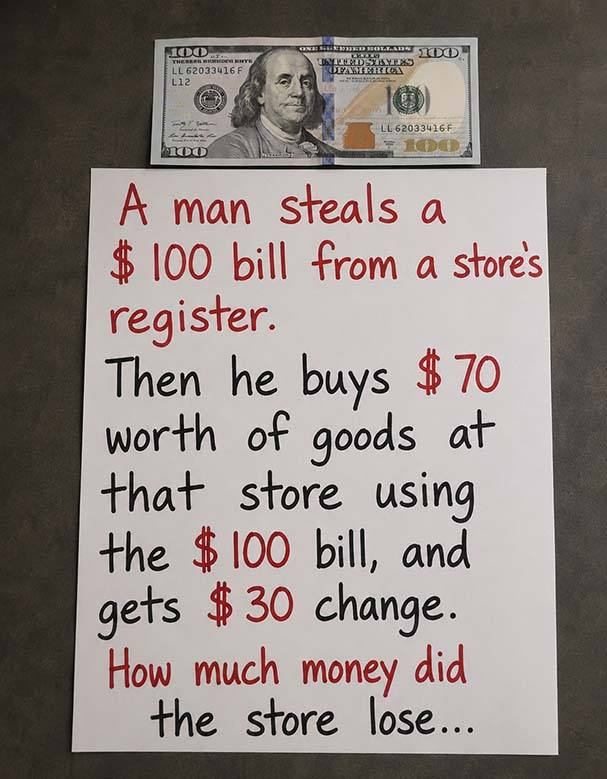
At first glance, this classic riddle seems remarkably easy, yet it consistently triggers intense debates across the internet. The confusion typically arises because the human brain tends to overcomplicate the exchange by counting the same money multiple times. Whether people guess $200, $170, or $130, the disagreement usually stems from how they track the stolen bill versus the change given.
To settle the debate once and for all, we can look at the movement of assets in three distinct phases:
The Three-Step Breakdown
- The Theft: The man takes a $100 bill from the register. At this specific moment, the store is down exactly $100.
- The Transaction: The man returns and “pays” with that same $100 bill. The store now has its original $100 bill back in the register. For a brief second, the store’s cash balance is back to where it started (Net loss: $0).
- The Exchange: The cashier hands the man $70 worth of goods and $30 in cash (the change).
When you add the value of the products ($70) to the physical cash handed out ($30), the total loss is exactly $100.
The “Clean Slate” Method
The most effective way to solve this—and the method that usually ends the social media arguments—is to ignore the “stolen bill” entirely during the second half of the story.
Since the thief used the store’s own $100 to pay for the items, he essentially gave the store nothing of value. From the store’s perspective, the final outcome is identical to a thief walking in and simply demanding $70 in merchandise and $30 in cash at gunpoint. In both scenarios, the store is missing a total value of $100.
Why the Brain Gets Tricked
The linguistic trap lies in the “change.” Because the man “pays” with a $100 bill, our brains want to add that $100 loss to the $30 in change, or subtract the $70 in goods from a running total. However, because the $100 bill finished the day inside the register where it belonged, it is no longer a loss. The only things that left the store and never came back were the merchandise and the change.
Final Answer: The store lost $100.