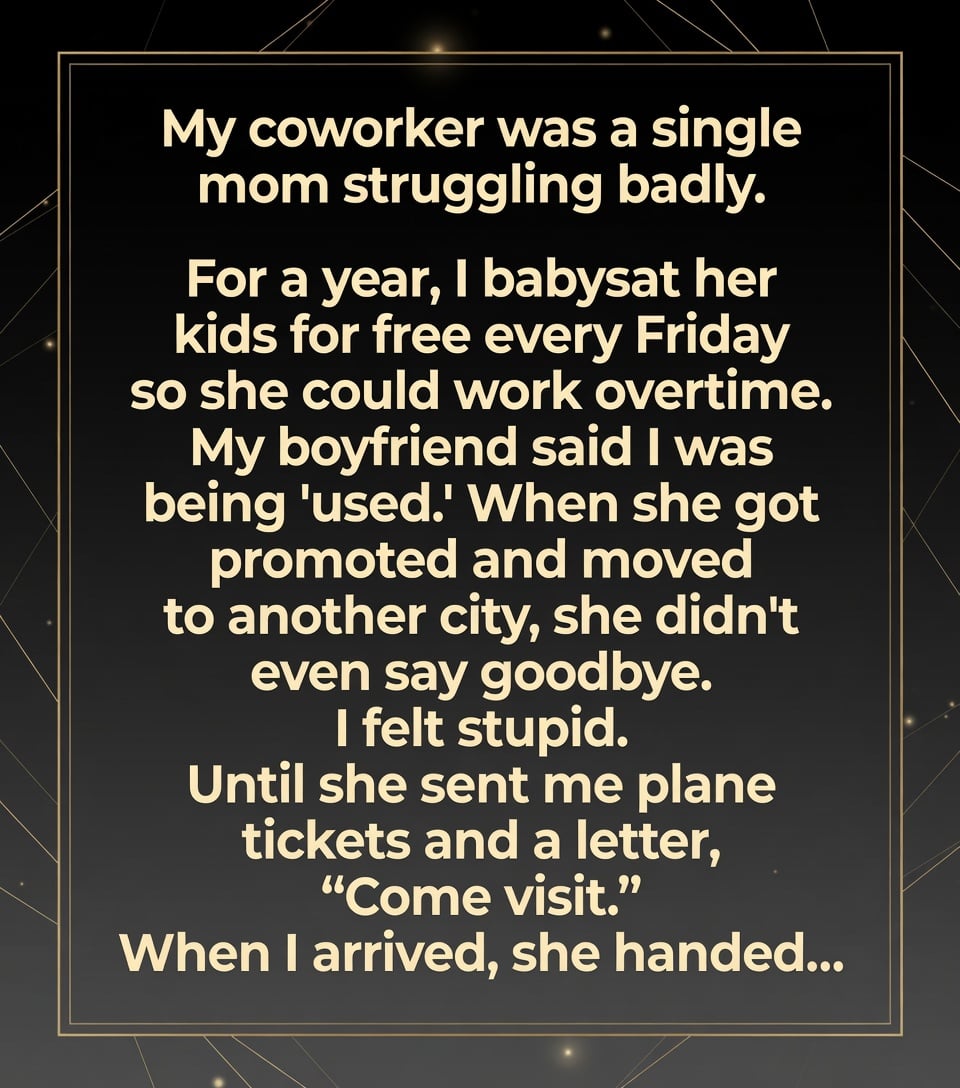
Mara was the type of coworker you noticed not because she dominated the environment, but because she always seemed to be operating at a level of intense, high-stress fatigue. Within the sterile, brightly lit office, she moved with a hurried elegance, her gaze constantly shifting to her phone as if she were awaiting an emergency. We worked together for six months before I understood the framework of her existence: she was a single mom raising a toddler and a five-year-old, trying to navigate a professional world that provided almost no support for someone attempting to advance their career while raising two small children.
The breaking point arrived on a grueling Tuesday. The building’s cooling system had broken down, and the tension was thick. Mara got a call that her childcare had fallen through for the third time that month. She looked utterly defeated, possessing that deep exhaustion that makes you feel like the world is collapsing around you. It was then that she asked, with great hesitation and apology, if I could look after her kids on Fridays. Her supervisor had offered her a recurring overtime slot that would greatly improve her modest savings, but it meant she had to stay late into the evening.
Without overthinking the logistics, I agreed. Back then, my Fridays were empty hours spent on mindless TV or the occasional social gathering. I didn’t view it as a burden; I saw it as a helping hand to a neighbor.
This arrangement turned into a year-long tradition. Every Friday at 5:00 PM, the energy of childhood would burst into my quiet home. We constructed massive cardboard castles that filled the living room, watched cartoons until they drifted off, and established a fun routine of Friday night dinners featuring plenty of macaroni and cheese. Mara would show up late, still buzzing from a long shift, reaching into her bag to offer me whatever money she could spare. I always refused. For me, the time spent with her kids had become its own compensation—a splash of vibrant life in my otherwise predictable world.
However, my social circle was less than encouraging. My boyfriend, Mark, was a harsh critic of the setup. In his view, the world was a series of trades, and I was getting a “bad deal.” He would point out the evenings I had to skip our dates or the times I looked worn out from chasing a toddler for six hours. “She’s using you for free labor,” he would claim with a cynical tone. “You’re trading your youth and freedom for someone who wouldn’t do the same for you. It’s a one-way arrangement.”
His words began to act like a slow poison. During the cold winter months, when the kids were restless and I felt the weight of my own tasks, I started to question if he was right. Was I a generous person, or just someone being taken advantage of? Was Mara truly thankful, or was I just an easy fix for her issues?
Then, the routine suddenly ended. I walked into the office one Monday to see Mara’s desk empty of its photos and notes. An HR announcement informed us she had taken a promotion in a city three hundred miles away. I got a short, rushed text from her: “Had to leave for the new position immediately. Everything is happening so fast. Thank you for everything.”
The following silence was intense. There was no proper farewell, no dinner, no heartfelt note. The year of Fridays seemed to disappear as if it never existed. In the following weeks, Mark’s silence was even worse than an “I told you so.” I felt incredibly foolish. I had dedicated hundreds of hours to her family, and in the end, I felt like a temporary tool that was put away once it was no longer needed. I convinced myself that kindness was a luxury I could no longer afford to give away.
Two months later, a large envelope arrived in my mail. Inside were two round-trip flight tickets and a handwritten note on thick paper. It was an invitation to see her in her new city. Part of me wanted to destroy them to keep my pride, but curiosity won. I needed to see the life that had been built on the foundation of my Fridays.
When I stepped off the plane, the change was immediate. The children, bigger and more energetic than I remembered, ran past security and jumped into my arms. In their eyes, I wasn’t just a babysitter or a convenience; I was a permanent part of their childhood, a safe place they hadn’t forgotten.
Mara drove me to her new residence, a bright house in a quiet suburb that felt miles away from her old, cramped apartment. Once the kids were occupied, she sat me down in the kitchen. She looked different—the high-stress vibration was gone, replaced by a calm, steady confidence. She didn’t give a long speech. Instead, she reached into a drawer and handed me a set of car keys.
I tried to turn them down, the old habit of saying “it was nothing” coming to my lips, but she looked at me in a way that insisted I listen. She explained that those Friday nights weren’t just about childcare. They were the engine of her success. Because I had offered a secure, free environment for her children, she was able to accept every difficult task, every late meeting, and every extra shift the office had. She had made herself essential to the company, eventually winning a promotion that included a relocation package and a salary that finally ended the cycle of poverty she had been stuck in.
The car was a physical gift, but the true present was the realization. My boyfriend had been focused on the trade of hours, but he had missed the transformation of a life. The help I had provided wasn’t “nothing” to her; it was the actual foundation of her entire future.
As I drove that car back toward my own life, I realized that we often think of kindness as a seed that should grow overnight. We want to see the flowers right away, and when we don’t, we assume nothing happened. But the most significant changes often occur in the dark, underground, slowly strengthening someone else’s roots until they are ready to break through. I realized Mark was wrong—kindness isn’t a one-way street; it’s an investment in another person. I didn’t just leave with a car; I left with the firm belief that no act of true compassion is ever wasted. It always finds its way back, even if it takes a different path than the one you expected.
The Unexpected Reason She Handed Me Her Car Keys After Going Missing
Previous Article Next Article
I Found A Secret Clinic Paper Hidden In My Daughters Suitcase And My Wifes Signature On The Bottom Changed Our Lives Forever
The Taylor Swift and Travis Kelce News That Actually Broke the Internet and Forced a Global Moment of Silence

Related Posts

The Mirror Lied To You This Morning And The Truth Will Terrify Yo ...
August 27, 2026
Country music icon Dolly Partons cause of death is revealed
August 26, 2026