The dust in my great-grandfather’s attic was thick enough to bury a secret. It was a gray, stifling layer that had accumulated over decades of discarded memories, masking piles of aging newspapers, moth-damaged wool blankets, and cartons of letters bound with rotting string. I had spent most of a Tuesday morning hauling out the ordinary remains of a long life, expecting nothing more than a few antique trinkets or perhaps a set of old coins. But when I reached into the furthest corner, where the roof met the floorboards in a tight, web-filled angle, my hand touched something chilly, heavy, and unmistakably metal.
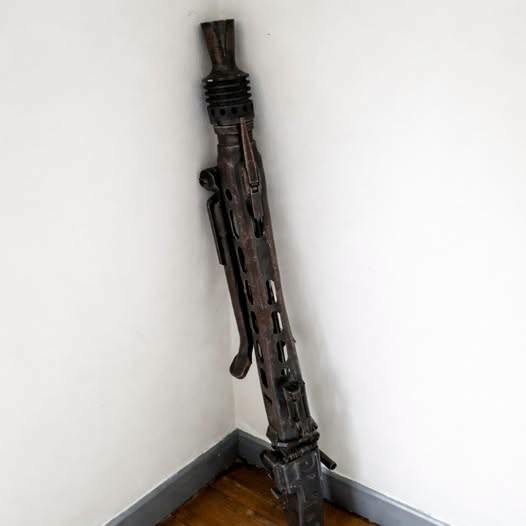
I pulled the object into the middle of the room, the floorboards creaking under its massive weight. As the light from the lone hanging bulb hit the frame, the air seemed to turn colder. It wasn’t a chest or a tool. It was a silhouette that had haunted the battlefields of Europe over eighty years ago. Propped against a stack of crates was a long, dark metal firearm, its ventilated barrel jacket staring back at me like the eye of a predator. I was looking at a Maschinengewehr 42, better known to history as the MG 42—the notorious “Hitler’s Buzzsaw.”
The weapon appeared as though it had been frozen in time. The dark, phosphate finish bore a somber patina, and the walnut buttstock, though marked with scratches, remained firm. Attached near the muzzle was a folded bipod, tucked away as if waiting for the order to establish a defensive line. My great-grandfather had never discussed his wartime service, at least not in detail. He was a man of quiet routines and gardening, yet here, concealed above his bedroom, was one of the most feared pieces of military engineering ever created.
As I began to clear more room, I realized the gun was only the start. Tucked behind it were several heavy olive-drab canisters and canvas satchels. This wasn’t just a random souvenir; it was a complete, high-capacity automatic support system. The further I searched, the more I found. There were five individual barrels housed in carriers, four with wartime markings and one clearly adapted for post-war 7.62 NATO rounds. There were MG 34 drum magazines, ammo cans packed with spare top covers and feed trays, and even a heavy, folding tripod mount fitted with an anti-aircraft sight.
In a small green canvas pouch, I discovered the field kit. It held a ruptured shell extractor, oilers, and a grimly functional asbestos glove, designed to let the operator change a glowing-hot barrel in the middle of a firefight without burning their skin. The sheer efficiency of the design was haunting. The MG 42 was a masterpiece of German mass production, using stamped steel and welding to ensure it could be produced in factories like Gustloff Werke and Mauser at a massive rate. During the height of the war, over 400,000 of these units were manufactured to provide relentless, suppressive fire.
I examined the markings on the receiver: M.U./5301/h/dfb. The wartime code dfb confirmed it originated at Gustloff-Werkes-Suhl. Every inch of the weapon was steeped in history, from the Waffenamt inspection stamps—the tiny Eagle/WaA510 proofs—to the tangent rear sight calibrated for distances up to 2,000 meters. The buttstock carried the stamp hvg/44, dating that specific part to 1944, the closing stages of the conflict.
As I sat on the dusty floor, the significance of the find began to hit me. This wasn’t just a historical oddity; it was a potential fortune. In the world of elite military collectors, a fully operational, original wartime MG 42 is the ultimate trophy. Due to the strict regulations regarding automatic weapons, specifically in the United States under Class III registration categories, a transferable, legal specimen can command an incredible price. With the vast array of accessories I had located—the tripod, the range finder, the spare barrels, and the original tools—the estimated value of this attic find could easily range between $40,000 and $60,000. It was a winning lottery ticket buried in a pile of trash.
However, the thrill was quickly balanced by a sobering truth. This was a machine engineered to fire 1,200 rounds per minute—a rate so rapid the human ear can hardly distinguish separate shots, creating a sound often compared to tearing linoleum. It was a tool built for one goal: to control a landscape through lethal power. Touching it felt like grabbing a live wire of history, a physical link to an era of total chaos.
I spent the rest of the afternoon carefully documenting the collection. I found a belt-linking tool with a crank handle for preparing ammunition and a tripod-mounted range finder still kept in its metal transit case. The completeness of the set was what made it truly exceptional. Most battlefield pickups were stripped of their gear or deactivated over time, but this set was a time capsule. It even featured a registration stamp, CELCO/KC/Mo., suggesting that at some point in its trip from a German factory to an Ohio attic, it had been legally registered by a professional.
The legal and safety concerns were significant. Owning such a device is strictly monitored, governed by a complex network of local and federal laws. This wasn’t something I could just display on a mantle or sell at a garage sale. It required an expert appraisal, legal confirmation, and extreme care. The MG 42 is a reminder that history doesn’t always stay in the books; sometimes, it sits silently in the dark, waiting for someone to tidy the rafters.
By the time the sun began to set, throwing long shadows across the attic, I had moved the gun back to its corner, covering it once more with a tarp. It felt different now. The attic was no longer just a place of dust and old blankets; it was a vault. My great-grandfather had kept this secret for decades, perhaps as a trophy, or perhaps as a weight he couldn’t bring himself to drop. As I climbed down the ladder, my hands still smelling of old oil and cold steel, I knew that the process of managing this find would be as complicated as the weapon’s delayed roller-locking mechanism. One thing was certain: the quiet, ordinary Tuesday I had expected was gone, replaced by the weight of a $60,000 relic that changed everything I knew about my family’s past.
I Found A Lethal Relic From The Loft That Could Be Worth More Than My Great Grandfathers House
Previous Article Next Article
My Neighbor Brought Me Soup Every Single Friday For A Year But When I Finally Walked Into Her Kitchen My Entire World Collapsed
Beyond the Bedroom Why One Night with the Wrong Person Can Cost You Everything