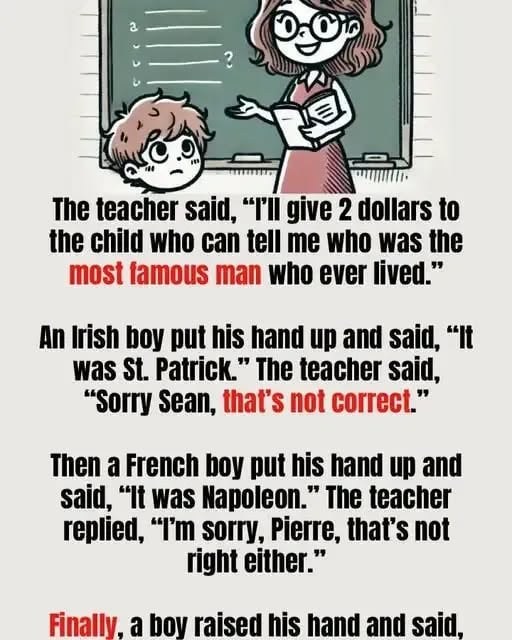
The depiction of a young boy standing at a moral junction, selecting a crisp two-dollar bill over a sacred religious icon, is often treated as a punchline in the halls of folklore. We smile at the child’s precocity, dismissing his choice as a harmless youthful eccentricity. However, beneath this layer of lighthearted wit lies a sharp, uncomfortable reality that mirrors the darker recesses of the human experience. This is not merely a joke about a child’s whim; it is a profound examination of the collision between identity and incentive. It reveals the alarming speed at which our most hallowed convictions can be traded the moment a concrete, immediate prize is laid on the table. The humor serves as a velvet sheath for a blade of truth, forcing us to admit a sobering fact: most of us have, at some point in our path, bartered our deepest principles for far less than we claim they are worth.
This occurrence represents the “quiet arithmetic” of existence. It is a psychological balance sheet that we begin drafting in our youth and continue to adjust until our final breaths. While we enjoy envisioning ourselves as heroes in a grand saga of honor, the reality is frequently found in the small-scale deals of daily life. Consider the classic fable of the penniless admirer who pursues a wealthy socialite, only to face a cold dismissal. In a world defined by romantic standards, one would expect a story of grief or the mourning of a lost partnership. Instead, the admirer laments the “loss” of the million-dollar fortune he never actually possessed. In this blunt reversal, affection is stripped of its emotional gravity and turned into a botched financial forecast. The phantom ache of a missed venture replaces the sting of a broken heart. It suggests that our highest virtues—love, devotion, and friendship—are often just placeholders we hold until a more lucrative opportunity arises, turning our most private human yearnings into a cold ledger of debits and credits.
This pervasive cynicism reaches even into the world of the supernatural. Take the account of Stanley, a man given the chance to buy a “mystical desk” for five thousand dollars—a piece of furniture rumored to grant its owner unparalleled, cosmic success. Stanley’s hesitation does not come from a principled doubt of magic or a devotion to scientific laws. Rather, his distrust is rooted entirely in the cost. He wonders if the miracle is worth the expenditure, effectively placing a monetary cap on his own capacity for wonder. This is the contemporary tragedy: we have become a society of doubters who can calculate the expense of everything but can no longer sense the significance of anything. Even the prospect of the divine or the remarkable must first undergo a cost-benefit check before we permit ourselves to trust it.
These accounts resonate across eras because they pull back the glittering mask of our noble rhetoric to show the basic transaction pulsing underneath. Whether the medium is faith, romance, or awe, we are in a constant state of appraisal, perpetually measuring what—and who—is “profitable.” We cloak ourselves in the comfort of thinking our honor is beyond price, yet history and human behavior suggest that nearly everyone has a threshold. There is almost always a figure, a title, or a convenience that can transform a lifelong belief into a mere product. The boy in the anecdote isn’t a villain; he is a realist who has grasped the art of the “now.” He recognizes that while Moses offers spiritual pathfinding for the far-off afterlife, two dollars secures a candy bar in the present. He picks the tangible over the transcendent—a choice we mirror every time we value a shortcut over a standard.
This quiet math characterizes the modern social and professional world. We observe it in the person who selects a high-status, soul-withering corporate job over a deeply meaningful but lower-paying calling because the math of the mortgage is more persuasive than the math of the heart. We see it in the individual who keeps toxic, empty social ties because the perceived social wealth is too high to abandon. We trade away our time, our creative fire, and our core tenets in tiny, gradual installments. These trades are so minor that we rarely notice the stock is failing, until one day we wake up and understand that the total of these small deals is the loss of our very self. We have swapped the masterpiece of our being for a pile of shiny, cheap trinkets.
The wit in these stories is vital because it grants us the necessary distance to acknowledge the parts of ourselves we usually hide in the shadows of our bank records. It is simpler to laugh at the child or the admirer than it is to confess that we, too, have a price tag. We reside in a world that constantly asks us to auction our own ethics. The drive to fit in, to triumph, and to collect creates a market where the spirit is often the most undervalued property. We are instructed that being “practical” means being transactional, and that clinging to a principle at a financial loss is a type of insanity.
Ultimately, these tales dare us to look at the “lingering taste” of our life’s decisions. When the deal is closed, when the first rush of gain has faded, and the bank balance is still, what truly remains? If worth is never what it seems on the surface, then perhaps the most costly and scarce thing any human can hold is the honor they have kept off the marketplace. Genuine prosperity is found in the moments where we decline the two dollars, where we grieve the person rather than the purse, and where we welcome the wonder without haggling for a discount.
The mirror these parables hold to our faces is not meant to judge us for our pragmatism, but to serve as a crucial alert. As long as we are occupied with pricing our souls, we are completely overlooking the true worth of leading a life that isn’t for sale. The expense of selling out is always higher than the payout, because when you finally reach the summit you purchased with your convictions, you realize you left the only person who could appreciate the view back at the base. The aim of a life well-lived is to reach the conclusion with a soul that is scarred, tired, and well-used, but one that remains entirely unowned by the market. In a world of commodities, being priceless is the only genuine form of mutiny.