It was expected to be just another routine press briefing.
Cameras were set, reporters were in place, and Donald Trump was once again speaking from the Oval Office. But within minutes, what began as a familiar criticism of media coverage took an unexpected turn—one that caught even experienced observers off guard.
Trump has never been known for holding back.
Whether addressing supporters, critics, or journalists, his style has always been direct, unfiltered, and often unpredictable. Over time, that approach has shaped his relationship with the media—frequently tense, openly confrontational, and rarely consistent.
On this particular Tuesday, the tone initially felt familiar.
Trump returned to a theme he often revisits—the idea that media coverage of him is overwhelmingly negative. Speaking with confidence, he referenced what he described as striking numbers.
“I get 93 percent bad publicity,” he said, presenting it as if it were a measured statistic rather than a personal view. Then, almost casually, he raised it even higher.
“Some people say 97,” he added, implying that nearly all coverage of him is negative.
For those listening, it was nothing new.
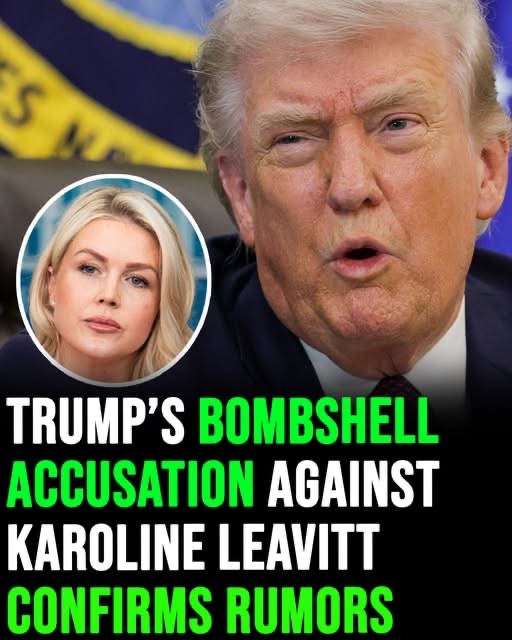
But then, in a moment that shifted the atmosphere in the room, Trump turned his attention to someone standing just a few feet away—his press secretary, Karoline Leavitt.
With a half-smile that blurred the line between humor and seriousness, he delivered a remark that immediately drew attention.
“If it’s 97 percent,” he said, glancing toward her, “maybe Karoline’s doing a poor job.”
There was a brief pause.
Then he followed it with something even more direct.
“You’re doing a terrible job.”
The words lingered.
For a moment, the room felt different. Reporters exchanged looks. Some leaned forward slightly, unsure whether they had just witnessed real criticism or an offhand joke.
Leavitt, who has spent years standing at the podium defending the administration, explaining decisions, and handling intense questioning, remained composed. There was no visible reaction, no immediate response—just professionalism in a moment that could have easily turned uncomfortable.
And just as quickly as the remark landed, Trump softened the tone.
“Should we keep her?” he said aloud, almost as if thinking in real time. Then he answered his own question.
“I think we’ll keep her.”
The mood shifted again.
What had sounded like sharp criticism now felt closer to a mix of teasing and performance—something intended as much for effect as for meaning. Still, the moment stuck.
Because even when delivered lightly, words carry weight.
Trump then returned to his broader argument about media bias, expanding on his long-standing belief that news organizations treat him unfairly.
“All they do is hit Trump,” he said, repeating a message that has become central to his communication style.
He went further, suggesting that major media outlets don’t operate independently, but instead act as extensions of political opposition.
“They’re an arm of the Democratic Party,” he claimed.
That argument, while not new, continues to fuel debate about the role of media and the line between criticism and bias.
But what followed drew even more attention.
Trump suggested that networks could face consequences for how they cover him. Referencing broadcast regulations, he implied that negative coverage might cross certain limits.
“They’re licensed,” he said. “They’re not allowed to do that.”
Then came a statement that immediately raised eyebrows.
“I would think maybe their licenses should be taken away.”
It was a comment that touched on deeper issues—press freedom, regulation, and the boundaries of political influence. While some dismissed it as rhetorical, others saw it as part of a broader pattern, where frustration with media coverage leads to calls for accountability—or even control.
Throughout all of this, the earlier moment with Leavitt remained central.
Because it revealed something beyond policy or media criticism.
It showed the dynamic inside the room.
Leavitt has long played a key role in shaping how the administration communicates with the public. She stands at the front line—answering questions, clarifying positions, and often absorbing the immediate impact of political narratives.
Her role demands precision, resilience, and the ability to stay composed under pressure.
And in that moment, she did exactly that.
Whether Trump’s comment was meant as humor, criticism, or something in between, it highlighted the unpredictable nature of his communication style. Allies can become targets of jokes. Serious discussions can suddenly shift tone. And the line between the two is often unclear.
For supporters, that unpredictability is part of the appeal—a sign of authenticity and spontaneity.
For critics, it raises concerns about consistency and message discipline.
Either way, it guarantees one thing.
Attention.
Moments like this don’t fade quickly. They circulate, get replayed, analyzed, and debated. Every word is examined, every reaction interpreted.
And in that process, a single comment can grow into something much larger.
Because in politics, it’s not only about what is said.
It’s about how it is received.
And on that day, what began as a familiar complaint about media coverage turned into something more revealing—how quickly the focus can shift, how easily the tone can change, and how even a passing remark can leave a lasting impression.
Whether it was a joke, a critique, or something in between, one thing was clear.
Everyone in the room noticed.
And no one forgot it.