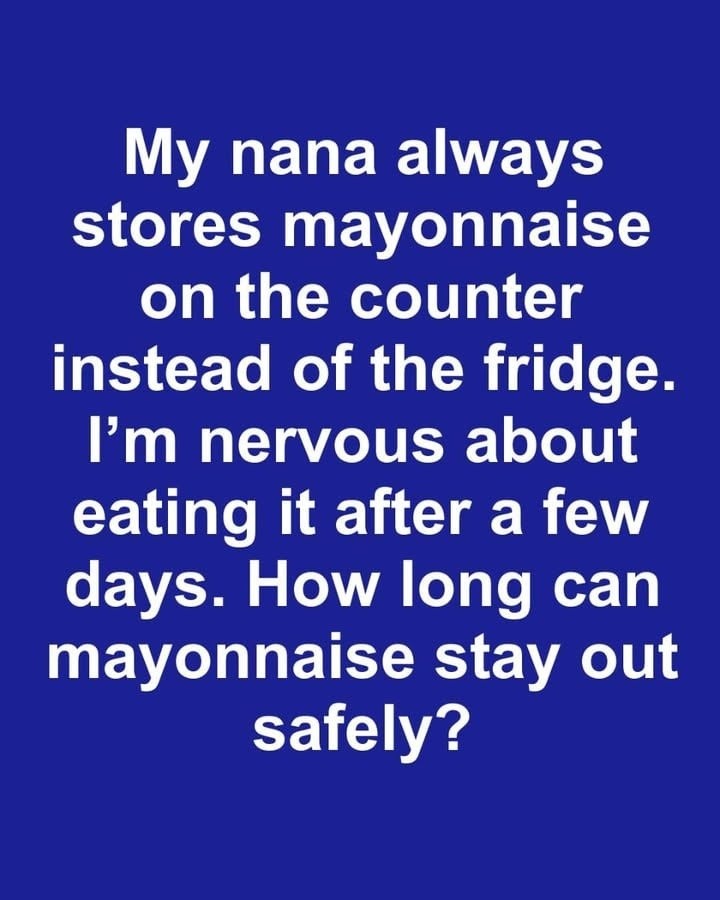
Mayonnaise doesn’t appear like something that could ever harm you.
It’s soft, pale, and familiar. It sits quietly in the refrigerator next to leftovers and sandwich ingredients, blending into the background of everyday life. Most people rarely give it a second thought. You open the jar, scoop a little out, close the lid, and move on. It feels harmless. Ordinary.
And that’s exactly why people often become careless with it.
Because risks rarely announce themselves in dramatic ways. They slip into daily routines through small habits that seem too minor to matter. A jar left out on the counter a little too long. A knife dipped in after touching something else. A lid loosely closed before the jar goes back into the refrigerator door.
On their own, these actions don’t seem like a big problem.
But together, they can quietly turn something ordinary into something unsafe.
The reality is that store-bought mayonnaise isn’t as fragile as many people believe. In fact, it’s more stable than most assume. Commercial mayonnaise is typically made with pasteurized eggs and a carefully balanced acidity level—usually from vinegar or lemon juice—which creates an environment where harmful bacteria struggle to survive.
That built-in protection plays an important role.
It’s why mayonnaise doesn’t spoil immediately if it’s left on the counter for a few minutes. It’s also the reason many long-standing warnings about mayonnaise being inherently dangerous are somewhat exaggerated.
But “more stable” doesn’t mean “untouchable.”
Once you open that jar, things begin to change.
Every time you scoop from it, there is a possibility of contamination. It doesn’t take much. A knife that was just used to spread butter on bread. A spoon that touched cooked meat or vegetables. Even crumbs or tiny food particles you may not notice.
Then there’s the invisible element—warm air, microscopic bacteria present in the kitchen, and the simple act of opening and closing the jar repeatedly.
Each time, something new can enter the container.
Mayonnaise may resist bacterial growth, but it isn’t designed to survive neglect.
Temperature is where things begin to shift from safe to questionable.
Mayonnaise needs to stay cold—consistently cold. Ideally below 40°F (about 4°C). At this temperature range, bacterial growth slows significantly, helping the product remain stable for regular use.
The problem usually isn’t one major mistake.
It’s a pattern of smaller ones.
You leave the jar on the table during lunch because you might use it again. You forget it while cleaning the kitchen. You place it in the refrigerator door, where the temperature changes every time the fridge is opened. You take it out, use it, and put it back repeatedly—each time exposing it to warmer air.
Just two hours outside proper refrigeration can already begin pushing mayonnaise into a risky zone, especially in a warm kitchen.
And often, it’s not the mayonnaise alone that becomes the issue.
It’s the chain of carelessness surrounding it.
In everyday life, people often excuse small mistakes. We tell ourselves everything is fine. That nothing bad will happen this time. That it’s just a condiment.
But food safety doesn’t rely on assumptions.
It relies on conditions.
And when those conditions are ignored for long enough, consequences can follow.
Homemade mayonnaise is where the margin for error becomes even smaller.
Unlike commercial versions, homemade mayo usually doesn’t have the same level of acidity or pasteurized eggs. It’s often made with raw or lightly cooked eggs, meaning it lacks the natural protection that helps store-bought mayonnaise resist bacterial growth.
It may taste fresher. More natural. Sometimes even better.
But that freshness also makes it more delicate.
Homemade mayonnaise requires much more caution. It should be refrigerated immediately after preparation, stored in a tightly sealed container, and consumed within only a few days.
Not a week.
Not “until it smells strange.”
Just a few days.
And it should never be left sitting out the way people sometimes treat store-bought mayo.
Because it simply can’t tolerate the same mistakes.
There’s a common belief that natural always means safer—that food made at home is automatically better.
But in this case, natural simply means less protected.
And protection is what keeps food safe.
The real difference comes down to habits.
Simple, consistent habits.
Always use clean utensils when scooping mayonnaise from the jar. Avoid double-dipping. Don’t reuse knives or spoons that have already touched other foods. Close the lid tightly after each use. Store it in a colder, stable section of the refrigerator instead of the door, where temperatures fluctuate.
Minimize exposure to room temperature. Don’t leave the jar sitting out while preparing meals or eating. Take what you need and return it to the refrigerator immediately.
These are not complicated rules.
But they are more important than many people realize.
And then there is the final safeguard—your own judgment.
Pay attention to changes.
If the texture appears different, if the color shifts, or if the smell seems even slightly unusual, don’t hesitate. Don’t convince yourself it’s still fine. Don’t keep it simply because throwing it away feels wasteful.
It’s not worth the risk.
One poor decision can turn a simple meal into hours—or even days—of illness.
Food poisoning doesn’t care whether the source was something expensive or something as ordinary as a sandwich spread.
It only cares that the conditions allowed it.
And those conditions often come from the small details we overlook.
Food should nourish you, not cause harm.
But that outcome depends on the care you give even to simple routines. The way you store your food. The attention you give to everyday habits. The discipline to follow basic safety practices even when they seem unnecessary.
Mayonnaise, in its quiet and ordinary way, reminds us of that.
It’s not about fear.
It’s about awareness.
Because sometimes the difference between safe and risky isn’t dramatic. It’s just a few seconds of attention. A better habit. A small decision repeated consistently.
And those small decisions are often what protect us from problems we never expected.