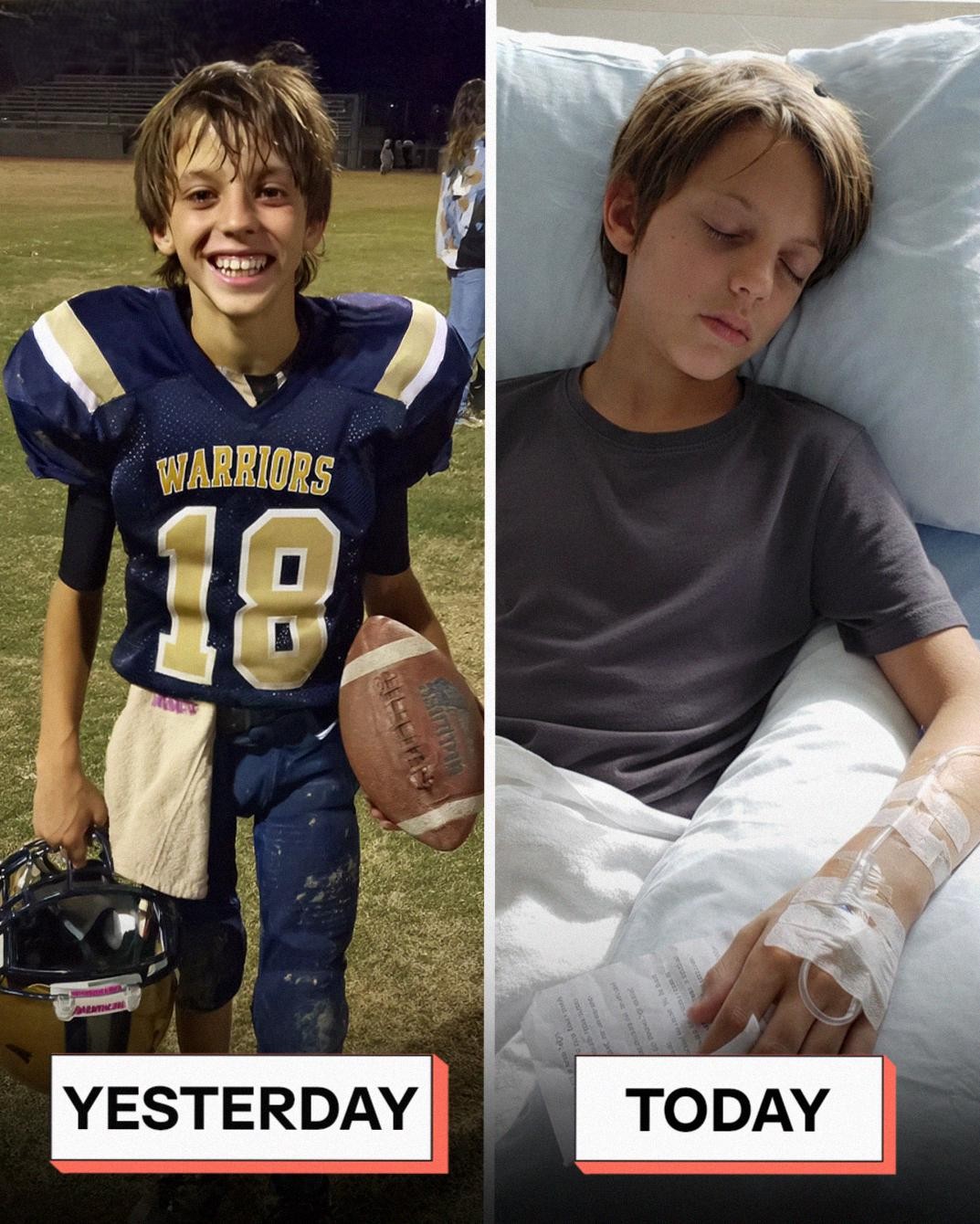
The hospital at three in the morning doesn’t feel entirely real.
The lights are too harsh, the air too chilly, the silence too heavy. It pushes in on you until everything else fades away—until the only thing left is the steady, mechanical rhythm of machines keeping your child breathing.
That’s where I stood when my thirteen-year-old son fell into a coma.
Yesterday, Andrew had gone for a walk with his father.
Today, he was lying in a hospital bed, surrounded by cables and monitors.
And I kept replaying the last words I had said to him.
“Take your inhaler, just in case.”
He’d rolled his eyes, half-grinning, the way he always did.
I didn’t realize that would be the last normal moment we would share.
When I reached the ER, Brendon—my ex-husband—was already there. Pale. Trembling. Repeating the same line again and again as if saying it enough times could somehow make it true.
“I don’t know what happened. One second he was okay… the next he just collapsed.”
I wanted to believe him.
But something felt wrong.
Brendon had always been careless about Andrew’s health. Skipped checkups. Ignored symptoms. Told him not to “baby himself.”
And now our son was lying there, unconscious.
The doctor spoke softly, but her words struck hard.
“Early indications suggest cardiac arrest. We’re still conducting tests. Every hour counts.”
Every hour.
I stood there gripping the side of the bed, watching Andrew breathe through machines.
Brendon cried next to me—but something about it didn’t feel right. Too dramatic. Too controlled. Like sorrow being performed.
I leaned down and gently moved Andrew’s hair from his forehead.
“I’m here, sweetheart,” I murmured. “You’re not alone.”
That’s when I noticed his hand.
It was tightly clenched around something.
Carefully, I pried open his fingers.
A wrinkled piece of paper.
My heart started racing before I even read the words.
“Mom, open my closet for the answers. BUT DON’T TELL DAD!”
The message wasn’t just a note.
It was a warning.
I returned home that night with that piece of paper burning in my palm.
The house felt empty without him. Too quiet. Too still.
Andrew’s closet door was slightly ajar—just enough to suggest someone had been there not long ago.
Inside, everything appeared normal at first.
Clothes. Shoes. Nothing unusual.
Until I discovered the shoebox.
It was hidden high on the shelf, behind a stack of old comics. Inside were documents—medical ones.
An appointment.
Canceled.
By Brendon.
Not forgotten. Not postponed.
Canceled.
As if it didn’t matter at all.
A small sticky note in Andrew’s handwriting sat beside it.
“Dad said I don’t need it. Mom is going to freak out.”
My chest tightened.
He knew something was wrong.
He tried to speak up.
And he was ignored.
My phone buzzed.
Brendon.
I answered.
“Why did you cancel his appointment?”
“He was fine,” he snapped. “You always overreact. Insurance wouldn’t pay for it.”
“I would have paid,” I said, my voice shaking. “You didn’t even tell me.”
“You turn everything into a crisis.”
“Maybe that’s what kept him alive,” I fired back.
He hung up.
And I kept looking.
That’s when I noticed the notification I had missed.
A video.
From Andrew.
My hands trembled as I opened it.
His face filled the screen—pale, uneasy.
“Hey, Mom… I don’t feel good. My chest hurts. Dad says it’s nothing… but I’m scared.”
My heart shattered right there.
Then Brendon’s voice appeared in the background.
“Put that away, Andrew! You’re fine. Stop making a scene.”
The video ended.
I sat there in silence, staring at the screen.
My son had reached out to me.
And I hadn’t seen it in time.
The next morning, I returned to the hospital carrying everything—the note, the canceled appointment, the video.
This wasn’t simply an accident anymore.
It was negligence.
I sat across from the doctor and the social worker, my voice steady even though everything inside me felt like it was breaking.
“You need to see this.”
They listened. Watched. Took notes.
Then the doctor nodded.
“We’re updating his records. From now on, you are the primary medical decision-maker.”
Just like that.
No more ignored warnings. No more dismissals.
No more chances for someone else to decide what mattered.
Brendon sat in the corner, quiet.
“I thought he’d be fine,” he said weakly.
“He told you he wasn’t,” I replied.
That was the difference.
Later, I sat beside Andrew again, holding his hand.
The machines still hummed. The room still felt frozen in time.
But something had shifted.
“I found it,” I whispered. “I know what you were trying to tell me.”
For the first time since this began, I felt something move.
Not relief.
Not yet.
But direction.
A way forward.
Because this wasn’t only about what had already happened.
It was about what came next.
And I knew one thing with complete certainty:
If—no, when—my son wakes up…
He will know that I listened.
That when it mattered most, I chose him.
Every single time.