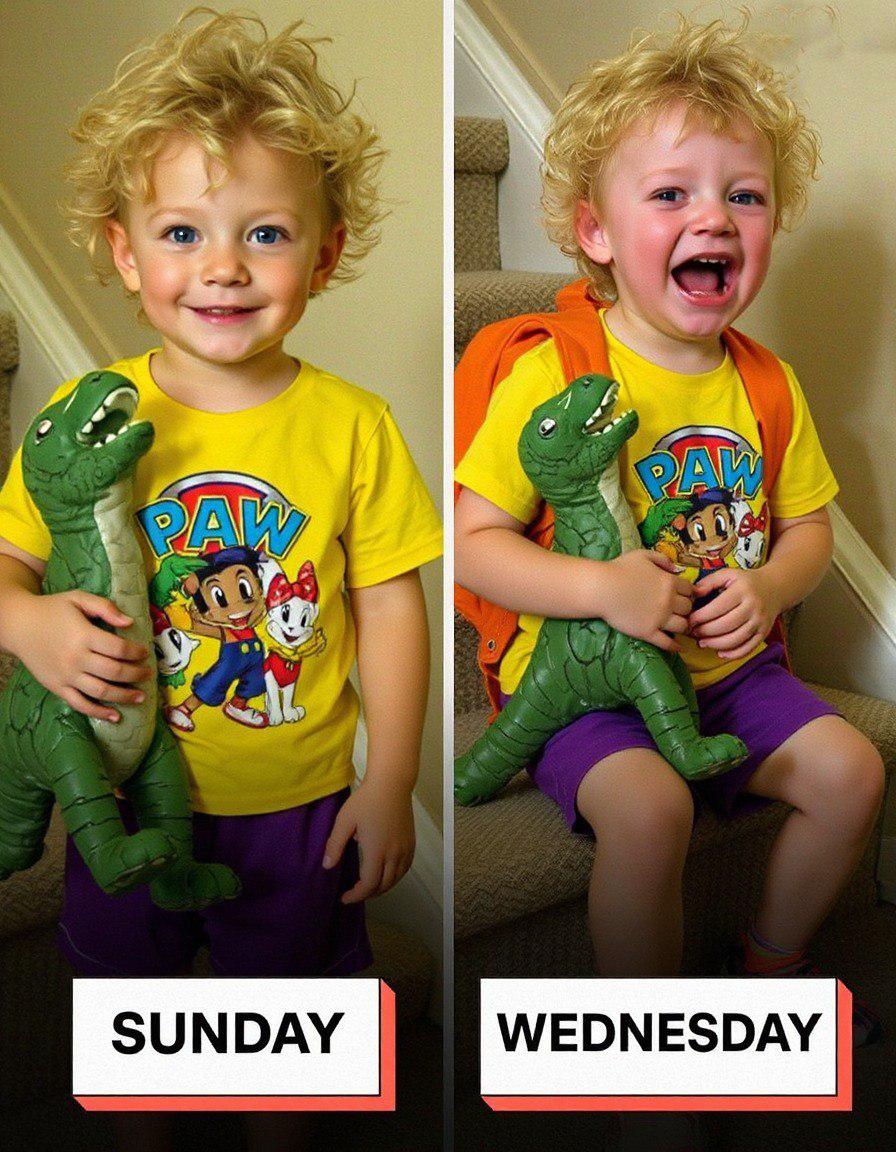
Until recently, daycare had been the brightest and happiest place in my three-year-old son’s life. Johnny didn’t just go there—he loved it. He was the kid who woke up before my alarm clock, already humming silly songs while pulling on mismatched socks. He’d sneak action figures into his backpack and run down the stairs with an excitement that made every morning feel like the beginning of a colorful adventure. I’ll admit, there were moments when I felt a small sting watching him rush out the door so happily without me. But I reminded myself that his enthusiasm meant he felt safe and loved there. I believed I had found a place where he was cared for. I believed he was protected.
That belief didn’t just weaken—it collapsed completely on an ordinary Monday morning.
I was standing in the kitchen with my first cup of coffee when a scream tore through the quiet house. It wasn’t whining or a small complaint. It was a raw, terrified cry that made my body react before I could even think. My mug slipped from my hand and shattered across the floor as I ran upstairs.
I found Johnny curled into a tight ball in the corner of his bedroom. His cheeks were wet with tears, and his little body was shaking uncontrollably.
When I knelt beside him and asked if he was hurt, he couldn’t even speak clearly through his sobs. But the moment I mentioned daycare, his fear exploded. He grabbed my legs and clung to me desperately.
“No, Mommy. Please don’t make me go!”
This wasn’t the usual protest of a toddler trying to avoid something. It was genuine terror.
I held him and tried to comfort him, telling myself it must be a phase. Maybe a bad dream, maybe separation anxiety. I tried to convince myself it was something normal.
But as the week went on, the fear only grew worse.
By Tuesday he refused to get out of bed.
By Wednesday he cried and begged.
By Thursday he was shaking just from hearing the word daycare.
Worried and exhausted, I took him to our pediatrician. Dr. Adams explained that strong separation anxiety can peak around age three and said many children go through something similar. I wanted to believe her. I needed to believe my son wasn’t experiencing something more serious.
But on Friday morning, overwhelmed by work deadlines and an entire week of stress, I finally lost my patience.
“Stop it,” I said more sharply than I should have. “You have to go.”
The silence that followed was worse than the crying.
Johnny froze mid-sob. His eyes went wide and distant, and his body trembled like he had completely shut down.
That was the moment something inside me changed.
I knelt down, apologized, and gently asked the question that suddenly felt incredibly important.
“Sweetheart… why don’t you want to go to daycare anymore?”
He stared at the floor for a long time, twisting the edge of his shirt between his fingers.
Then he whispered something so quietly I almost missed it.
“No lunch.”
At first I didn’t understand. Johnny had never been picky about food—he just stopped eating when he felt full. I couldn’t figure out how lunchtime could cause that much fear.
So the next day I decided to test something.
I promised him I would pick him up before lunchtime.
He hesitated, but eventually nodded. For the first time all week he let me buckle him into his car seat without crying.
At drop-off he held my hand tightly until the very last second.
I spent the next few hours unable to focus on anything except the clock.
At 11:30 I left work early and drove back to the daycare. Instead of going through the front entrance, I walked around the side of the building where large windows looked into the dining room.
And that’s when I saw it.
Johnny sat at the end of a long table with his head lowered.
Next to him was a woman I had never seen before—older, with gray hair pulled into a tight bun. She wasn’t wearing a staff badge or any identification.
Her expression was hard and impatient.
She wasn’t helping him eat.
She grabbed his chin and forced his face upward, pushing a spoon against his tightly closed mouth so roughly that his head jerked back.
Tears ran silently down his face while she snapped at him.
“You’re not leaving until that plate is empty.”
I didn’t think.
I didn’t stop to call the director.
I burst through the side door so hard it slammed against the wall.
People turned in shock, but I didn’t see anyone except my son.
When I reached him and lifted him into my arms, his entire body relaxed with overwhelming relief. He clung to me while I looked directly at the woman who had turned his happy place into something terrifying.
In that moment everything became clear.
This wasn’t a phase.
It wasn’t normal separation anxiety.
My son had been suffering in a place I trusted to care for him.
Experts often speak calmly about childcare safety, but even small percentages of mistreatment represent real children and real trauma. Forced feeding and harsh mealtime discipline can create long-term problems with eating and increase anxiety in young children.
I wasn’t just taking Johnny home that day.
I was protecting him.
And standing there with him in my arms, my heart racing, I knew one thing for certain:
I wasn’t leaving that building until I understood exactly what had been happening to my child—and until I was sure it would never happen again.