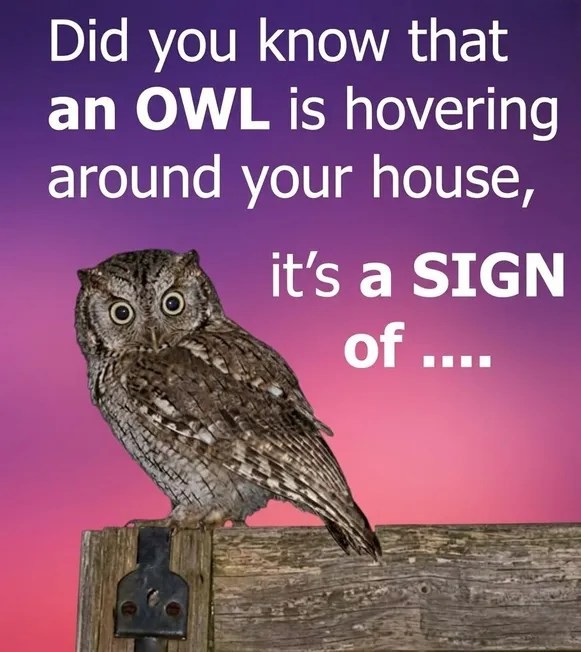
On quiet nights, when movement slows and the air feels unusually still, owls emerge as silent figures gliding through the darkness. Their presence is subtle but powerful. Often, people notice them not by sight but by sensation—a faint shadow overhead, a distant call echoing through the night, or a quiet shift in the atmosphere.
For centuries, these moments have fascinated humans, giving owls a reputation that blends natural beauty with a sense of mystery.
Masters of Silent Flight
Owls belong to the order Strigiformes, a group of birds specially adapted for life in low light. One of their most extraordinary abilities is silent flight. Unlike most birds whose wings create noticeable sound as they move through the air, owls possess uniquely structured feathers that soften and disperse noise.
The edges of their wings reduce air turbulence, allowing them to glide almost completely silently. This remarkable adaptation is essential for hunting, enabling them to approach prey without being detected.
Vision Built for the Night
Owls are also known for their large, forward-facing eyes, which are extremely sensitive to light. This allows them to see clearly in dim environments where most animals would struggle.
However, their eyes are fixed in place and cannot move like human eyes. To compensate, owls have developed the ability to rotate their heads up to 270 degrees, giving them a wide field of vision without needing to move their bodies.
Extraordinary Hearing
In addition to sharp eyesight, owls rely heavily on exceptional hearing. Many species have ears positioned at slightly different heights on their heads. This asymmetrical placement allows them to detect tiny differences in sound, helping them pinpoint the exact location of prey.
Even the faint rustle of a mouse beneath leaves or the movement of an animal under snow can be enough for an owl to locate it with remarkable precision.
Important Predators in the Ecosystem
As natural predators, owls play a critical role in maintaining balance within ecosystems. Their diet mainly consists of small mammals such as mice, voles, and rats, though they may also eat insects, reptiles, and occasionally other birds.
This flexibility allows owls to thrive in many different environments—from dense forests and open grasslands to rural farmland and even urban areas where they quietly coexist with human activity.
Masters of Camouflage
During daylight hours, owls rely on camouflage to remain hidden. Their feathers often resemble the textures and colors of tree bark, branches, and foliage. When perched motionless in a tree, they can become almost invisible, even when in plain sight.
This camouflage allows them to rest during the day and conserve energy until nightfall, when they become active hunters.
Nighttime Activity
As darkness falls, owls become alert and active. Guided by instinct and highly refined senses, they move through their environment with precision and efficiency. Every movement appears purposeful, reflecting millions of years of evolutionary adaptation.
Owls in Human Culture
Beyond biology, owls have held a powerful place in human culture and symbolism for centuries. In ancient Greece, owls were associated with wisdom and knowledge, often linked to the goddess Athena. Their ability to see in darkness was interpreted as insight—the ability to perceive what others could not.
Other cultures have viewed owls differently. Some traditions see them as symbols of change or transition, while certain folklore associates their calls with warnings or hidden messages. In other beliefs, owls are considered guardians—silent observers of the world after sunset.
The Reality Behind the Mystery
Despite these symbolic interpretations, an owl’s behavior is entirely natural. Their calls, movements, and appearances are driven by survival, not symbolism.
When an owl appears near a home or calls out during the night, it is usually responding to environmental conditions such as food availability or nesting opportunities. Their presence is simply part of the natural rhythm of the ecosystem.
Why Encounters Feel Special
Still, many people feel something deeper when encountering an owl. In a fast and noisy world, the quiet presence of an owl can create a moment of stillness and reflection.
Their calls—sometimes haunting, sometimes melodic—serve practical purposes like marking territory or communicating with other owls. Yet to human ears, these sounds can feel strangely meaningful.
A Balance Between Science and Wonder
Owls exist at a fascinating intersection between science and perception. On one side, they are highly efficient predators perfectly adapted to their environment. On the other, their mysterious presence continues to inspire stories, myths, and cultural beliefs.
When an owl appears nearby, it is not interrupting the environment—it is simply participating in it.
A Quiet Reminder of Nature
Ultimately, owls don’t need symbolism to be extraordinary. Their true significance lies in what they are: creatures shaped by evolution, equipped with remarkable abilities, and vital to the ecosystems they inhabit.
They move quietly, act with precision, and exist within a rhythm that is subtle yet complex.
And in the stillness of the night, their presence reminds us that even when the world seems calm, life continues in ways we may not always see.