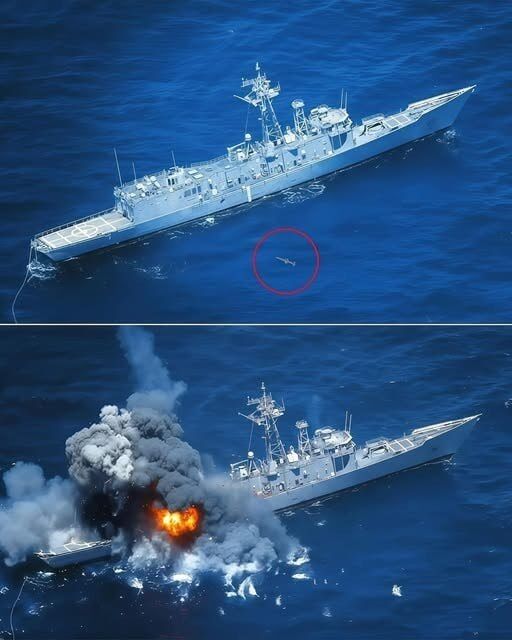
The final chapter in the life of a naval vessel rarely happens quietly. Even when it is carefully planned and controlled, there is always a sense of weight surrounding the moment—history, years of service, and the memories of the sailors who once stood on its decks. That was certainly the case with the former USS Rodney M. Davis (FFG-60), a guided-missile frigate that, after decades of active duty, reached its end not in combat, but during a deliberate training exercise meant to support the future of naval operations.
The ship’s final mission took place as part of a SINKEX, short for “sinking exercise,” a type of operation where decommissioned ships are used as live targets. These exercises are not meant as spectacles of destruction, but as controlled scenarios that allow the Navy to test weapons, evaluate ship durability, and gather valuable information that can shape future naval strategy. In this case, the Rodney M. Davis was struck by an AGM-84 Harpoon anti-ship missile, a weapon specifically designed for precision strikes in maritime combat.
The strike was intentional.
The result was expected.
But that didn’t make the moment insignificant.
Commissioned in 1982, the USS Rodney M. Davis belonged to the Oliver Hazard Perry-class frigates, a group of ships developed during the Cold War to perform essential roles such as anti-submarine warfare and escorting larger vessels. At the time, naval strategy required ships capable of operating across vast oceans, protecting fleets, and responding quickly to threats both above and below the water. The Perry-class frigates became an important part of that strategy, combining versatility with long-range endurance.
The ship was named after Rodney Maxwell Davis, a Medal of Honor recipient who displayed extraordinary bravery during the Vietnam War. Because of that, the vessel carried more than just a name—it carried a legacy. It represented both the technological strength of the U.S. Navy and the values associated with the man it honored: courage, sacrifice, and dedication to duty.
Throughout its service life, the Rodney M. Davis participated in numerous operations around the world. It conducted patrol missions, joint training exercises with allied forces, and maritime security operations that rarely made headlines but were vital for maintaining stability across international waters. Like many ships of its class, it was defined not by a single dramatic moment, but by years of steady and dependable service.
Over time, many sailors served aboard the vessel, each leaving with personal memories tied to it. For them, the ship was more than steel and machinery—it was a workplace, a temporary home, and often a defining chapter in their careers. The routines, the challenges, and the shared responsibility created bonds that remain long after the ship itself is gone.
Eventually, like all military equipment, the Rodney M. Davis reached the end of its operational life. Advances in technology, shifting strategic priorities, and the natural wear of decades at sea made retirement inevitable. Yet even after decommissioning, the vessel still had a final role to fulfill.
Before the SINKEX exercise could take place, extensive preparation was necessary. Environmental safety standards required the removal of hazardous materials that could harm marine ecosystems once the ship sank. Fuel residues, certain coatings, and sensitive equipment were carefully removed. Components that were no longer useful were either extracted or made safe.
This process ensured the exercise would serve its purpose while also meeting environmental protection guidelines.
Once preparations were complete, the ship was positioned for the exercise. Engineers, analysts, and military personnel observed closely, ready to collect data from every stage of the operation. The launch of the Harpoon missile was not just symbolic—it was a test designed to measure accuracy, impact behavior, and the structural response of a ship under controlled combat conditions.
When the missile struck, it performed exactly as designed.
The resulting damage offered valuable insight. How quickly the vessel began taking on water, how the structure responded to the impact, and how different systems behaved under stress—all of this information contributes to a deeper understanding of naval warfare scenarios. These findings can influence future ship design, defensive systems, and weapons development.
In that sense, the sinking did not represent an end—but rather a continuation of service.
Still, for those who once served aboard the Rodney M. Davis, the moment carried emotional significance. Watching a ship filled with memories disappear beneath the ocean surface cannot simply be reduced to data or technical analysis. It marks the closing of a chapter and the physical end of something that once felt permanent.
There is a quiet respect in how these moments are handled.
No fanfare.
No unnecessary spectacle.
Just recognition that even in its final act, the ship contributed to something greater than itself.
Exercises like SINKEX demonstrate how military readiness is maintained—not only through active missions, but through constant learning and adaptation. Every piece of information gathered helps refine strategy, improve equipment, and better prepare those who continue to serve.
In its final moments, the USS Rodney M. Davis became part of that ongoing process.
It transformed from an operational vessel into a source of knowledge—moving from active service to a role that supports future advancement. That transformation reflects an important principle within military systems: even at the end of its life, a resource can still serve a meaningful purpose.
The legacy of the ship is therefore not defined by how it ended, but by everything it represented during its years at sea. From Cold War operations to modern training exercises, it remained relevant, adapting to the needs of each era.
For former crew members, the memories remain untouched by the ship’s absence. The routines, deployments, and friendships built onboard continue through the people who experienced them.
And for the Navy, the exercise stands as another step in the constant process of preparation and improvement.
In the end, the USS Rodney M. Davis did not simply vanish beneath the ocean.
It completed one final mission—contributing to the knowledge, safety, and readiness of those who will serve in the years ahead.
Its final act was not about destruction.
It was about ensuring that the future is stronger, better informed, and prepared for whatever comes next.