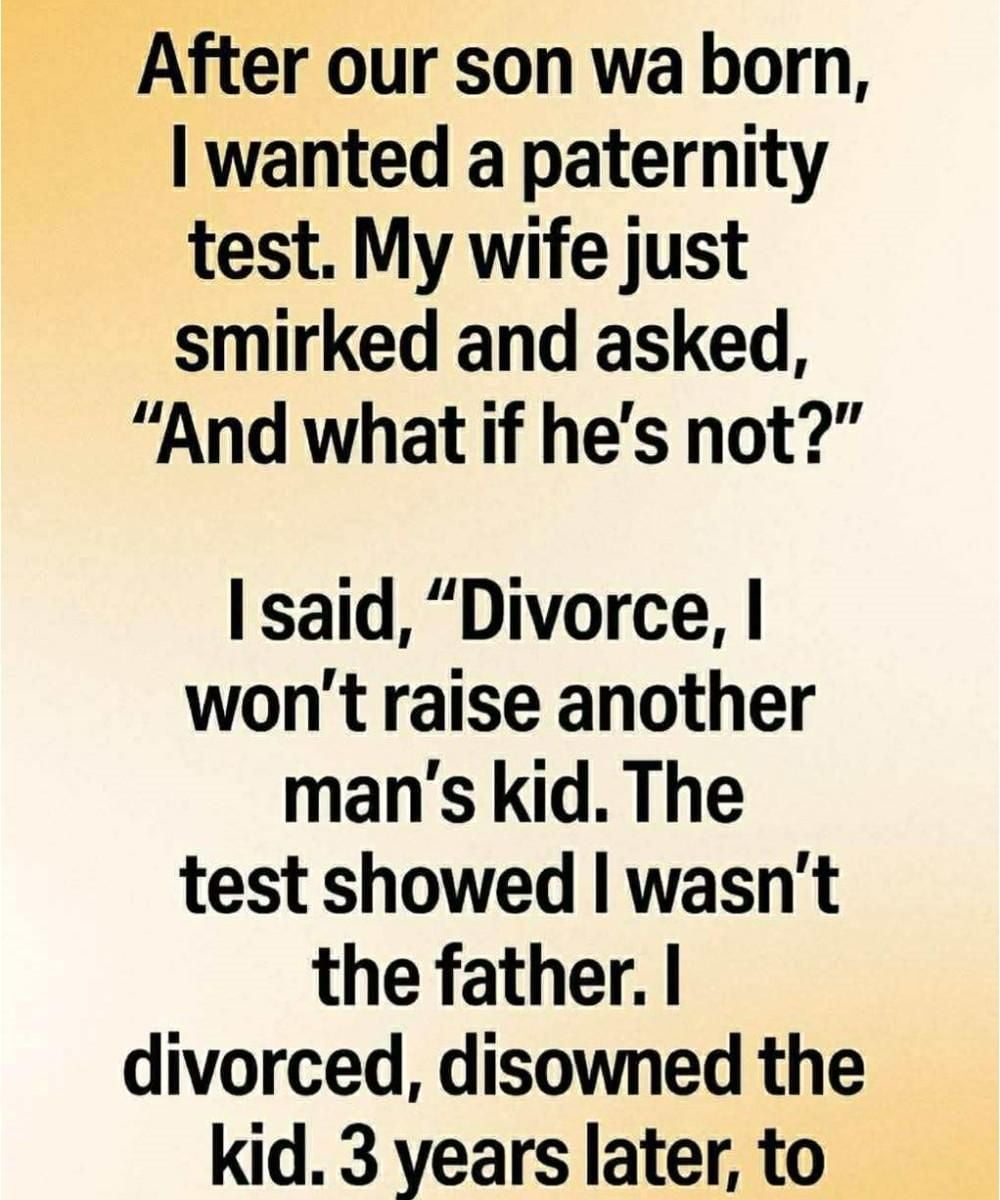
He would carry the memory of that yellow nursery for the rest of his life. Not as the place where his son first slept, or the room filled with hopeful anticipation and carefully chosen details, but as the space where everything quietly fell apart. The walls had once felt warm and full of promise, painted in a soft color meant to welcome a future. Instead, they became silent witnesses to a choice that would follow him long after the room itself was gone.
At the time, it didn’t feel like a single life-defining moment. Rarely does it happen that way. Doubt does not arrive dramatically. It slips in quietly, settling somewhere beneath the surface and feeding on insecurities that have long existed. By the time the envelope reached his hands, the suspicion had already taken root. The paper itself did not create the doubt—it simply gave it shape.
He remembered how still everything felt when he opened it. The world outside continued moving, but in that moment it seemed to shrink, as if nothing beyond that envelope mattered anymore. Words blurred together, numbers forming conclusions he wasn’t ready to question deeply. Instead of stepping back or asking more questions, he allowed the doubt to guide him. It felt easier to accept what confirmed his fear than to challenge it.
Emma stood in the same house, holding their child, completely unaware of the storm building in his mind. She spoke to him with the same warmth she always had, the steady tone that once grounded him. But he no longer saw it the same way. Suspicion has a way of reshaping everything. Tone changes, intentions become uncertain, even silence begins to feel suspicious. What once felt like trust slowly transformed into something fragile.
He never truly confronted her. There was no open conversation, no real attempt to understand what was happening, no effort to hold onto the life they had built together. Instead, he withdrew. The distance began quietly, almost unnoticed, but soon it became undeniable. His words grew shorter, eye contact faded, and the house that once held shared routines and quiet laughter began to feel divided.
When he finally spoke, it was not with clarity but with restrained accusation, as if saying less might soften the damage. It didn’t. Emma didn’t react with anger as he had imagined. Instead, she responded with disbelief—a quiet kind of hurt that didn’t need to be loud to be overwhelming. She tried to explain, tried to reach him, but he had already decided what he believed.
And once that decision was made, everything else followed.
He left before anything could truly be resolved. Before questions were answered. Before trust had a chance to heal. The nursery remained behind him, unfinished in a way that had nothing to do with furniture or paint. The crib he had carefully assembled still stood there, waiting for a life he would no longer be part of.
In the years that followed, he built something else entirely. His career moved forward. His name became known in ways he had once worked toward with determination. From the outside, it looked like success. Achievements filled the space where something else had once existed. But success has a way of amplifying silence when there is nothing meaningful waiting at the end of the day.
There were moments—usually late at night or between the distractions of work—when the past would return. Not as a distant memory, but as something sharp and detailed. The color of the walls. The way Emma had looked at him that final day. The weight of the envelope in his hands. He replayed it often, sometimes trying to justify what he had done, sometimes realizing how quickly he had walked away from what mattered.
The truth did not come right away. It rarely does.
When it finally arrived, it came without drama, almost quietly, as if it had always been there waiting for him to catch up. The lab had made a mistake. A technical error. A mislabeling. Something small enough to slip through the process—but powerful enough to dismantle a life.
At first, he didn’t react the way people might expect. There was no collapse or sudden breakdown. Only a quiet realization that slowly spread through everything he thought he understood.
He could have blamed the lab. And to some extent, it might have been justified. But the longer he reflected on it, the clearer it became that the mistake wasn’t only theirs. The document had simply confirmed something he was already willing to believe. The real fracture had begun much earlier.
It started in the quiet doubts he never addressed. In the fears he never shared. In the belief that trust might leave him vulnerable. The test hadn’t created his decision—it had only revealed it.
By the time he found the courage to return, to face the life he had left behind, the world he once knew was no longer waiting.
Emma had moved forward. Not by forgetting, but by rebuilding. She created a life shaped by stability and strength rather than absence. Their son had grown under her care, shaped by her presence and her refusal to allow one painful moment to define everything that followed.
When he returned, he didn’t expect everything to be restored. But part of him hoped for something—a conversation, a possibility, even the smallest opening.
Instead, he found distance. Not from cruelty, but from necessity.
Emma listened as he spoke, but the connection they once shared no longer existed. It hadn’t remained frozen in time waiting for him. It had been replaced by something else—something quieter and more cautious, built without him.
Their son stood nearby, curious but distant. He looked at him not as a father returning home, but as a stranger being introduced. There was no memory linking them together, no shared past bridging the distance.
The apologies came, but they felt late even as he spoke them. Not because they lacked sincerity, but because they arrived after everything had already changed. There are moments when words can repair something, and others when they simply acknowledge what cannot be undone.
In the end, there was no dramatic rejection. No anger or harsh dismissal. Only a clear boundary. A life that had continued without him—not out of bitterness, but out of survival.
Sometimes he would return and sit in his car a short distance away, watching quietly from where he wouldn’t be noticed. Not out of obsession, but from a quiet need to witness what he had lost. He would see them living ordinary moments—walking together, laughing, moving through life in a way that felt complete without him.
It was during those quiet observations that the weight of his decision fully settled.
He had not simply walked away from a moment.
He had walked away from a future that continued without him.
The lesson never arrived as a sudden revelation. It unfolded slowly, in the space between what had happened and what might have been. Trust, once broken by doubt, does not always return. Love, even when it forgives, does not always return to the place where it began.
Some decisions do not echo loudly at first. They move quietly through time, revealing their consequences little by little.
And some bridges, once burned, remain exactly as they are—not because rebuilding is impossible, but because the people on the other side have already learned how to live without them.