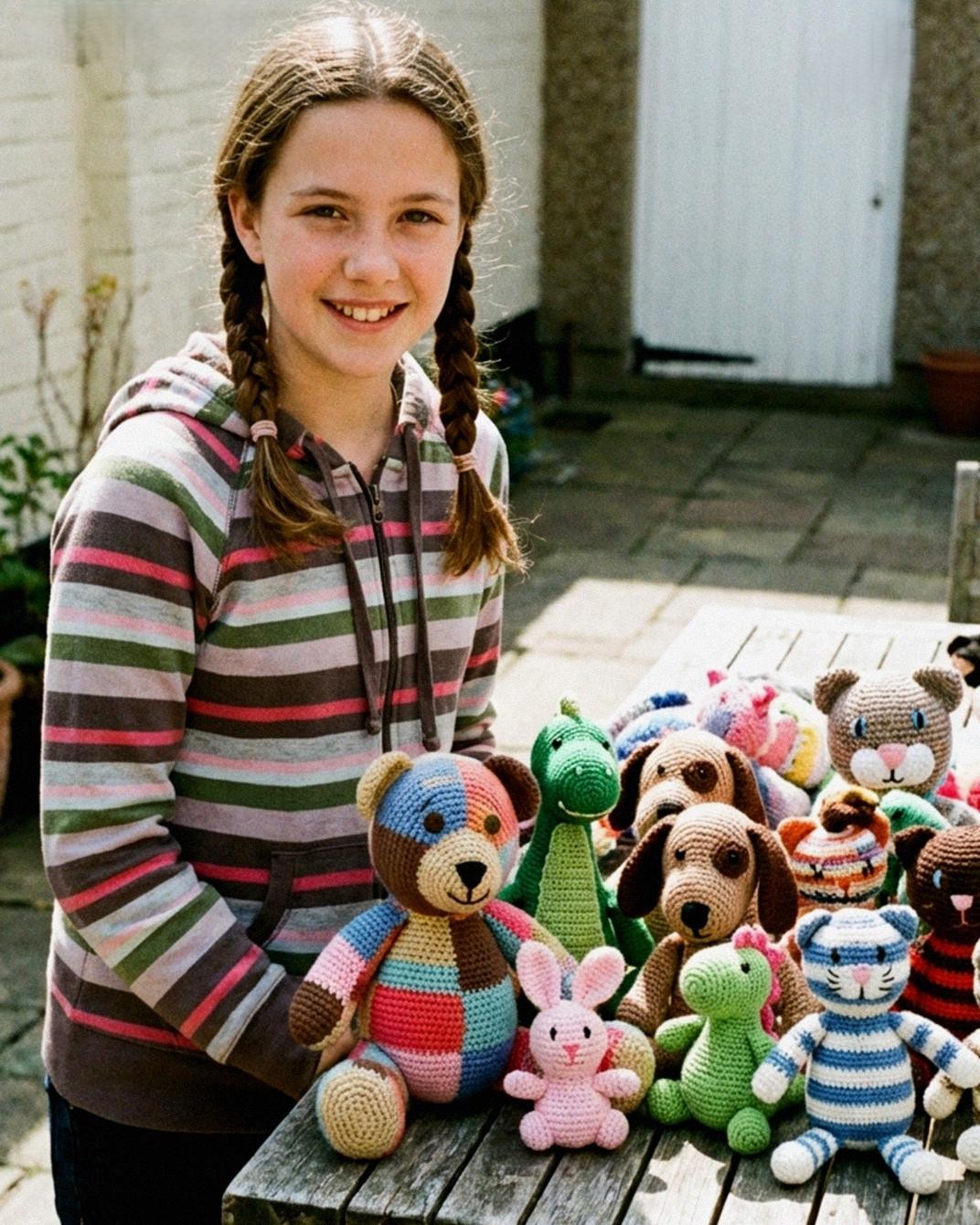
Five years ago, hope sounded like my daughter laughing in the kitchen, her voice filling the house in a way that made everything feel lighter. These days, hope looked different. It looked like a thirteen-year-old girl sitting at a small table in our yard, yarn wrapped around her fingers, her brow furrowed in concentration as she carefully stitched tiny crocheted animals.
She called it crocheting. I saw it for what it really was—her quiet way of trying to keep our world from falling apart.
My name is Brooklyn. I’m forty-four, a widow, and for the past year I’ve been battling cancer. Life hasn’t exactly been gentle with us. My husband, David, died when our daughter Ava was only two years old, leaving me with grief I didn’t know how to carry, a house full of unpaid bills, and a toddler who still smelled like baby shampoo.
For a short time after the funeral, his family stepped in. They filled the house with casseroles, sympathy, and carefully measured kindness. But underneath it all, something felt strange. Conversations would stop when I walked into a room. Papers appeared in front of me when I could barely think straight.
“Just sign here, Brooklyn,” my mother-in-law had said, her voice calm but firm. “We’ll take care of everything. You need to rest.”
I was exhausted, grieving, overwhelmed. I signed without asking many questions.
That choice followed me for years.
Not long after, they disappeared from our lives completely. No visits. No calls. No presence in Ava’s life as she grew up. It was as if they had erased themselves—and, in a way, erased us too.
When I was diagnosed with cancer, I told myself we’d manage. Insurance barely covered half of my treatments, and every day felt like a fight against something larger than I could handle. Ava noticed more than I wanted her to. She saw when I winced, when I couldn’t finish meals, when I had to lie down more often than before.
One afternoon, after a long day of chemo, I came home and found her sitting on the living room floor, completely focused, her hands moving quickly with a crochet hook.
“Did you make that?” I asked, easing onto the couch.
She smiled, holding up a bright orange fox. “It’s for you, Mom. I wanted it to look happy.”
I laughed softly, even though my body ached. “It worked.”
Then she showed me the rest. A small pile of animals—bunnies, cats, even a turtle with a slightly crooked shell. Each one made with care.
“Do you think people would buy them?” she asked.
I looked at her—really looked at her—and nodded. “I think they would.”
A few days later, I woke from a nap to the sound of scraping outside. When I looked out the window, I saw Ava dragging an old folding table into the yard. She lined up her crocheted toys neatly and taped a sign to the front.
“Handmade by Ava – For Mom’s Medicine.”
My chest tightened as I stepped outside.
“Ava… what is this?”
She looked up, determined but gentle. “I want to help. Maybe if I do something, you’ll get better faster.”
I pulled her into a hug, holding on longer than usual. “You’re already helping more than you know.”
Neighbors began stopping by, drawn by the sign and her quiet determination. They bought her toys, sometimes more than they needed, offering encouragement along with cash. I watched from inside, overwhelmed with a mix of pride and heartbreak.
Then, as the sun dipped lower and the sky turned gold, a different sound broke the calm.
A motorcycle.
It pulled up slowly in front of our yard. The rider stepped off, scanning the scene before approaching Ava’s table. I felt a flicker of unease and stepped outside.
“Hi, sir,” Ava said politely. “Do you want to buy one? I made them myself.”
The man picked up a small crocheted bunny, studying it carefully.
“You made these?” he asked.
She nodded. “My grandma taught me.”
He smiled faintly. “They’re really good. Your dad would’ve loved them.”
Ava blinked. “You knew my dad?”
Something inside me shifted.
I stepped closer. “Ava, sweetheart, why don’t you go inside for a minute?”
She hesitated, then nodded and walked toward the house.
The man removed his helmet.
I froze.
“Marcus?”
He nodded. “Yeah… it’s me.”
Marcus was David’s brother—the one who had disappeared after the funeral, just like the rest of them.
Anger rose instantly. “You don’t get to show up here like this.”
“I know how it looks,” he said.
“Do you?” I shot back. “Your parents told me you walked away. That you wanted nothing to do with us.”
His expression hardened. “That’s not true.”
I stared at him.
“I tried to reach you,” he said. “Calls, letters… I even came by. They told me you moved. Said you didn’t want me around.”
A chill ran through me.
“They told me you left,” I whispered.
“I didn’t,” he replied. “I was pushed out.”
Then he added more quietly, “And that’s not the worst thing they did.”
Something in his tone made my stomach drop.
Inside the house, he took in the sight of medical bills and prescription bottles scattered across the table. His face tightened.
“You’ve been dealing with all this alone?” he asked.
I shrugged. “It’s been a year.”
He sat down and placed a folder in front of me.
“A lawyer contacted me recently,” he said. “There were irregularities in David’s financial records. Things didn’t add up.”
I didn’t touch the folder.
“My parents forged your signature,” he continued. “They took the life insurance money David left for you and Ava. Every bit of it.”
The words didn’t register at first.
“No,” I said slowly. “I signed papers. I remember signing.”
“You signed some,” he said gently. “Not these.”
The room felt like it was spinning.
“I was grieving,” I whispered. “I didn’t know what I was doing.”
“I know,” he said. “That’s why they got away with it.”
Ava walked back into the room, clutching two of her crocheted animals. “Mom?”
I pulled her close. “It’s okay, baby. This is your uncle Marcus.”
He looked at her with something soft in his eyes. “Your dad was my brother. And you deserved better than what happened.”
Ava looked up at me. “Did someone lie to you?”
I nodded. “Yes. But we’re going to fix it.”
And we did.
In the weeks that followed, Marcus helped us build a case. The truth came out piece by piece—documents, signatures, transfers. When we finally confronted my in-laws, they didn’t even try to pretend anymore.
“We did what needed to be done,” my mother-in-law said coldly.
“No,” I replied. “You stole from us.”
For the first time in years, the shame didn’t belong to me.
Marcus stayed. He became part of our lives again, helping Ava build things in the yard and telling her stories about her father. Slowly, the emptiness we’d lived with began to change.
When the settlement finally came, it wasn’t just about money.
It was proof.
Proof that we hadn’t imagined the betrayal. Proof that we had a future again.
That night, as I tucked Ava into bed, she looked at me and whispered, “Does this mean you’re going to get better?”
I smoothed her hair. “It means I can finally breathe.”
Later, Marcus handed me a crooked wooden birdhouse he and Ava had made together.
“It’s not perfect,” he said.
I smiled, holding it close. “It’s exactly what we needed.”
For the first time in a long time, I believed something I hadn’t dared to before.
We were going to be okay.