The winter wind on Fifth Avenue cut through the streets like a blade, slipping into every opening in my coat. I lived a life of simple routines—work, deadlines, and the quiet hope that a bigger paycheck or a better coat might eventually fix the constant exhaustion I carried around.
Outside my office building, a woman sat pressed against the marble wall, trying to draw some warmth from the stone. She wore only a thin, worn sweater, her hands red and trembling from the cold. People walked past her without slowing down, stepping around her the way water moves around a rock in a river.
I planned to do what most people do—give a polite nod and maybe a dollar. But when she asked if I had spare change, I realized my pockets were empty.
I started my usual apology, the kind you say automatically when you want to move on. But something about her calm eyes stopped me. She didn’t look desperate. She looked like someone quietly observing the world.
Ten minutes of cold at the bus stop wouldn’t ruin my life.
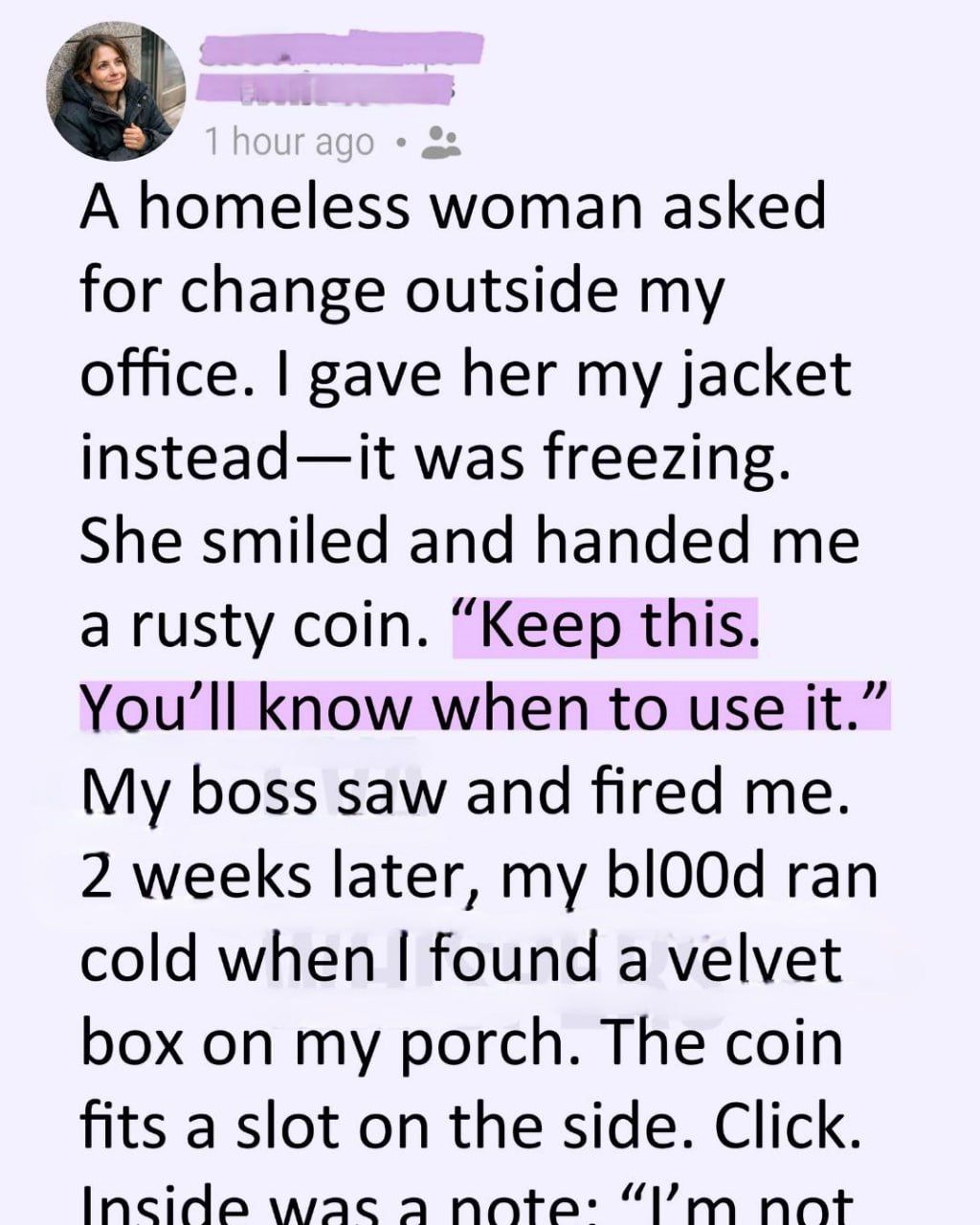
So instead of apologizing, I took off my jacket and handed it to her.
She hesitated, surprised, but I insisted. When she slipped her arms into the sleeves, she reached into her pocket and pressed something into my palm—a rusty, heavy coin.
“Keep this,” she said quietly.
“You’ll know when to use it.”
Before I could ask what she meant, my boss appeared.
Mr. Harlan had the kind of expression people reserve for unpleasant smells. He looked at the woman, then at me, and shook his head in disgust. In his eyes, I had just created a scene in front of the building.
Without hesitation, he told me to clear my desk.
No warning. No conversation. Just like that, I was fired.
A few minutes later I stood on the sidewalk, jobless, jacketless, holding a rusty coin while my old life continued inside the building behind me.
The next two weeks were brutal.
Every morning I sent out resumes. Every afternoon I checked my email. Every evening I watched my savings shrink a little more. Rejection messages piled up until they started to feel like a slow erasure of everything I thought I was.
Then, on the fourteenth day, something strange happened.
When I opened my front door, I found a small velvet box sitting on the porch. No address. No note. Just a narrow metal slot on one side.
It looked oddly familiar.
My heart started racing as I realized the slot was the exact shape of the rusty coin.
Slowly, I slid the coin into the opening.
The box clicked.
Inside was a single card.
“I’m not homeless. I’m a CEO. I test people.”
For a moment I thought it had to be a joke.
But beneath the card was a black envelope. Inside it was a formal job offer—an executive position at a company I had only ever heard about in business magazines.
The salary alone was enough to change my entire life.
According to the note, many people had given the woman money over the years. But very few had given something that actually cost them something.
The jacket had been the test.
The following Monday I walked into a glass tower far more impressive than my old office building.
A receptionist led me to a large boardroom.
And there she was.
The woman from the sidewalk stood at the head of the table, no longer wrapped in a thin sweater but dressed in a sharp suit that radiated authority.
She smiled when she saw the coin in my hand.
“You kept it,” she said.
I admitted that I had almost thrown it away.
She shook her head.
“Most people would have,” she replied.
“That’s why you were the right choice.”
In that moment, the cold I had carried for weeks finally disappeared. I realized she hadn’t just offered me a job.
She had proven something far more important—that simple kindness still mattered in a world where most people had stopped believing in it.