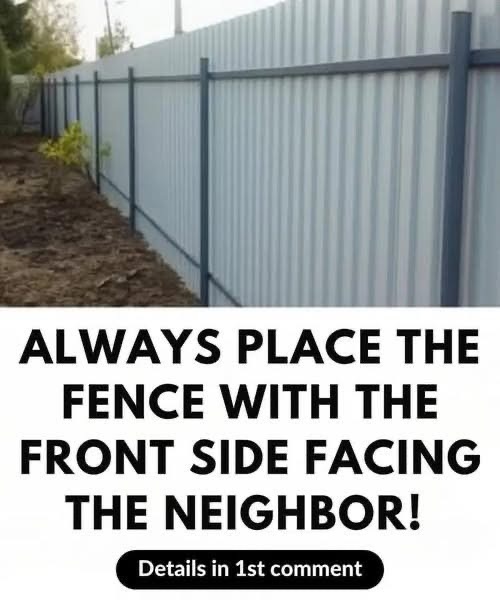
The installation of a perimeter fence is often viewed through a purely functional lens. For most homeowners, the primary objectives are clear: establishing a definitive boundary, securing the safety of children and pets, and carving out a sanctuary of privacy from the outside world. However, beyond the utilitarian requirements of lumber and hardware lies a subtle but profound principle of domestic diplomacy. This principle dictates that when erecting a barrier between two properties, the “finished” or aesthetically superior side of the fence should always face outward toward the neighbor, while the structural supports—the rails and posts—remain facing the installer’s own yard.
At first glance, this tradition may seem like nothing more than a courtesy gesture. In reality, it serves several practical and social purposes that have shaped neighborhood construction standards for decades. Presenting the smooth, polished side of the fence outward helps maintain a visually pleasant environment for surrounding properties. Instead of exposing the framework, nails, and support beams, neighbors see a clean and uniform surface that blends more naturally with the landscape.
This practice also reflects a long-standing idea in property etiquette: if you are the one building the fence, you assume responsibility for its appearance and impact on the surrounding area. By placing the finished side outward, the homeowner demonstrates consideration for those living nearby. It sends a subtle message that the fence is not intended as a hostile barrier, but simply a practical boundary that still respects the shared environment of the neighborhood.
There is also a structural reason behind this design choice. When the rails and posts face inward, they remain easily accessible for maintenance and repairs. Over time, fences naturally require occasional adjustments—boards may loosen, wood may need treatment, or hardware may require tightening. Having the structural side within your own yard allows you to perform these tasks without needing to access your neighbor’s property.
In some cases, local building codes or homeowners’ associations even require that the finished side face outward. These regulations aim to maintain a consistent visual standard across residential areas and reduce potential disputes between neighbors. A fence that exposes its unfinished structure toward a neighboring property can sometimes be viewed as inconsiderate or even lead to complaints, particularly in tightly spaced communities.
Ultimately, the direction a fence faces is about more than aesthetics—it reflects the broader idea of coexistence within shared spaces. A simple construction decision can influence how neighbors perceive one another and how harmonious a community feels. By choosing to present the finished side outward, homeowners follow a quiet tradition that balances practicality, respect, and good neighborly relations.
In this way, the humble backyard fence becomes more than a boundary. It becomes a small but meaningful expression of how people share space, maintain civility, and build communities that function not just through rules, but through everyday acts of consideration.