The March air that night cut through everything.
Standing on those back steps with a pizza balanced in one hand and my phone glowing in the other, I could already tell something about this delivery wasn’t normal. The yard was overgrown, the windows were dark, and the note on the order — Please knock loud — felt less like a request and more like a warning.
I knocked anyway.
“Come in.”
I paused for a second, imagining all the ways this could go wrong. Then I pushed the door open.
The cold hit me immediately.
Not the kind that drifts in from outside, but the kind that settles into a house that hasn’t been heated in a long time. The only light came from an open refrigerator in the kitchen, throwing a faint glow across empty shelves.
“Back here,” the voice called.
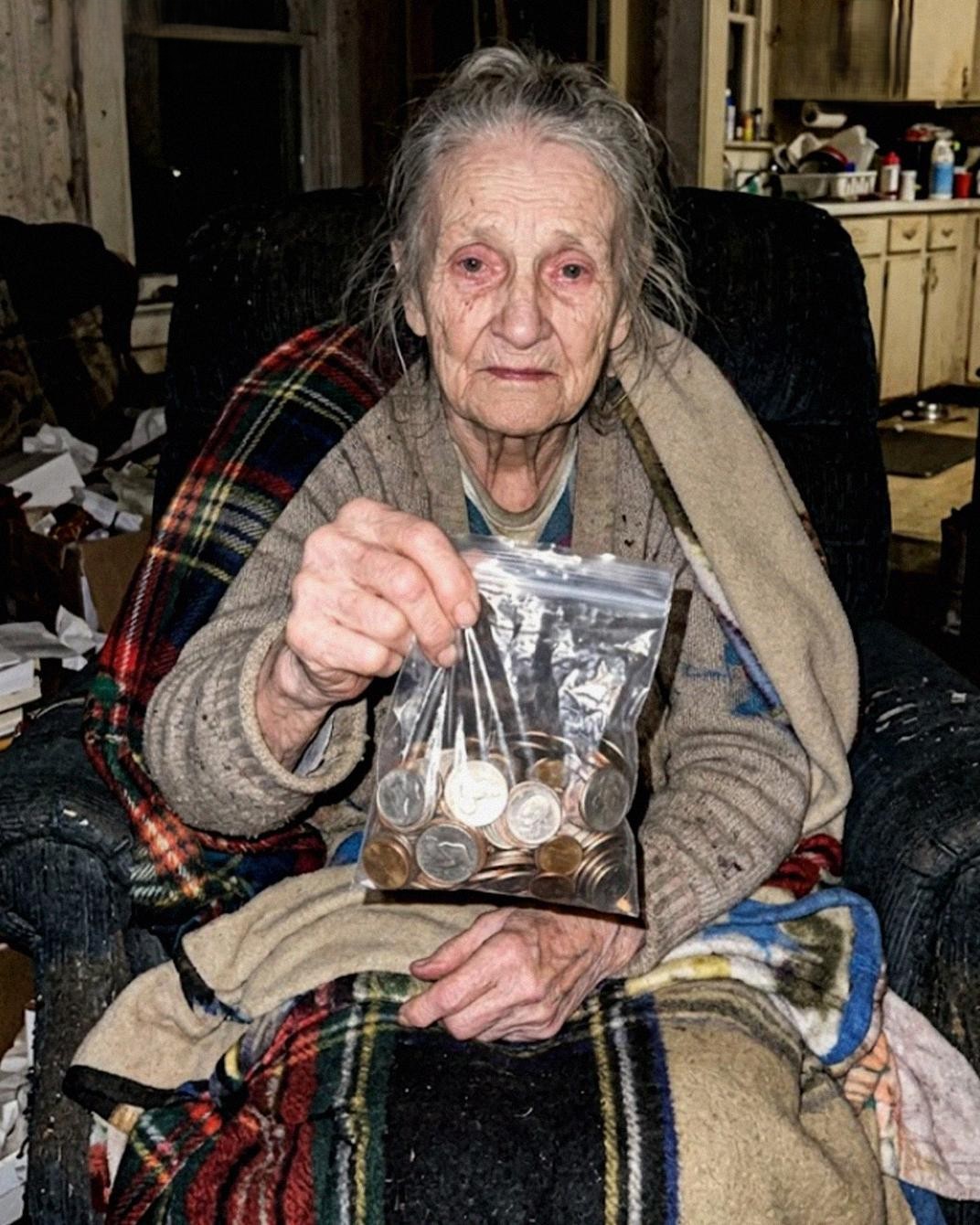
I followed it into a dim living room where an elderly woman sat wrapped in blankets in a worn recliner. A single candle flickered beside her, barely pushing back the shadows.
Her eyes didn’t look at me.
They locked onto the pizza box.
“Ma’am,” I said carefully, “are you alright? It’s freezing in here.”
“I’m fine,” she replied, as if she had repeated those words many times before. “Heat costs money. Medication comes first.”
Then she pushed a small plastic sandwich bag toward me.
Coins. Nothing but coins.
A lifetime of small change gathered together into something that barely looked like enough.
“I counted twice,” she added quietly.
For a moment, I couldn’t move. My eyes drifted back toward the kitchen — bottles of water, a pharmacy bag, and nothing else.
That’s when I understood.
This wasn’t dinner.
This was survival.
“Don’t worry about it,” I said, sliding the bag back toward her. “It’s already taken care of.”
Her eyes narrowed slightly. “I don’t want you getting in trouble.”
“It’s fine,” I said quickly. “I own the place.”
I don’t know why I said that. Maybe it was easier than explaining what I was feeling.
She studied me for a moment, then nodded slowly, her eyes dropping to the name on my tag.
“Thank you, Kyle.”
When I handed her the pizza, she opened the box slowly, almost carefully. Steam rose into her face, and for a moment she closed her eyes and just… breathed it in.
That moment stayed with me longer than anything else.
I left a minute later, but I didn’t go far.
I sat in my car across the street, staring at the dark windows of her house. No lights. No heat. No one coming or going.
Just her.
Pretending everything was okay.
I called dispatch and said I had a flat tire — buying myself about forty-five minutes I hadn’t earned — and drove straight to the police station.
I didn’t know exactly what to say. Only that someone needed to check on her. Someone who understood what to do.
The officer listened, asked a few questions, then made the call.
A welfare check.
I walked out thinking I had done something good.
Thinking I had helped.
I was wrong about how it would feel.
When I drove past her house again, ambulance lights were already flashing. Neighbors stood outside, watching quietly, whispering to each other the way people do when something becomes visible too late.
Paramedics helped her out slowly, carefully.
Then she saw me.
Her face changed instantly.
“You!” she shouted, pointing. “This is your fault.”
The words hit harder than I expected.
“I was worried about you,” I said, stepping closer.
“I told you I was fine!”
“You were freezing.”
“I was managing!” she snapped, her voice shaking. “Now they’re taking me out of my home because of you.”
People turned toward me.
The accusations came quickly.
“You had no right.”
“She’s always been like this.”
“Who do you think you are?”
Anger rose in my chest.
“Then why didn’t any of you help her?” I shot back.
No one answered.
They didn’t need to.
I left with her words stuck in my head.
This is your fault.
They followed me through every shift after that. Every quiet house. Every porch light that stayed dark.
I kept telling myself I had done the right thing.
But it didn’t feel right.
Not at all.
A week later, my manager handed me a delivery ticket.
“They asked for you.”
I looked down at the address.
Her house.
This time, the porch light was on.
When the door opened, it wasn’t her. A woman I didn’t recognize stood there.
“Come in,” she said. “She wants to see you.”
The difference was immediate.
Warm air. Lights everywhere. Voices. Movement.
People filled the house — carrying groceries, setting up heaters, talking over each other in that messy, human way that happens when something finally changes.
And there she was.
Same chair.
No pile of blankets.
Two kids sat at her feet tangled in yarn, arguing over how to fix a knot in their knitting.
“Slow hands,” she told them with a small laugh. “You’re rushing.”
For a moment, I just stood there holding the pizza, wondering if I had the wrong house.
Then one of the neighbors walked over.
“I owe you an apology,” he said quietly. “We didn’t realize how bad things had gotten.”
“We all missed it,” someone else added from the kitchen.
No excuses.
Just honesty.
She looked up and saw me.
And smiled.
“I’m glad you came,” she said. “Come here.”
I stepped closer, unsure what she would say.
“I was angry,” she said gently. “And scared. At the hospital they told me what might have happened if I had stayed like that.”
She reached for my hand.
“You were the only one who noticed. Even when I didn’t want you to.”
Around us, the house kept moving.
Neighbors had created a schedule. Someone stopped by every day. Services visited twice a week. The pantry was full. The heat was running.
Everything that should have been there before… was there now.
“We should have done this sooner,” someone said quietly.
No one argued.
Standing there, I finally understood why that night had felt so heavy.
Doing the right thing doesn’t always feel good.
Sometimes it feels like you broke something.
Sometimes people look at you like you’ve taken something from them — their independence, their pride, their ability to pretend everything is fine.
But sometimes what you interrupt… is the silence that allows things to get worse.
And sometimes being blamed is just the first step before things finally begin to change.