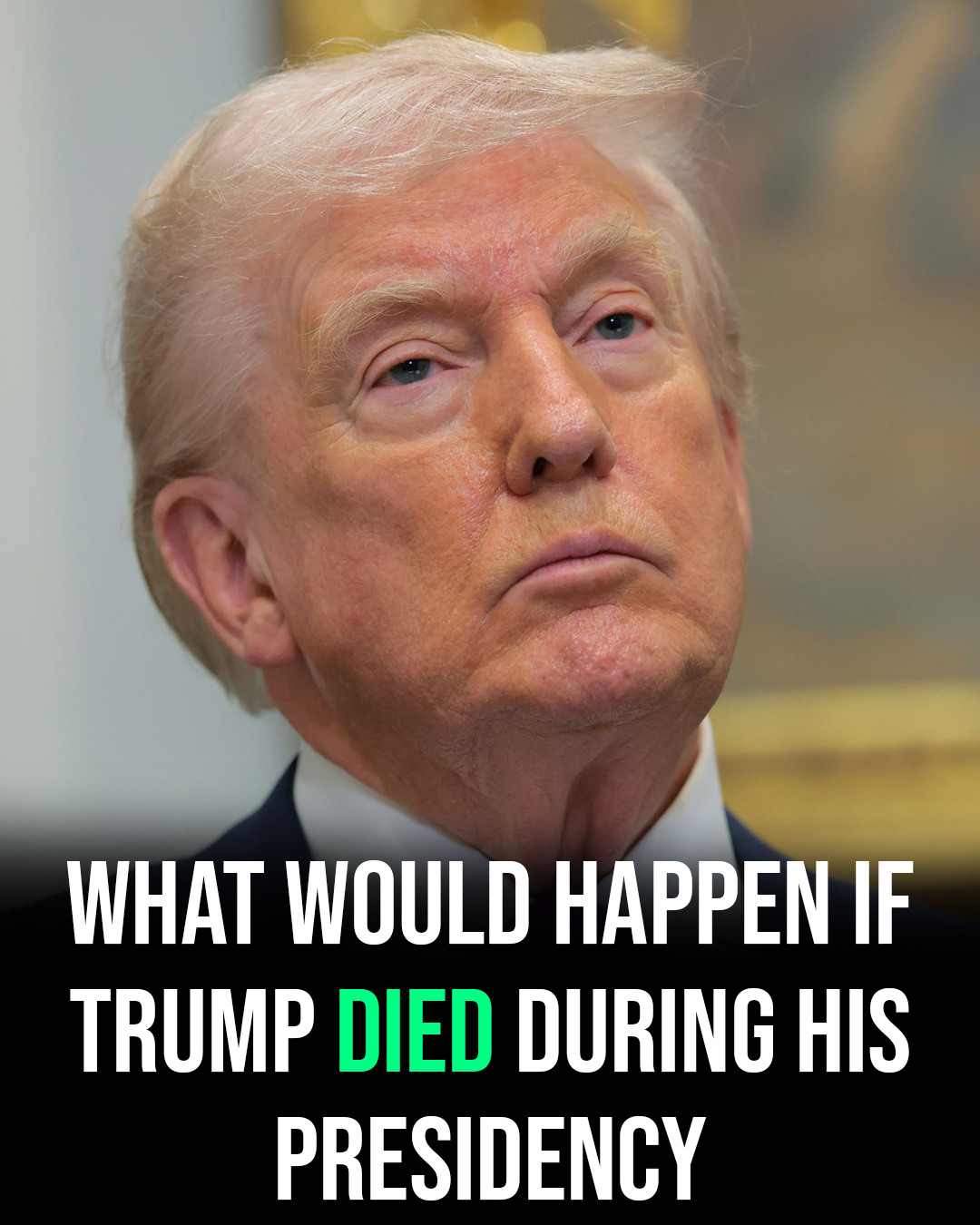
Discussions about a sitting president’s health often go beyond simple curiosity and move into questions about national stability, continuity, and the systems created to manage uncertainty. In the case of Donald Trump, those conversations tend to attract even more attention, partly because of his age and partly because of his own public comments about his health and stamina.
As he approaches his 80th birthday, Trump has frequently highlighted his energy and endurance, often describing himself as unusually strong for his age. At the same time, speculation about his health occasionally appears in media discussions and online commentary, sometimes triggered by small physical details or unverified opinions. However, as with anyone, predicting life expectancy or sudden medical outcomes remains uncertain and largely speculative.
What is clearly defined, however, is how the United States would respond if a president were to die while serving in office.
The process is outlined in the United States Constitution. According to Article II, if a president dies, resigns, is removed from office, or becomes unable to perform their duties, the vice president immediately assumes the presidency. The transfer of authority happens automatically to guarantee continuity of government.
In practical terms, if such an event occurred during Trump’s presidency, Vice President JD Vance would be sworn in as president without delay. The oath of office typically follows as quickly as possible—often within hours—to demonstrate stability both domestically and internationally.
After taking the oath, the new president gains full executive authority. They may decide to keep the current cabinet to maintain continuity or begin restructuring leadership according to their own priorities. One of their early constitutional responsibilities would also be to nominate a new vice president. That nominee must then be confirmed by both chambers of United States Congress.
There are also long-term political implications related to how long the successor serves. If the new president completes less than two years of the previous president’s term, they are still eligible to run for two additional full terms. If they serve more than two years, they may only run for one additional term.
A historical example frequently referenced is the aftermath of the assassination of John F. Kennedy in 1963. When Kennedy was killed in Dallas, Lyndon B. Johnson took the presidential oath aboard Air Force One within hours. That swift transition became one of the most well-known demonstrations of how the American system handles sudden leadership changes.
In total, eight U.S. presidents have died while serving in office. Four—Abraham Lincoln, James A. Garfield, William McKinley, and John F. Kennedy—were assassinated. Others, including Franklin D. Roosevelt, died from illness while in office.
Although these events are rare, they have repeatedly tested—and ultimately reinforced—the resilience of the constitutional framework governing the United States.
If a modern president were to die while serving, the institutional response would likely remain orderly because the procedures are well established. The broader public reaction, however, would depend heavily on the political and social climate of the time.
In today’s environment, marked by strong political divisions and intense public debate, such an event could trigger a wide range of responses—mourning, political interpretation, and renewed national discussion about leadership and governance.
In that sense, while the legal process itself is straightforward, the national reaction is far more complex. The United States has built its political system around continuity and structure, but how society experiences such a moment often reflects the broader mood of the era in which it occurs.