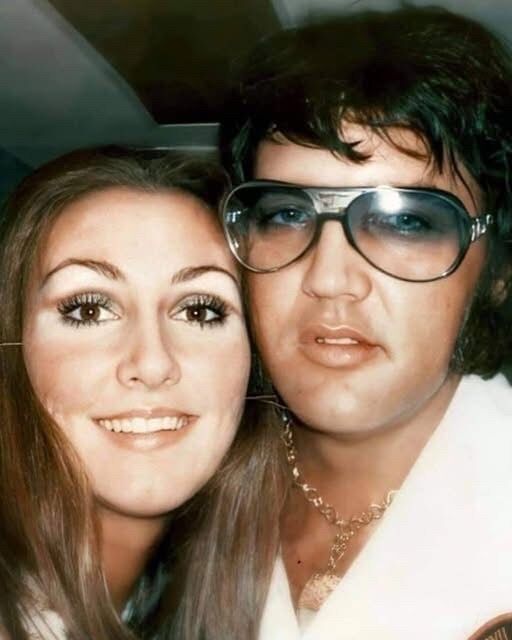
The story of Linda Thompson and Elvis Presley is a poignant chapter in the history of American popular culture, representing a unique bridge between the vibrant, youthful energy of the 1950s and the complex, shadowed majesty of the King’s final years. While the world saw Elvis through the lens of flashing bulbs and sold-out arenas, Linda Thompson saw him through the quiet, often heavy reality of the domestic life they shared between 1972 and 1976. Her recent reflections on this period offer a nuanced, deeply humanizing portrait of a man who was simultaneously one of the most famous people on the planet and someone carrying the weight of an extraordinary life.
Linda’s journey into the orbit of Elvis Presley began shortly after his separation from Priscilla. A former Miss Tennessee, she was not just a beauty queen but a woman of intellect and empathy, qualities that would become essential as she navigated the eccentricities of life at Graceland. Their initial meeting blossomed into a whirlwind romance that saw Linda become his constant companion, his confidante, and, in many ways, someone who offered steady support in his daily life. Her memories of those early days are filled with the kind of lightheartedness that is often missing from the tragic narratives surrounding the singer’s later life. She recalls a man of immense humor and playfulness, someone who loved to laugh and who possessed an almost childlike curiosity about the world when he was away from the constant demands of fame and public attention.
Their connection was built on a foundation of genuine affection and shared Southern roots. Linda often speaks of their late-night conversations, where they would discuss everything from philosophy and religion to their shared love of music. One of the most captivating details to emerge from her recent reflections is the mention of a rare, private duet the two recorded together. For fans who have examined every official studio release, the existence of such a recording offers a fascinating glimpse into their private moments. It represents a time when Elvis could simply be a man singing with the woman he loved, free from the pressure of producing a hit record or satisfying a label.
However, the reality of being the partner of Elvis Presley during the mid-1970s was often challenging. As his fame continued to grow, so did the pressures surrounding his health and demanding schedule. Linda has spoken openly about the difficulties that gradually became part of their relationship, including Elvis’s increasing reliance on prescription medications used to manage the physical and emotional strain of his intense touring and recording life. She found herself in a position many partners recognize—constantly watching over someone they care about and trying to maintain a sense of stability in an environment that was anything but ordinary. She was often the one staying awake late into the night to check on him, monitoring his routines and trying to keep daily life running smoothly within a household that operated almost like a small, private world.
Despite the deep affection she felt for him, the relationship eventually reached a turning point. Linda’s decision to leave was not due to a lack of love, but rather a recognition of her own limits. She has described the painful realization that she could not fix every difficulty he faced, and that staying might mean witnessing a gradual decline she could not change. Her departure in late 1976 was a decision made for her own future and emotional well-being. Even after their romantic relationship ended, she remained a supportive friend. They stayed in touch until his death in 1977, maintaining a bond of respect that survived the transition from partners to trusted confidants.
In the years following Elvis’s passing, Linda Thompson did not allow herself to be defined solely by her connection to the King. She went on to build an impressive career as an award-winning lyricist and songwriter. Her work, including songs performed by artists such as Whitney Houston and Celine Dion, often reflects emotional depth and sensitivity. She has credited her experiences during those years as a period of personal growth that helped shape her creative voice.
Her recent interviews offer a thoughtful perspective that balances many of the more dramatic versions of the Elvis Presley story. By emphasizing his creativity, kindness, and musical brilliance, she brings attention back to his humanity rather than the larger-than-life legend often portrayed in headlines. She recalls his generosity—not only the gifts he famously gave away, but also the warmth and loyalty he showed to those close to him. In her memories, he appears not just as an icon but as a friend and partner who cared deeply about the people around him.
For modern audiences, Linda Thompson’s reflections provide insight into how someone can cherish love while still choosing to move forward. Her journey is an example of resilience and grace. She has managed to preserve the beauty of their time together while remaining honest about the realities that shaped their lives. Her stories remind us that behind every global icon is a person who hopes to be understood beyond the stage lights and public image.
Today, when she reflects on that extraordinary era, she does so without bitterness. Instead, there is gratitude for having shared part of such an unforgettable life. Her memories honor Elvis’s legacy by presenting a balanced portrait—one that acknowledges the challenges but also celebrates the remarkable spirit that made him a legend. Linda Thompson continues to thrive, her life shaped by many experiences, including her time with the King, but defined by her own creativity, strength, and achievements. Her story shows that even relationships that do not last forever can still inspire a lifetime of growth, creativity, and understanding.