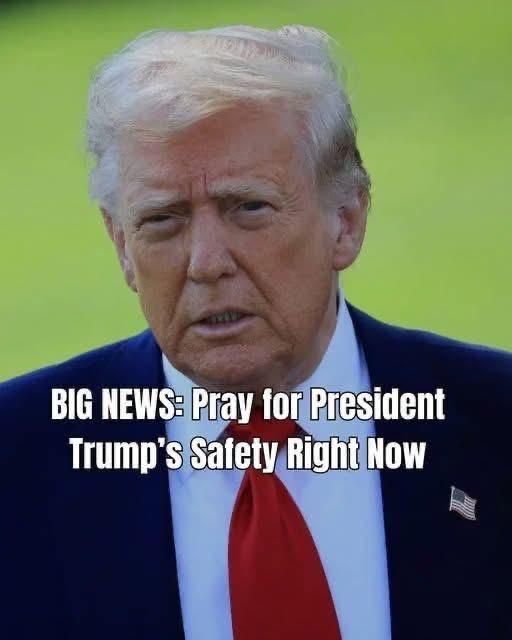
The professional security environment surrounding prominent political figures in the United States has entered an unusually tense period, prompting experienced security specialists to raise concerns about whether existing protection systems remain sufficient. Among those voices is Dan Bongino, a former Secret Service agent who spent more than a decade protecting U.S. presidents from both political parties. Drawing on years of experience in executive protection and threat evaluation, Bongino has expressed concern about the current safety climate surrounding former President Donald Trump. In his view, several major risk factors are now overlapping, creating a security situation he describes as unusually complex and potentially dangerous.
Bongino’s perspective is based on the structured approach used in professional threat assessment rather than on political rhetoric. He argues that protecting a former president involves much more than visible security details or physical barriers. Instead, it requires constant analysis of geopolitical tensions, domestic stability, and the operational health of the agencies responsible for protection. According to his assessment, four key categories of risk currently influence the security landscape: foreign adversaries with long-term strategic motivations, the growing presence of radicalized domestic actors, friction within parts of the federal bureaucracy, and a protection culture that may be affected by political pressures.
One of the most traditional risks comes from foreign adversaries. Bongino highlights the ongoing tensions involving Iran, particularly following the 2020 U.S. strike that killed Iranian General Qassem Soleimani. Iranian officials have publicly spoken about retaliation, and intelligence analysts have noted that various groups linked to Iran continue to express interest in targeting individuals connected to that decision. At the same time, other global powers—including China—have strategic reasons to oppose the return of political leadership that previously pursued aggressive trade and diplomatic policies toward them. Bongino warns that in modern asymmetric conflict, even a single determined individual exploiting a brief security gap could create a serious international crisis.
Beyond international concerns, the domestic political climate has also become increasingly volatile. Bongino argues that intense political hostility can sometimes fuel radicalization among individuals on the fringes of society. When public rhetoric becomes highly confrontational, it can create what security analysts describe as a “permission structure,” encouraging unstable individuals to translate political anger into violent action. The challenge is especially severe when dealing with potential lone-wolf attackers, who often act independently without belonging to organized groups. Because they may leave few digital traces or communication patterns, these individuals can be extremely difficult for intelligence and security services to identify in advance.
Another risk Bongino points to involves tensions within the broader federal bureaucracy. While protective agencies operate independently, they still rely on cooperation and intelligence-sharing across multiple government departments. If relationships between political figures and parts of the federal system become strained, that friction could potentially slow communication or create bureaucratic delays. Bongino cautions that even small breakdowns in coordination—such as delayed intelligence reports or resource disputes—can introduce vulnerabilities in a system that depends on constant responsiveness.
Perhaps his strongest criticism focuses on what he describes as the growing influence of political considerations on security operations. According to Bongino, agencies such as the Secret Service must maintain strict neutrality in their mission. Decisions about protection levels, staffing, and intelligence access should be based solely on threat assessments and risk calculations. If political tensions begin to influence these operational choices—whether through funding decisions, staffing limitations, or policy debates—the effectiveness of the entire protection system could be compromised. In his view, security must be guided by practical safety considerations rather than by political optics.
History offers numerous examples of how serious consequences can arise when security warnings are overlooked or when protection measures are weakened by competing priorities. Bongino argues that the current moment represents a convergence of pressures—a situation where different vulnerabilities could reinforce each other. For example, a domestic extremist might exploit a delay caused by bureaucratic complications, or a foreign actor could take advantage of a security environment distracted by political conflict.
To reduce these risks, Bongino advocates for a stronger emphasis on nonpartisan professionalism within the field of executive protection. This includes ensuring that security agencies have adequate resources, maintaining uninterrupted intelligence flows, and keeping leadership structures insulated from political pressure. The objective, he argues, should be a protection system that functions independently of party politics and focuses solely on the safety of those under its care.
From his perspective as a former protective agent, the margin for error has become extremely small. The combination of international tensions, domestic polarization, and institutional challenges creates a complex environment for modern security services. As political campaigns and public attention intensify, these pressures may continue to grow.
Bongino’s warnings ultimately emphasize the importance of separating political debate from professional security analysis. In high-level protection work, prevention depends on recognizing threats early and responding without hesitation. Safeguarding national leaders, he notes, is not only about protecting individuals but also about preserving the stability of the broader political system. Achieving that goal requires a level of discipline, coordination, and objectivity equal to the seriousness of the risks involved.