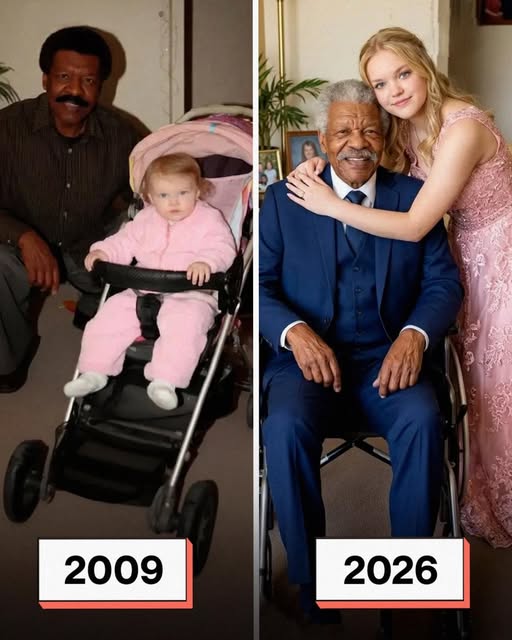
I was barely more than a year old when a fire tore through our house in the middle of the night.
Of course, I don’t remember any of it. Everything I know comes from my grandfather, from neighbors, and from the quiet stories people shared once I was old enough to understand what loss really meant. There had been an electrical problem. The flames spread quickly. My parents never made it outside.
Neighbors stood in their yards wearing pajamas, watching the windows glow orange against the darkness. At some point someone screamed that the baby was still inside.
My grandfather was sixty-seven years old.
He went back in.
Through thick smoke and heat, he came out with me wrapped tightly against his chest, coughing so violently he could barely stay standing. Paramedics told him he needed to remain in the hospital for at least two days because of the smoke he had inhaled.
He stayed one night.
The next morning he signed himself out and took me home.
That was the night Grandpa Tim became my entire world.
People sometimes ask what it was like growing up with a grandfather instead of parents. I never quite know how to answer, because to me it never felt unusual. It was simply the life I knew.
Grandpa packed my lunches every morning, slipping a small handwritten note beside my sandwich. He did it from kindergarten all the way until middle school, when I finally begged him to stop because school was already cruel enough without someone finding a note that said, “Have a great day, kiddo.”
He even taught himself how to braid hair by watching YouTube videos. He practiced on the back of the couch until he could manage two neat French braids without losing track halfway through.
He came to everything.
School plays. Choir concerts. Award ceremonies.
He clapped louder than anyone else in the room.
He wasn’t just my grandfather.
He was my mom, my dad, and every version of family I had.
We weren’t perfect—far from it.
He burned dinner sometimes. I forgot my chores more often than I should have. We argued about curfews, homework, and why my shoes always ended up in the middle of the hallway.
But somehow, we worked.
Whenever I got nervous about school dances, Grandpa would push the kitchen chairs aside and say, “Come on, kiddo. A lady should always know how to dance.”
Then he’d pull me onto the linoleum floor and spin me around until I was laughing too hard to stay nervous.
He always ended those dance lessons the same way.
“When your prom comes,” he’d say, “I’ll be the most handsome date there.”
I believed him every time.
Then three years ago, I came home from school and found him lying on the kitchen floor.
His right side wouldn’t move. His words came out broken and tangled in a way that made my stomach drop before I even understood what I was seeing.
The ambulance came quickly. At the hospital the doctors used words like massive and bilateral. One of them gently explained to me in the hallway that Grandpa might never walk again.
The man who had once carried me out of a burning house could no longer stand.
I sat in that waiting room for six hours and refused to fall apart. For once in my life, he needed me to be the strong one.
When he finally came home, it was in a wheelchair.
A bedroom was set up downstairs. He complained about the shower rail for two weeks before accepting that it was necessary. With therapy and time, his speech slowly improved—not perfect, but enough.
Enough to tease me when I overslept.
Enough to remind me to eat breakfast before school.
Enough to tell me he was proud of me.
He still came to everything—school meetings, events, even my scholarship interview, where he sat in the front row and gave me a thumbs-up before I walked inside.
Once, when I was doubting everything about myself, he looked at me and said:
“You’re not the kind of person life breaks, Macy. You’re the kind it makes stronger.”
I carried that sentence with me like armor.
Unfortunately, there was one person at school who seemed determined to chip away at that armor whenever she could.
Amber.
We had been competing for the same grades, the same scholarships, and the same spots on the honor roll since freshman year. She was intelligent, but she often used that intelligence to make other people feel smaller.
In the hallway she’d speak just loud enough for others to hear.
“Can you imagine who Macy’s bringing to prom?”
Pause.
Giggle.
“I mean, what guy would actually go with her?”
People nearby would laugh, eager to be part of the moment.
When prom season arrived, the entire school buzzed with excitement—dresses, dates, limos, flowers, endless group chats.
I had only one plan.
At dinner one evening, I looked at Grandpa and said, “I want you to be my date to prom.”
He laughed at first.
Then he realized I was serious.
His eyes dropped briefly to the wheelchair.
“Sweetheart,” he said quietly, “I don’t want to embarrass you.”
I knelt beside him.
“You carried me out of a burning house,” I said. “I think you’ve earned one dance.”
Something warm passed across his face.
“All right,” he said softly. “But I’m wearing the navy suit.”
Prom night arrived.
The gym had been transformed with lights and flowers everywhere. I wore a deep blue dress from a consignment shop that I had altered myself. Grandpa wore the navy suit, perfectly pressed.
When I pushed his wheelchair through the doors, heads turned.
Some people smiled.
Some looked surprised.
Some simply stared.
For a moment, it felt like everything might actually be okay.
Then Amber saw us.
She walked over with a few friends and looked Grandpa up and down.
“Wow,” she said loudly. “Did the nursing home lose a patient?”
A few people laughed.
Others froze.
My hands tightened on the wheelchair handles.
“Amber,” I said quietly, “please stop.”
But she continued.
“Prom is for dates,” she said. “Not charity cases.”
Then something unexpected happened.
Grandpa rolled his wheelchair forward toward the DJ.
The music lowered.
The entire gym went quiet.
Grandpa took the microphone and looked directly at Amber.
“Let’s see who embarrasses whom,” he said.
Then he smiled slightly.
“Amber… come dance with me.”
The room erupted with shocked laughter.
Amber stared at him.
“Why would I dance with you?”
Grandpa tilted his head.
“Or are you afraid you might lose?”
That changed everything.
Now everyone was watching.
Reluctantly, she stepped forward.
The music started.
Grandpa rolled his wheelchair to the center of the floor.
And then he danced.
The chair spun and glided with surprising rhythm. You could see the effort it took. You could see the tremor in his hand.
But he moved with style.
With dignity.
With joy.
Amber’s expression slowly changed—from amusement, to surprise, to something softer.
By the time the song ended, her eyes were wet.
The entire gym erupted in applause.
Grandpa took the microphone again.
He told them about our kitchen dances. About moving the chairs aside. About me stepping on his feet when I was seven.
“My granddaughter is the reason I’m still here,” he said.
The room fell silent.
Then he looked at me.
“I promised her I’d be the most handsome date at prom.”
By then half the gym was crying.
Grandpa held his hand out to me.
“You ready, sweetheart?”
Amber quietly pushed his wheelchair back toward me.
The DJ started “What a Wonderful World.”
We danced exactly the way we always had—just a little differently now.
When the song ended, the applause filled the room again.
Later, outside under the stars, Grandpa squeezed my hand.
“Told you,” he said.
I laughed through tears.
“You did.”
“Most handsome date there.”
“And the best one,” I said.
Everything good in my life had grown from one act of love many years ago.
Grandpa didn’t just carry me out of that fire.
He carried me all the way here.