For many parents who lose a child, grief is not only about loss—it is about the painful absence of answers.
When Christopher died in 2012, his mother Kim did not only face the heartbreak of losing her son. She was also left with uncertainty that would follow her for years. In the chaotic days after his death, several decisions were made quickly, including a rapid cremation that Kim later said happened without her full understanding or consent.
Because of that decision, she never had the opportunity for a final goodbye.
The situation became even more troubling when police photographs reportedly showed unexplained bruising on Christopher’s body. Although authorities later conducted a homicide investigation and a grand jury reviewed the case, officials ultimately concluded there was no evidence of foul play.
Yet for Kim, the conclusion did little to ease her pain.
Without physical remains and without clear answers, she was left with a void where certainty should have been.
For many grieving parents, official conclusions cannot replace the emotional closure that comes from laying a loved one to rest.
A Shocking Moment at a Museum
Years passed, but the questions never disappeared.
Then something unexpected happened.
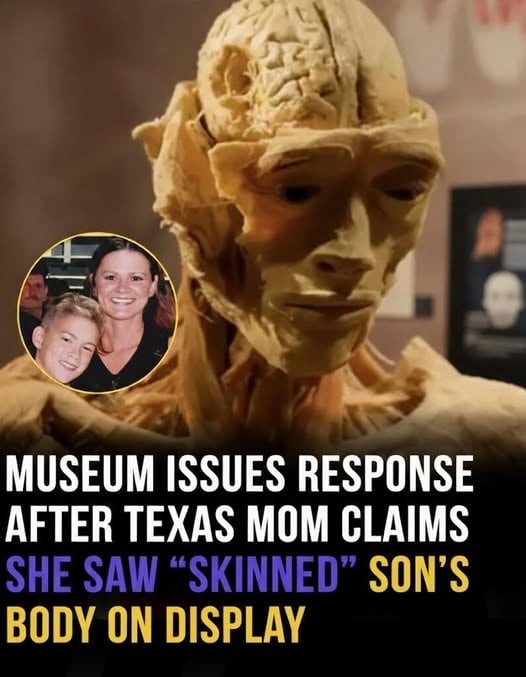
While visiting a traveling exhibition called “Real Bodies,” which displays plastinated human remains to educate visitors about anatomy, Kim suddenly found herself frozen in front of one particular figure.
The specimen was titled “The Thinker.”
To most visitors, the display was simply a detailed anatomical model showing muscles and bone structure. But to Kim, the figure felt hauntingly familiar.
She believed she recognized the body.
According to her claims, certain features—such as the structure of the muscles and what she believed were signs of injury—seemed similar to what she remembered from her son.
In that moment, the educational exhibit turned into something far more personal.
To Kim, it felt like she might be looking at Christopher.
The Museum’s Response
The organization responsible for the exhibition responded quickly.
According to their documentation, the body used for “The Thinker” had been obtained and prepared years before Christopher’s death in 2012.
Based on those records, Kim’s belief could not be correct.
From the museum’s perspective, the timeline alone made the claim impossible.
But grief does not always respond to paperwork or official explanations.
For a mother who never received the closure she needed, documents and dates could not fully erase the feeling that something about the display was painfully familiar.
The disagreement soon attracted public attention and raised questions about the origins of human specimens used in exhibitions.
The Psychology of Unresolved Loss
Experts say situations like this can happen when people experience unresolved grief.
When families are unable to see or bury a loved one, the mind sometimes struggles to accept the reality of death. Without that final moment of closure, the brain may continue searching for signs that the person still exists somewhere.
Psychologists describe this as a form of “re-embodiment”—when someone unconsciously projects the identity of a lost loved one onto another object or person.
In Kim’s case, the exhibit may have become a physical focus for years of emotional pain.
If the body truly belonged to Christopher, she would finally have what she had been denied: a body to mourn and a place to grieve.
Officials Say the Case Is Closed
Legal authorities and museum officials maintain that the situation has already been resolved.
They point to documentation tracing the specimen’s origin and preparation long before Christopher’s death.
To them, the situation represents a tragic overlap between public science education and private grief.
However, Kim insists that her efforts are not about creating a conspiracy.
Her argument centers on dignity, transparency, and the right of families to know exactly what happened to their loved ones.
A Larger Ethical Debate
The controversy has also revived a broader conversation about the ethics of displaying human bodies.
Exhibitions like “Real Bodies” are designed to educate the public about anatomy, medicine, and the complexity of the human body. Organizers say all specimens are legally obtained and handled respectfully.
Still, critics argue that when human remains are displayed without personal histories or identities, it can create discomfort for some viewers.
Once a body is preserved and displayed anonymously, it becomes a universal representation of humanity rather than an individual life.
For most people, that anonymity is part of the scientific purpose.
For Kim, however, it leaves room for doubt.
Without clear identifying information, she fears it is impossible to completely rule out the possibility she believes she sees.
A Mother Still Searching for Peace
Today the museum exhibition continues traveling to different cities, attracting visitors curious about human anatomy and science.
But for Kim, the display represents something entirely different.
To her, it is not simply a museum exhibit.
It is a reminder of the questions surrounding her son’s death.
She continues to seek independent verification and hopes one day to receive answers that allow her to finally find peace.
A Story About Loss, Not Just Controversy
At its heart, the story is not only about a museum exhibit.
It is about the enduring strength of a mother’s love.
Kim’s search reflects a deeply human desire—to understand what happened and to give her son the dignity of a clear final resting place.
Whether her suspicions come from intuition or from the deep wounds left by unanswered questions, the emotion behind them is undeniable.
Sometimes official systems—investigations, reports, and legal conclusions—cannot fully contain the magnitude of human grief.
When closure is missing, the search for answers may continue for years, even in the most unexpected places.
And for Kim, that search is far from over.