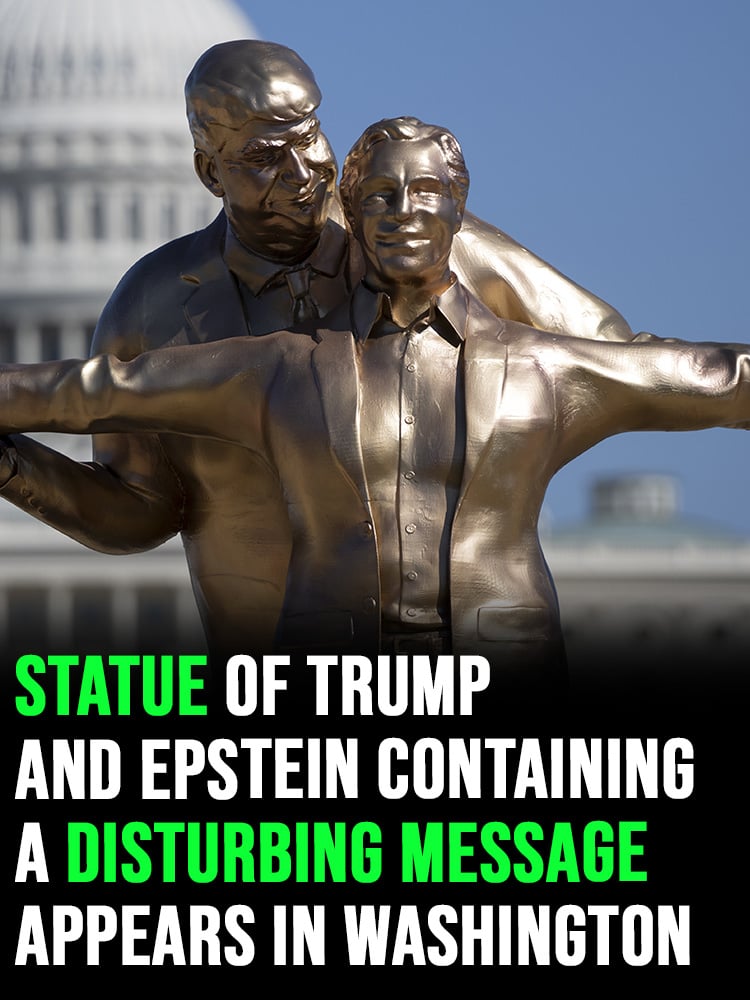
A provocative art installation titled “King of the World” has sparked widespread discussion after appearing near the National Mall in Washington, D.C. The sculpture quickly drew the attention of tourists, locals, and political observers because of its dramatic pose—one that many viewers say resembles the iconic “I’m the king of the world” moment from the film Titanic.
The unusual imagery immediately ignited debate.
Some visitors described the piece as bold political satire, while others considered it unsettling or inappropriate for such a historic civic setting. Regardless of opinion, the artwork has become a focal point of conversation among people walking through the area.
The Design That Started the Debate
The sculpture depicts Donald Trump and the late financier Jeffrey Epstein in a stylized gold-colored form. The striking metallic finish and theatrical pose were clearly intended to attract attention.
For critics of the installation, the pairing of the two figures raises questions about whether the piece crosses a line between satire and provocation. Some believe the imagery is intentionally controversial and designed to stir strong reactions.
Supporters of the artwork, however, argue that the sculpture invites viewers to reflect on issues of power, influence, and how society remembers prominent figures.
Message From the Artists
According to statements attributed to the anonymous art collective Secret Handshake, the project was never meant to offer a single clear interpretation.
Instead, the group says the installation was designed to encourage conversation about themes such as public memory, celebrity culture, and the complex relationship between power and perception.
By placing the sculpture near one of the most symbolic locations in the United States, the artists hoped to prompt visitors to pause and consider how historical narratives are shaped.
Public Reaction
Since appearing near the National Mall, the sculpture has generated strong reactions both in person and online.
Some observers see it as a legitimate example of political commentary expressed through art—something that has long been part of public discourse. Others believe the installation is inappropriate for a national landmark known for honoring historical figures and events.
Social media discussions quickly amplified the debate, with thousands of users sharing photos of the statue and offering their own interpretations of its meaning.
Art, Satire, and Public Space
Public art has historically played a role in challenging perspectives and encouraging dialogue. Installations placed in prominent civic locations often become part of broader cultural conversations about history, politics, and social values.
The “King of the World” sculpture appears to be doing exactly that.
Whether viewed as satire, protest, or simply a provocative artistic statement, the installation has succeeded in capturing attention and prompting discussion about how power, fame, and legacy intersect in modern society.
As reactions continue to unfold, the piece serves as a reminder that art placed in public spaces rarely remains neutral—it invites people to interpret, question, and debate the messages it presents.