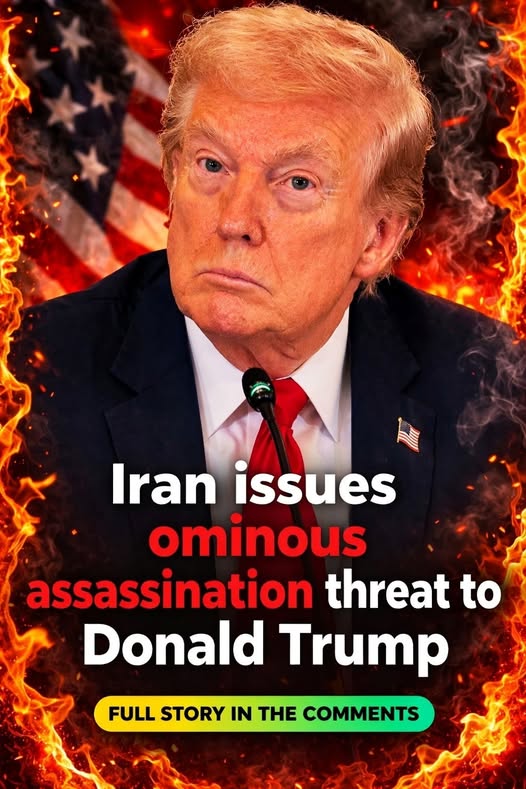
Global tensions in March 2026 have intensified dramatically as the confrontation between Washington and Tehran shifts into far more dangerous territory. What began as escalating military pressure in the Middle East has now taken on a deeply personal dimension after Iranian officials delivered a stark warning directed at the life of President Donald Trump. The statement has alarmed diplomats and security analysts worldwide, marking one of the most serious rhetorical escalations in the ongoing conflict.
The situation escalated following a strong message from President Trump posted on his Truth Social platform. In the post, he warned Iran against attempting to interfere with shipping through the Strait of Hormuz — one of the world’s most critical energy corridors. Trump stated that if Iran tried to disrupt oil transport through the narrow waterway, the United States would respond with force “twenty times stronger” than anything seen so far in the conflict.
The warning came after more than a week of intense military activity in the region. The fighting reportedly began with coordinated airstrikes carried out by U.S. and Israeli forces against targets inside Iran. According to some reports, those strikes resulted in the death of Iran’s supreme leader, Grand Ayatollah Ali Khamenei, a development that dramatically intensified the political and emotional stakes of the confrontation.
Tehran responded quickly.
Ali Ardashir Larijani, the secretary of Iran’s Supreme National Security Council, publicly rejected Trump’s warning and issued a chilling response. While dismissing the American president’s comments as empty threats, Larijani concluded his message with language that security experts interpreted as a direct threat against Trump’s life.
Referencing the historic religious event of Ashura, Larijani warned the U.S. leader to “be careful not to be eliminated,” a phrase widely interpreted as an assassination threat. The statement was dated March 19, 1404 according to Iran’s calendar, marking ten days since the reported death of Khamenei — a detail that underscored the symbolic and ideological tone of the message.
At the center of the confrontation remains the Strait of Hormuz, one of the most strategically important waterways on the planet. Nearly one-fifth of the world’s oil shipments pass through the narrow channel, making it a critical artery for global energy markets. Even the possibility of military disruption there has historically caused instability in financial markets.
Following the exchange of threats, oil prices surged sharply, briefly approaching $119 per barrel before stabilizing closer to the $90–$100 range. For many consumers around the world, such fluctuations translate into higher fuel costs and increased pressure on already fragile economies.
Although President Trump previously suggested that the conflict might end “very soon,” developments on the ground suggest a far more complex situation. Iran has launched several waves of drone and missile strikes targeting U.S. military installations and allied assets across the region, signaling that its military capabilities remain active despite the earlier strikes.
The conflict has quickly expanded beyond traditional battlefield lines. Regional proxy groups have begun mobilizing, while international airlines and shipping companies are rerouting operations to avoid potential danger zones. These changes are placing additional strain on global trade routes and supply chains.
In Washington, the threat against the president has triggered an immediate reassessment of security measures surrounding the executive branch. U.S. intelligence and security agencies are treating the statements from Tehran with extreme seriousness, recognizing that modern geopolitical conflicts increasingly blur the line between rhetoric and real-world action.
American political leaders remain divided on how to proceed. Some lawmakers argue that a stronger military response is necessary to deter further threats. Others insist that diplomatic channels must be reopened before the crisis expands into a broader regional war.
Beyond the immediate conflict, the events of 2026 are raising deeper concerns about the future of international relations. The use of preemptive strikes, the targeting of leadership figures, and increasingly personal threats between governments represent a shift in the norms that have governed global conflict for decades.
Meanwhile, the human cost of the war continues to grow. Civilians in Iranian cities and American personnel stationed at regional bases are increasingly caught in the middle of an unpredictable and rapidly evolving conflict.
The psychological impact is also significant. After years marked by pandemics, economic instability, and political divisions, the possibility of a larger Middle East war has created widespread anxiety across global populations.
Media narratives surrounding the crisis have become sharply polarized. Some commentators frame the conflict as a necessary confrontation with a long-standing adversary. Others warn that prolonged instability in the region could trigger major economic consequences worldwide if energy flows are severely disrupted.
As the conflict enters its third week, uncertainty dominates the global outlook. Diplomatic options appear limited, and both sides continue exchanging warnings and military signals.
For now, the Strait of Hormuz remains the focal point of global tension — a narrow stretch of water carrying enormous geopolitical weight.
Whether the situation will stabilize or spiral into a wider confrontation remains unclear. What is certain is that the events unfolding in March 2026 have significantly reshaped the geopolitical landscape and reminded the world how quickly modern conflicts can escalate.
As night falls over the Persian Gulf, governments, markets, and citizens around the globe remain on edge, watching closely and waiting to see what move comes next.