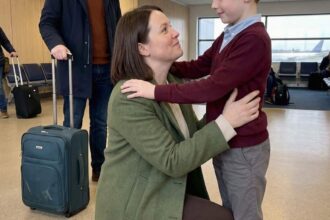
A marriage that lasts seventy-two years is built from thousands of quiet, ordinary moments. Morning coffee shared across the same kitchen table. Familiar routines. The comforting certainty that you know the person beside you better than anyone else in the world.
That was the life Edith believed she had with her husband, Walter.
She knew the small details of his habits — how he always checked the back door twice before bed, how he folded his church coat over the same chair every Sunday evening. After more than seven decades together, Edith believed there were no corners of his life left unexplored.
But at Walter’s funeral in early 2026, a stranger appeared holding a worn wooden box that would reveal a piece of his past she had never known.
The service itself was quiet and respectful. Neighbors and relatives filled the small church, moving gently through the room with the soft patience that grief often brings.
Edith sat in the first row, her hands clasped tightly in her lap while she stared at the polished lid of the casket. Their daughter Ruth sat beside her wiping away tears, while her grandson Toby stood nearby in shoes his grandfather would have joked were “too shiny for a young man.”
Everything about the moment felt familiar — until the service ended and a man in an old army jacket slowly approached.
He introduced himself as Paul, someone who had served alongside Walter during the final months of World War II.
Edith felt a small shock at hearing the name. In all their years together, Walter had never mentioned anyone named Paul.
That small omission felt like the first crack in something she thought she understood completely.
Paul held out a small wooden box. Its corners were worn smooth, as if it had spent many years tucked inside drawers and pockets.
“Walter asked me to give this to you,” he said quietly.
Edith opened the lid carefully.
Inside, resting on a faded piece of cloth, was a thin gold wedding ring — far smaller and more delicate than the one on her own hand.
For a moment, the room seemed to grow cold around her.
Another woman’s wedding ring sitting in her husband’s funeral box raised a question she had never imagined asking after seventy-two years of marriage.
Had there been someone else?
The thought shook her more than the grief itself.
People nearby leaned closer, curiosity spreading quietly through the room as Edith looked up at Paul and asked him to explain.
Paul took a breath before speaking.
The story did not lead to a secret affair. Instead, it led back to 1945 in France, just after the war had begun to wind down.
Walter had been stationed near the city of Reims. During those chaotic days, refugees and families searching for loved ones gathered near the military gates.
One of them was a young woman named Elena.
Every morning she came looking for her missing husband, Anton.
Walter had been the soldier who noticed her. He shared some of his food rations and helped her write letters in broken French to anyone who might know where Anton had gone.
There was very little he could actually do for her — except offer kindness and hope.
Eventually Elena was forced to leave the area as civilians were evacuated.
Before she left, she placed her wedding ring into Walter’s hand.
Her request was simple: if he ever found Anton, he should give him the ring and tell him she had waited.
Soon afterward, Walter learned that the region where Elena had been sent had suffered heavy casualties.
He never discovered what happened to her.
But he kept the ring.
For the rest of his life.
Not as a memory of another love, Paul explained, but as a promise he had never been able to fulfill.
Inside the box were two small letters Walter had written.
The first was addressed to Edith.
In handwriting she instantly recognized from decades of birthday cards and grocery lists, Walter explained that the war had taught him how fragile love could be.
Carrying Elena’s ring had reminded him every day that people sometimes lose those they love without warning.
That knowledge, he wrote, made him cherish his life with Edith even more deeply.
“You were my safe return,” the letter said.
The second note was meant for Elena’s family. In it, Walter apologized for never finding Anton and honored the courage of a woman who had waited faithfully for someone she loved.
Even in his final years, Paul explained, Walter had asked him to help search for Elena’s relatives so the ring could be returned.
They never found them.
Slowly, the fear that had gripped Edith began to soften.
Walter had not hidden another life.
He had carried a small piece of the war quietly inside him — a reminder of loss that deepened his appreciation for the family he came home to.
The next morning, before anyone else arrived at the cemetery, Edith returned to Walter’s grave with her grandson Toby.
The grass was still damp with morning dew.
With Toby helping her kneel, Edith placed the small pouch containing the ring and the letters beside the fresh flowers on Walter’s grave.
It felt like laying to rest a promise that had traveled silently through seventy years of life.
As she stood there in the quiet morning air, Edith realized something important.
Even seventy-two years together cannot reveal every story a person carries.
But she knew the part of Walter that mattered most — the man who came home from war, built a life beside her, and spent every ordinary day making sure she was loved.