The human body has long served as a living canvas, a permanent archive where identity, belief systems, and the scars of experience are etched into the skin. Tattoos are rarely just aesthetic choices; they are silent narratives that speak when words fail. From the sprawling, intricate tapestries of traditional sleeves to the sharp, minimalist lines of modern geometry, every mark represents a chapter of a larger story. These designs act as milestones, marking the transition from who a person was to who they have become. Yet, in recent years, a singular, tiny piece of punctuation has emerged as one of the most profound symbols in the world of body art: the semicolon.
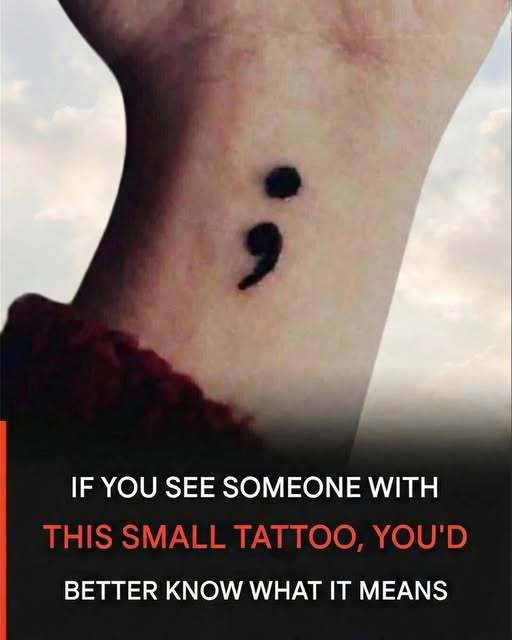
To a grammarian, the semicolon is a functional tool. It exists to bridge two independent clauses that are closely related in thought. It signifies a pause that is more substantial than a comma but less definitive than a period. It is used when an author could have chosen to end a sentence but decided, instead, to keep going. In the realm of personal symbolism and mental health advocacy, this grammatical function has been elevated into a breathtaking metaphor for human existence. The semicolon tattoo is a declaration that a person’s life is a sentence that was nearly finished, but the author—the individual themselves—decided to continue the story.
The meteoric rise of this symbol began in 2013 with the inception of Project Semicolon. Founded by Amy Bleuel, who sought to honor her father’s legacy and her own struggles with mental health, the initiative was designed to transform a simple mark of punctuation into a global beacon of hope. The project aimed to shift the cultural conversation away from the shadows of stigma and toward the light of resilience. By choosing a symbol rooted in the act of writing, the movement reminded the world that we are the protagonists of our own lives. We hold the pen, and even when the plot becomes dark or the weight of the previous words feels unbearable, we have the agency to place a semicolon and begin the next phrase.
This movement arrived at a critical juncture in history. For decades, discussions surrounding mental health, depression, and anxiety were often shrouded in shame or dismissed as secondary to physical health. The semicolon tattoo helped break this silence. Because of its small size and understated nature, it became an accessible “entry point” for those who wanted to wear their history without necessarily inviting intrusive questions from every stranger. It created a visual shorthand for a complex internal struggle. When someone sees a semicolon on a wrist, an ankle, or behind an ear, there is an immediate, unspoken understanding. It is a badge of survival that signals to others: “I have been through the darkness, and I am still here.”
One of the most powerful aspects of the semicolon is its role in fostering solidarity. In a world where emotional pain can feel incredibly isolating, the symbol acts as a quiet signal in the crowd. It creates a sense of belonging among a community of survivors and allies. This shared visual language has significantly contributed to the reduction of stigma. When a person displays this tattoo, they are not just telling their own story; they are validating the stories of millions of others. They are making it clear that mental health challenges are not a source of shame, but a part of the human condition that requires compassion and endurance.
The psychological weight of the symbol is rooted in the concept of resilience. Resilience is not the absence of struggle, but the ability to integrate that struggle into a meaningful future. For many, the semicolon marks a specific turning point—a moment when they chose to seek help, a day they survived a crisis, or a period of time when they reclaimed their sense of self. It serves as a permanent, physical grounding mechanism. In moments of renewed distress, the tattoo stands as a reminder of past strength. It is a testament to the fact that while the “sentence” of life may be difficult to write, it is inherently valuable and deserves to move forward.
The simplicity of the design is perhaps its greatest strength. It transcends cultural and linguistic barriers. Whether in New York, Tokyo, or London, the meaning remains consistent because the metaphor is universal. Its minimalist nature allows it to be combined with other symbols—sometimes it is the body of a butterfly, representing transformation; other times, it is woven into a heartbeat line or a cross. This versatility allows each individual to customize the symbol to fit their specific journey while maintaining the core message of continuation. It proves that a symbol does not need to be loud or elaborate to be earth-shakingly powerful.
Furthermore, the visibility of the semicolon has been amplified by public figures and artists who have used their platforms to discuss their own mental health journeys. When celebrities or influencers share the meaning behind their ink, it ripples through society, normalizing the act of asking for help. This cultural shift has led to more supportive environments in workplaces, schools, and homes. We are moving away from a “stiff upper lip” mentality and toward a more empathetic understanding of emotional well-being. The semicolon has become the punctuation mark of this new era of transparency.
Ultimately, the semicolon is a reminder that no single chapter defines the entire book. Life is a series of pauses, breaths, and transitions. There will be moments where the pen falters and the ink runs thin, where the previous paragraph is filled with grief or exhaustion. But as long as there is a semicolon, there is the promise of more text to come. The story is not over. The decision to keep going is an act of profound courage, and the tiny mark on the skin serves as a daily vow to the self. It is a quiet, permanent whisper that says: “To be continued.”