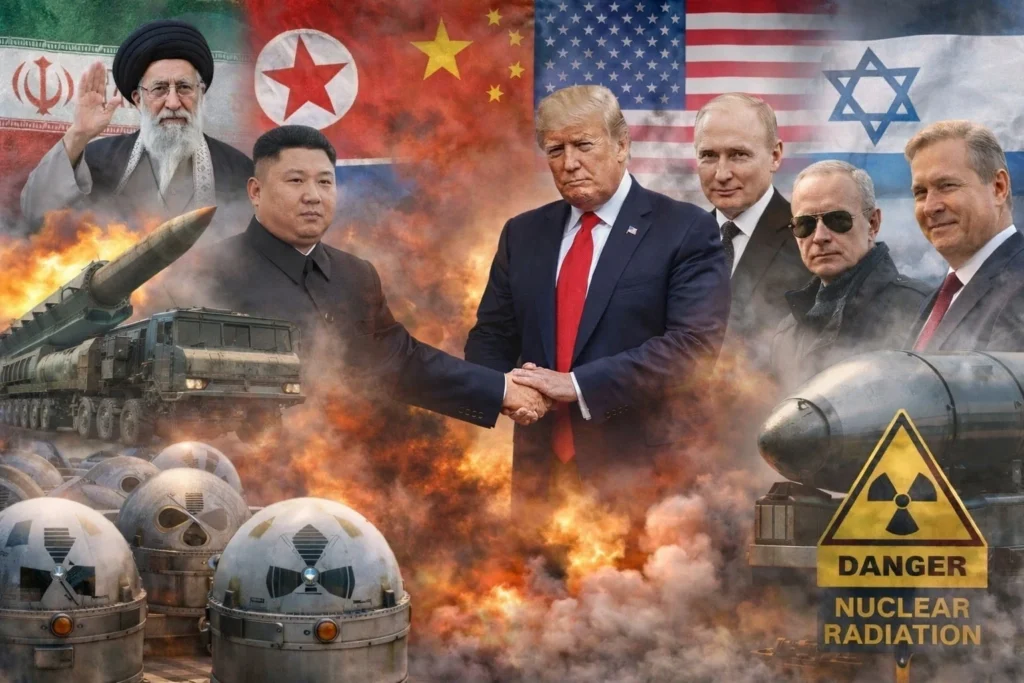
The geopolitical landscape of the Arctic has long been characterized by a fragile “high north, low tension” equilibrium, but recent rhetorical exchanges have pushed this frozen frontier into the center of a global firestorm. The catalyst for this latest surge in international anxiety is the renewed discourse surrounding Greenland—a territory that remains legally under the Kingdom of Denmark but has become a recurring focal point of President Donald Trump’s strategic vision. This renewed interest, framed by Trump as a necessity for U.S. national security, has elicited an unprecedentedly sharp response from Moscow. Russian senior lawmakers have transitioned from diplomatic disagreement to apocalyptic warnings, with one official characterizing aggressive U.S. assertions over Greenland as a potential trigger for “the end of the world.” While the language is undeniably hyperbolic, it signals a profound shift in how the Arctic is being viewed: no longer as a remote wilderness, but as the primary theater for the next great power confrontation.
To understand why a landmass largely covered in ice has become a potential flashpoint for a third world war, one must look at the convergence of geography, climate change, and military technology. Greenland occupies the literal high ground of the Northern Hemisphere, sitting as a massive strategic bridge between North America and Europe. For decades, the United States has maintained a presence there via the Pituffik Space Base, formerly known as Thule Air Base. This installation is a cornerstone of the U.S. Integrated Tactical Warning and Attack Assessment system, providing critical radar coverage for incoming ballistic missiles. As Russia modernizes its own Northern Fleet and develops hypersonic delivery systems, the real estate upon which these early-warning sensors sit has become infinitely more valuable. Trump’s argument for acquiring or exerting more direct control over Greenland is built on the premise that in an era of renewed great power rivalry, the U.S. cannot afford any ambiguity regarding its Arctic defenses.
However, the Arctic of the 21st century is changing physically as much as it is politically. The rapid melting of polar ice is opening trans-Arctic shipping lanes that could eventually rival the Suez or Panama Canals in commercial importance. Furthermore, the region is believed to hold vast untapped reserves of rare earth minerals, oil, and natural gas. For Russia, the Arctic is an existential economic and security interest; it possesses the world’s longest Arctic coastline and has spent the last decade re-opening Soviet-era military bases and deploying icebreaker fleets that far outnumber those of the West. From Moscow’s perspective, any attempt by the United States to unilaterally alter the status of Greenland is seen as a direct threat to the strategic balance of power. The “end of the world” rhetoric used by Russian senators is a specific reference to the collapse of nuclear deterrence. Russian military doctrine relies on the ability to strike back if attacked, and they fear that a “Golden Dome” of U.S. missile defenses stretched across the Arctic would effectively neutralize their retaliatory capacity, thereby inviting a first strike.
The response from traditional U.S. allies has been a mix of firm rejection and diplomatic alarm. The Kingdom of Denmark and the government of Greenland have been consistent: “Greenland is not for sale.” While Greenland maintains significant self-governance, its foreign and security policy remains tied to Copenhagen, a fellow NATO member. Danish officials have cautioned that unilateral American rhetoric regarding the territory risks fracturing the very alliance unity that is currently required to manage European security. Within the NATO framework, there is a deep-seated fear that aggressive posturing in the Arctic could lead to a “miscalculation loop.” In a region where nuclear-armed submarines, long-range bombers, and sophisticated radar arrays operate in close, constant proximity, a simple navigational error or a misinterpreted exercise could escalate into a kinetic conflict before diplomacy has a chance to intervene.
This tension is further complicated by the emergence of the “Golden Dome” concept—a vision of an impenetrable missile defense shield covering the northern latitudes. In the logic of Cold War diplomacy, such a shield is paradoxically viewed as a destabilizing force. The doctrine of Mutually Assured Destruction (MAD) suggests that the world is safest when neither side believes it can win a nuclear exchange. If one side believes it has a shield that can stop 99% of incoming missiles, they might be more willing to take aggressive risks. Russia’s extreme warnings are designed to signal that they will not allow this technological disparity to occur. They view the Arctic as their “backyard” and see any U.S. expansion as an encirclement strategy aimed at stripping Russia of its status as a global power.
Beyond the military and diplomatic maneuvering, there is a domestic political dimension that cannot be ignored. Donald Trump’s framing of the Greenland issue is often presented as a “deal” or a strategic acquisition, applying a real-estate mindset to international relations. To his supporters, this represents a bold, forward-thinking approach to ensuring American dominance in a changing world. To his critics, it is a reckless provocation that alienates a loyal ally (Denmark) and provides Russia with an easy narrative of “American imperialism” to sell to the global south. This political friction at home translates to uncertainty abroad, as world leaders struggle to discern whether these statements are serious policy goals or high-stakes bargaining chips.
As we move further into 2026, the Arctic continues to transform into a crowded and contested space. The Arctic Council, once a forum for peaceful scientific cooperation, has seen its effectiveness hampered by geopolitical rivalry. Meanwhile, the military footprint of both NATO and Russia in the high north continues to expand. We are seeing more frequent naval patrols, larger-scale winter warfare exercises, and the deployment of increasingly sophisticated electronic warfare units. Every new sensor placed on the ice and every new silo dug into the permafrost adds a layer of complexity to an already volatile situation.
The ultimate risk remains the human element. In the harsh, unforgiving environment of the Arctic, where communication lines are stretched thin and sensors can be fooled by atmospheric conditions, the margin for error is razor-thin. History shows that the most dangerous moments of the nuclear age were not the result of a leader wanting to end the world, but of a leader believing the other side had already started the process. The “end of the world” warnings emanating from Moscow may be designed to capture headlines, but they also serve as a stark reminder that the frozen north is no longer a buffer zone. It is a tripwire.
Whether the current situation regarding Greenland remains a war of words or evolves into a more tangible crisis depends on the ability of world leaders to balance national ambition with the necessity of strategic stability. As shipping lanes open and resources become accessible, the temptation to “claim” the Arctic will only grow. However, the cost of a mistake in this region is higher than anywhere else on Earth. The global community now watches the Arctic with bated breath, recognizing that in the pursuit of strategic advantage, the world’s superpowers are dancing on increasingly thin ice. The rhetoric of “the end of the world” is a shadow that now hangs over the aurora borealis, a grim warning that in the high north, the heat of political tension can be far more destructive than the cold of the climate.