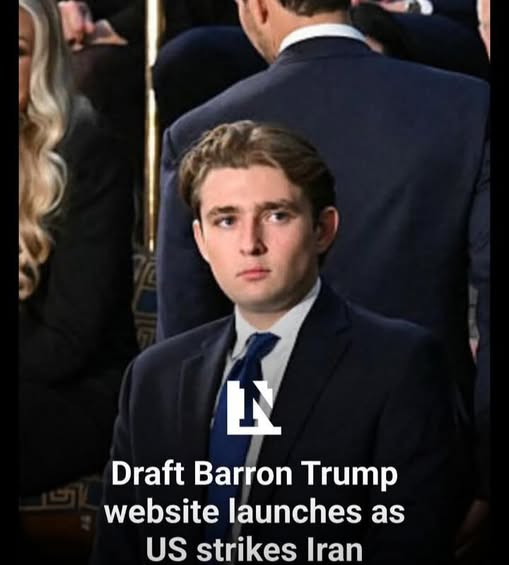
The digital landscape has long been a mirror for the chaos of geopolitical conflict, and the recent escalation between the United States, Israel, and Iran has proven no different. As missiles illuminated the skies over the Middle East, a different kind of ignition occurred online: the launch of a controversial and highly provocative website targeting the youngest member of the Trump family. The emergence of “DraftBarronTrump.com” has sparked a firestorm of debate, serving as a jarring intersection of wartime anxiety, political satire, and the relentless scrutiny that follows the children of world leaders.
According to domain registration records, the site was officially established on February 28, 2026—the precise date that the United States and Israel initiated their joint military operations against Iranian targets. This timing was almost certainly not a coincidence. As the nation grappled with the reality of a significant military confrontation, the creators of the site sought to capitalize on the moment by calling for the enlistment of 19-year-old Barron Trump. The site’s core messaging centers on a satirical demand: that if the country is to go to war, the families of the architects of that war should be the first to serve on the front lines.
While the website adopts a tone that is overtly satirical, its presence has touched a raw nerve in a country already on edge. The content features a variety of hyperbolic claims and entirely fabricated quotes attributed to members of the Trump family, designed to mimic the rhetoric of high-stakes patriotism and military fervor. By using Barron Trump as their central figure, the creators have tapped into a long-standing American tradition of using political offspring as proxies for broader critiques of executive power. However, the move has also drawn significant criticism from those who argue that the children of politicians—even those who have reached the age of majority—should remain off-limits from such aggressive public campaigns.
The phenomenon of the “Draft Barron” campaign highlights a growing trend in digital activism where satire is used as a weapon to highlight perceived social or political hypocrisies. In this case, the creators are leveraging the tension of the current conflict to question the “arithmetic of sacrifice.” The argument presented by the site, albeit through a lens of irony and fabrication, mirrors historical anti-war sentiments that often question why the burdens of combat are so often carried by the general populace while the elite remain insulated. By focusing on a specific individual like Barron, the site makes an abstract political debate intensely personal and highly shareable, ensuring it gains traction in an era where the “attention economy” is the primary driver of political discourse.
The timing of the launch is also a critical element of its impact. On the very day the site went live, the White House was coordinating one of the most significant naval and aerial campaigns in the region in decades. As citizens watched news reports of the strikes, many encountered the “Draft Barron” site via social media algorithms that thrive on high-emotion, topical content. This juxtaposition creates a strange, dual-screen reality for many Americans: on one side, the somber news of a potential global conflict, and on the other, the biting, irreverent world of internet memes and political pranks.
The use of satire during wartime is a complex and often polarizing practice. During previous conflicts, such as the Vietnam War or the Iraq War, underground newspapers and late-night comedians served as the primary outlets for this kind of dissent. Today, that energy has migrated to domain names and social media feeds, where a single website can reach millions within hours. However, the digital age also complicates the “satire” label. With the prevalence of misinformation, many users may encounter the fabricated quotes on the site and mistake them for genuine family statements, further muddying the waters of an already confused public discourse.
Furthermore, the legal and ethical questions surrounding the site are significant. While the First Amendment provides broad protections for parody and satire, particularly when directed at public figures or their family members, the inclusion of Barron Trump—who has largely stayed out of the political spotlight compared to his older siblings—presents a unique case study in privacy versus public interest. At 19, Barron is legally an adult, yet his role in the public eye has remained minimal. The “Draft Barron” site essentially drags him into the center of a geopolitical firestorm, using his likeness and name to serve a broader ideological point that he had no part in shaping.
The reaction from the Trump administration and its supporters has been one of predictable condemnation. Allies of the President have categorized the site as a “new low” in political discourse, accusing the creators of using a teenager as a pawn in a dangerous game of rhetorical brinkmanship. They argue that at a time when the nation should be united in support of its military objectives, such distractions serve only to sow division and disrespect the office of the presidency. Conversely, those who support the spirit of the site argue that it is a legitimate, if uncomfortable, way to force a conversation about the human costs of war.
As the conflict with Iran continues to evolve, the “Draft Barron” website serves as a digital artifact of a specific moment in American history. it represents the convergence of high-tech warfare and high-octane internet culture. In the past, the “home front” during wartime was a place of posters and radio broadcasts; today, it is a place of viral websites and domain warfare. The site’s longevity is uncertain, as platforms often move to de-index or restrict content that is deemed harassing or factually misleading, but its initial success in capturing the public’s attention is a testament to the power of provocative digital branding.
The broader story here is not just about a single website or a single family member, but about how America processes the trauma of war in the 2020s. We are a nation that expresses its fears through irony and its dissent through code. As the U.S. and Israel continue their operations, and as the possibility of further escalation looms, we can expect the digital sphere to become even more cluttered with these kinds of satirical incursions. Whether “DraftBarronTrump.com” is seen as a biting piece of social commentary or a distasteful act of harassment, it remains a clear indicator that in the modern world, no one—not even the family of the Commander-in-Chief—is shielded from the fallout of the digital frontline.
The intersection of Barron Trump’s 19th year with a major international conflict has created a perfect storm for this kind of content. As he moves into adulthood, the boundaries between his private life and his father’s public legacy will likely continue to blur. For the creators of the draft site, this blurring is an opportunity to challenge the status quo; for others, it is a cautionary tale about the erosion of civility in the age of the internet. Regardless of where one stands, the site has successfully injected itself into the national conversation at a moment when the stakes could not be higher.