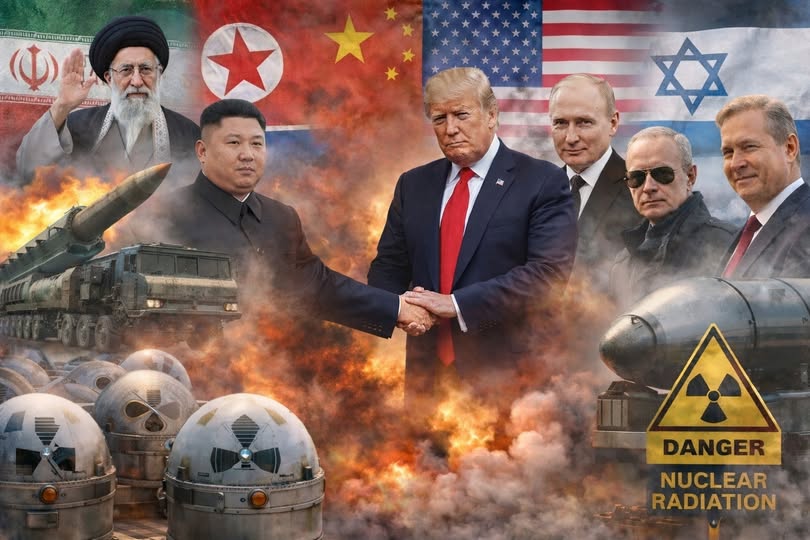
The geopolitical landscape of the Persian Gulf has been thrust into a state of profound and dangerous volatility following reports of a coordinated series of strikes against United States military installations. Iranian state television, citing high-ranking military officials, has confirmed the commencement of a broad offensive targeting several key strategic assets throughout the region. This development represents a dramatic escalation in regional tensions, transitioning from a period of diplomatic friction into a direct and overt kinetic confrontation. As the news ripples across the globe, the immediate impact has been felt in the closure of airspaces, the mobilization of missile defense systems, and a pervasive sense of dread among the civilian populations of several Gulf nations.
According to initial reports, the Al Dhafra air base in the United Arab Emirates has become a primary focal point of the hostilities. Witnesses in Abu Dhabi reported hearing a series of thunderous explosions that rattled the city’s skyline, followed by the visible ascent of smoke on the horizon. Reuters has corroborated these accounts, noting that the UAE government moved with unprecedented speed to shutter its commercial airspace, redirecting flights and grounding departures to prevent civilian casualties amidst the missile barrages. The Al Dhafra base, which hosts thousands of American personnel and critical surveillance and strike aircraft, was reportedly targeted by a salvo of Iranian ballistic missiles. The scale of the explosions suggests significant impact, although the full extent of the damage to infrastructure and personnel remains under assessment by both Emirati and American officials.
Simultaneously, the island nation of Bahrain has been drawn into the center of the storm. In the capital of Manama, specifically within the Al Jufair area, thick plumes of black smoke have been observed rising near the headquarters of the US Fifth Fleet. This installation serves as the nerve center for American maritime operations across the Middle East and Central Asia, making it one of the most strategically significant targets in the theater. While details regarding the specific nature of the ordnance used in Bahrain are still emerging, the proximity of the strikes to the fleet’s command center has sent shockwaves through the maritime community. Local authorities have issued urgent directives to the citizenry, advising them to shelter in place and strictly avoid any areas in the vicinity of military or governmental perimeters.
The escalation has also touched Qatar, a nation that has historically navigated a complex middle ground in regional disputes. The Qatari Interior Ministry has moved into an emergency posture as sirens echoed across the Al Udeid airbase. According to military reports, Qatar’s integrated air defense network, specifically the Patriot missile batteries, was engaged to intercept incoming projectiles. At least one missile was reportedly neutralized mid-air, preventing what could have been a catastrophic strike on the largest American military facility in the Middle East. Despite the successful interception, the atmosphere in Doha remains one of high alert. Authorities have followed the lead of their neighbors by closing the national airspace, effectively severing one of the world’s busiest transit hubs from the global aviation network.
This synchronized wave of attacks represents a fundamental shift in the security architecture of the Persian Gulf. For years, the region has existed in a state of “gray zone” conflict, defined by proxy skirmishes, cyber warfare, and maritime harrassment. However, the use of ballistic missiles against established air and naval bases marks the end of ambiguity. The Iranian military’s public claim of responsibility serves as a direct challenge to the American security umbrella that has defined the region for decades. The implications for global energy markets are already becoming apparent, as the Strait of Hormuz—the world’s most vital oil transit chokepoint—now sits at the heart of an active war zone.
The human element of this crisis is equally stark. In the cities of the Gulf, where modern skyscrapers often look out over the waters of the peninsula, the sounds of missile interceptions and explosions have replaced the hum of commerce. The directives for citizens to stay home and seek shelter reflect the terrifying reality of modern missile warfare: the line between military targets and civilian population centers is dangerously thin. Families in Abu Dhabi, Manama, and Doha are now living through the “nightmare scenario” that analysts have warned about for years. The closure of airspaces has also left thousands of travelers stranded, turning international airports into scenes of confusion and anxiety.
From a strategic perspective, the choice of targets appears designed to cripple the United States’ ability to project power in the region. By hitting Al Dhafra, Al Jufair, and Al Udeid, the offensive has struck at the air, sea, and logistical pillars of the US presence. These bases are not merely barracks; they are the eyes, ears, and fists of American policy in the Middle East. An attack of this magnitude demands a response, and the international community is now waiting with bated breath to see how Washington will react. The potential for a wider regional war—one that could draw in multiple nations and disrupt the global economy for years—is higher than it has been in a generation.
The timing of these events adds another layer of complexity. Coming at a moment when the international community was already grappling with various geopolitical shifts, the “Iranian launch” has effectively reset the global agenda. Diplomacy, which had been the preferred tool for managing Gulf tensions, now seems a distant memory. In its place is the cold logic of deterrence and retaliation. As the smoke continues to rise over the Al Jufair area and the Al Dhafra base, the primary focus for the involved governments is damage control and the prevention of an all-out conflagration.
As night falls over the Persian Gulf, the region remains a tinderbox. The “powerful explosions” reported by Reuters and the “shelter in place” orders from Qatar are symptoms of a profound systemic failure in regional stability. The 6-country coalition mentioned in emerging reports suggests that the response to this aggression may be multilateral, potentially involving a combined force of Western and regional allies aimed at restoring the status quo. However, in the immediate aftermath of a ballistic missile attack, the priority is survival and the securing of vital infrastructure.
The coming hours will be critical in determining whether this is a localized exchange of fire or the opening salvo of a much larger conflict. For the soldiers stationed at the targeted bases and the civilians living in their shadow, the routine of daily life has been replaced by the visceral reality of war. The Persian Gulf, a region that has seen more than its share of conflict, is once again the center of a global crisis that threatens to reshape the 21st-century world order. The explosions in Abu Dhabi and the smoke over Manama are not just news headlines; they are the sounds of a world that has suddenly and irreversibly changed.