The day everything broke didn’t arrive with thunder.
It arrived in a hospital hallway that smelled like antiseptic and burnt coffee.
I was pacing between white walls, counting ceiling tiles, listening to the steady rhythm of machines beyond a closed door. I remember thinking that if I kept walking, if I didn’t stop moving, the outcome couldn’t catch up to me.
Then the doctor stepped into the corridor.
He didn’t need to speak. His eyes carried it already.
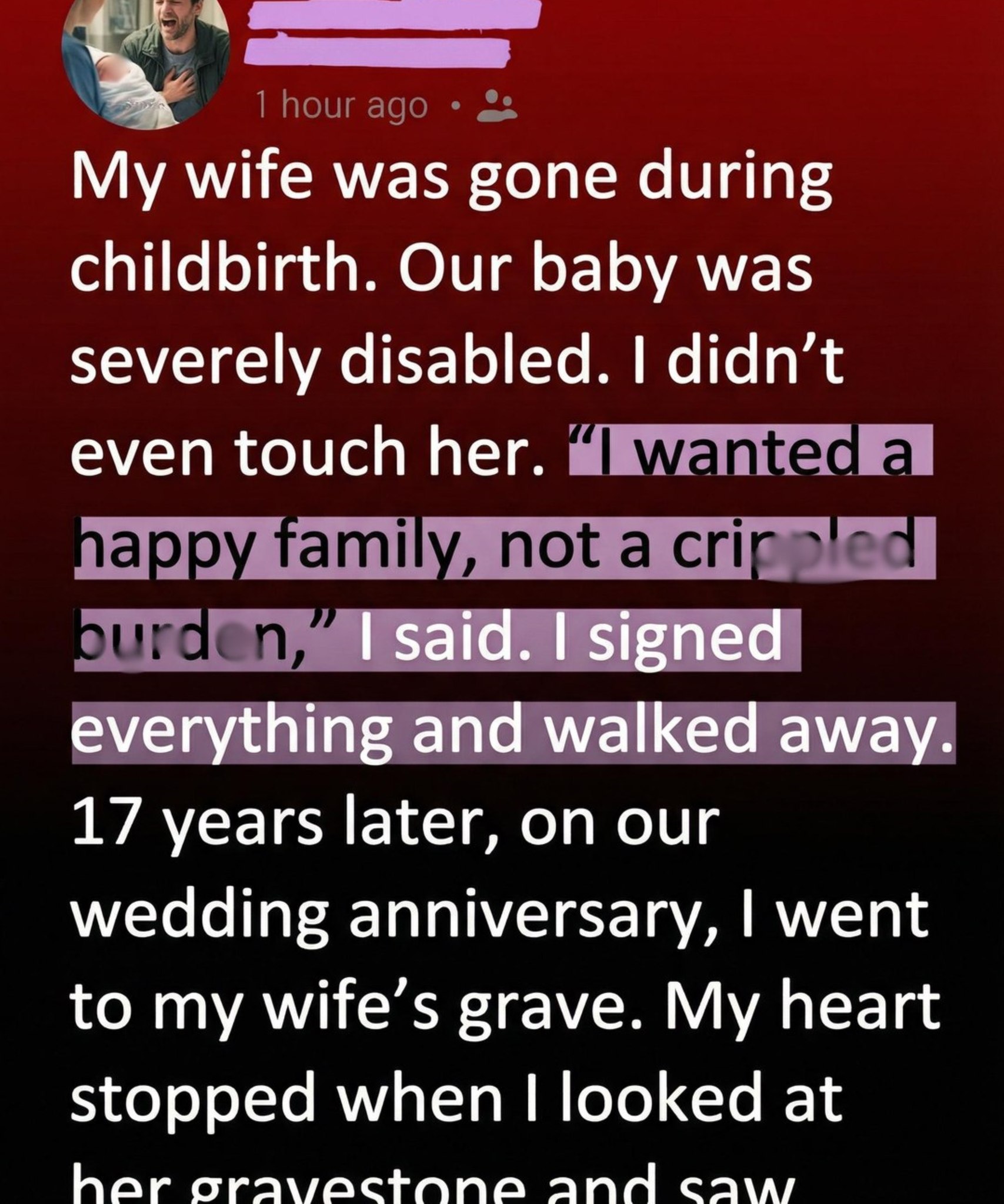
My wife was gone.
The words passed through me like cold air. Before I could understand them, before I could even sit down, there was more.
Our daughter had survived.
But she would face serious medical challenges for the rest of her life.
In the span of an afternoon, I lost the woman I loved — and inherited a future I didn’t recognize.
And instead of stepping forward, I stepped back.
Instead of holding my newborn daughter, I let fear take my hand.
That moment — not the funeral, not the signing of papers — defined the next seventeen years.
I told myself I wasn’t strong enough.
I renamed abandonment “survival.”
Grief has a way of distorting language. It makes cowardice sound practical. It makes retreat feel rational.
There were forms placed in front of me. Guardianship papers. Legal arrangements. I signed without reading. Without absorbing that ink can become permanent in ways regret cannot undo.
Friends called.
Family pleaded.
But I built walls and convinced myself they were boundaries. I buried myself in work, in long hours and louder rooms, in anything that drowned out the image of a little girl growing up without me.
On her birthdays, I stayed busy.
On my wedding anniversary, I scheduled meetings.
Silence became my strategy.
But silence doesn’t erase truth.
It magnifies it.
Seventeen years later, on what would have been our anniversary, I found myself standing in a cemetery I hadn’t visited in far too long.
The stone was unchanged. Her name carved in permanence.
I traced the letters with my fingers.
Love had once made me brave.
Fear had made me run.
“I’m sorry,” I whispered — to the earth, to the air, to the memory of the woman who believed I was stronger than I proved to be.
For the first time in nearly two decades, I let myself grieve fully — not just for my wife, but for the father I chose not to become.
Standing there, another realization settled in.
Seventeen years don’t rewind.
There is no door you can open that takes you back to a hospital hallway with better choices waiting.
But there is always the next step.
Redemption doesn’t begin with a grand gesture.
It begins with turning around.
I reached out.
Carefully. Quietly.
I asked about her — the daughter I had never held long enough to memorize.
What I learned humbled me.
She was strong.
Resilient.
Brilliant in ways that had nothing to do with what she lacked and everything to do with what she had built.
She had faced surgeries, therapy, classrooms that underestimated her — and she had risen anyway.
Without me.
Other people had stepped in. Teachers. Relatives. Mentors. They had seen possibility where I had seen only fear.
Shame still sits heavy in my chest.
But something else has begun to grow beside it.
Hope.
The hardest truth I’ve faced isn’t that my wife died.
It’s that I ran.
That I convinced myself my daughter was better off without a grieving, broken man — when what she needed was a grieving man who stayed.
I don’t know if forgiveness belongs to me.
I don’t know if seventeen years can be bridged with a phone call, or even with a lifetime of effort.
What I do know is this:
The moment I stopped running —
The moment I turned back toward love —
was the first moment I felt like I might become whole again.
Second chances don’t erase what came before.
But sometimes, they begin the instant you choose to face it.