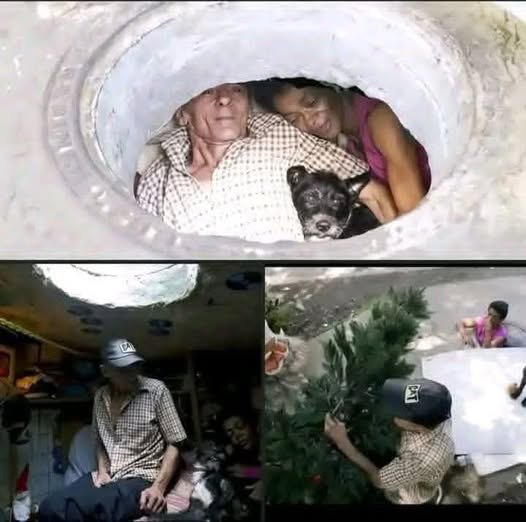
In the modern urban landscape, the line between a stable life and a state of total displacement has become dangerously thin, a reality that often remains invisible until it manifests in the most startling of places. Across the country, the intersection of skyrocketing rents, a scarcity of affordable housing, and the erosion of traditional support networks has pushed individuals to the absolute margins of society. For one couple and their loyal dog, this marginalization led them to a dwelling that most would consider mere construction debris: the hollow, cold interior of a massive concrete drainage pipe. This was not a lifestyle choice born of a desire for minimalism or adventure; it was a tactical maneuver for survival in an environment that offered them no other seat at the table.
To a passerby or a motorist catching a fleeting glimpse, the large concrete cylinders resting on a patch of neglected land appear to be nothing more than forgotten infrastructure waiting for a crew that may never arrive. They are symbols of progress stalled. However, a closer look inside one of these industrial husks reveals a narrative of heartbreaking resourcefulness. Within the curved, unforgiving walls of the pipe, a home—or the skeletal remains of one—has been meticulously constructed. A mattress is wedged firmly against the gray concrete, its edges conforming to the circular geometry of the space. Personal belongings are not strewn about in chaos; they are arranged with a precision that speaks to an underlying need for control in a life that has likely felt uncontrollable for some time. Small trinkets, a stack of folded clothes, and basic necessities are positioned with care, suggesting a daily routine that persists despite the lack of four walls and a roof. This attempt to maintain order within the confines of a sewer pipe is a profound expression of human dignity; it is an assertion that even in the absence of a house, one can still possess a home.
The architectural limitations of a drainage pipe are severe. It offers a modicum of protection from the biting wind and the steady fall of rain, acting as a primitive barrier against the elements, yet it remains a place of profound exposure. There is no insulation against the creeping chill of a damp night, and during the summer months, the concrete retains heat like an oven. In the absence of traditional housing, these partial protections become incredibly precious, guarded with the same intensity one might guard a mansion. Yet, it is a fragile sanctuary. The threat of flooding during a sudden downpour is a constant shadow, and the lack of lockable doors means that safety is a relative term, dependent entirely on the couple’s vigilance and the obscurity of their location.
The presence of the couple’s dog adds a layer of poignant complexity to the scene. In the world of housing insecurity, animals are often seen as liabilities by those who provide temporary shelter, yet for the people living on the streets, they are vital anchors. For this couple, their dog is not just a pet; it is a source of unconditional companionship, a living heartbeat in a cold concrete world. A dog provides a sense of structure—the need to feed, walk, and care for another being creates a schedule that fends off the lethargy of despair. More importantly, the animal provides emotional grounding. When the world looks at you with pity, judgment, or total indifference, the gaze of a dog remains unchanged. Caring for a pet in these conditions is a radical act of love that preserves a sense of purpose and humanity when the surrounding circumstances seek to strip both away.
Living in such a space presents a relentless cycle of challenges that those with indoor plumbing and electricity rarely have to contemplate. Privacy is a luxury that has long since vanished. Every movement is potentially visible to the public, and every conversation must be hushed. Access to clean water for drinking, cooking, or basic hygiene requires a logistical plan, often involving long walks to public parks or gas stations. Sanitation is a constant battle against the environment. What might appear to the casual observer as a temporary refuge is, in truth, a high-stakes balancing act where a single illness, a sudden cold snap, or a visit from local law enforcement could collapse the entire arrangement in an instant.
This improvised dwelling is a stark reflection of a broader systemic truth about the nature of homelessness in the 21st century. Far too often, society views displacement as a failure of character or a lack of individual effort. In reality, the path to a drainage pipe is usually paved with economic pressures that are indifferent to a person’s work ethic. It is the result of medical debt that spirals out of control, a sudden job loss in an “at-will” employment state, a family breakdown that severs a safety net, or the widening gaps in public support systems that are supposed to catch the vulnerable before they hit the ground. The pipe is not a symbol of the couple’s failure; it is a stark monument to the failure of the housing market and the social contract. It represents the absolute limit of available options in a society that has prioritized property values over human habitation.
Despite the darkness of the situation, there is a visible, stubborn resilience in the way this couple lives. The act of organizing a small space, keeping belongings neat, and maintaining a partnership under the crushing weight of poverty is an incredible feat of the human spirit. It takes an immense amount of mental energy to stay “neat” when you live in the dirt. It takes profound emotional strength to stay together when every external force is trying to pull you apart. These are not small accomplishments; they are the quiet victories of people who refuse to be defined by their lack of a zip code. They reflect a determination to remain “themselves” even when the world no longer recognizes them as part of the social fabric.
Housing is, at its core, much more than a collection of building materials. It is the foundation of safety, continuity, and the psychological freedom to plan for a future beyond the next twenty-four hours. Without the stability of a permanent address, every decision becomes short-term, reactive, and urgent. You cannot plan for a career or a long-term health goal when your primary focus is where you will sleep tonight and whether your belongings will be there when you wake up. The drainage pipe provides a place to rest, but it does not provide the peace required to truly live.
Scenes like this serve as a confrontation for the rest of the community. They challenge observers to move beyond a momentary pang of sympathy or a fleeting sense of curiosity and toward a sense of collective responsibility. Addressing the crisis of homelessness requires more than the occasional donation or temporary shelter bed; it demands a coordinated effort to implement affordable housing strategies, accessible mental health services, and employment pathways that lead back to stability. It requires us to look at the concrete pipe not as an eyesore or a curiosity, but as a dwelling place for neighbors who have been let down.
Behind every improvised shelter, whether it is a tent in a park, a car in a parking lot, or a drainage pipe on a construction site, there is a human story. These stories are complex, deeply personal, and inherently worthy of our respect. They are stories of people who once had childhood dreams, who have favorite songs, and who possess a history that exists long before they ever stepped inside a concrete cylinder. Recognizing that shared humanity is the essential first step toward building a world where no one has to find “dignity” in the hollow of a pipe. Until we address the root causes of this displacement, the curved walls of the drainage pipe will continue to serve as a silent, cold indictment of our collective indifference.