The digital vibration of my phone against the nightstand felt like an electric shock. When my ex-husband Jasper’s name illuminated the screen, I answered before the second ring could finish. Our son, Howard, was spending the week with him, and a call at this hour never signaled good news.
“Hey, listen… don’t freak out,” Jasper began, his voice carrying that strained, overly casual pitch he used when he was navigating a crisis of his own making.
My heart hammered a frantic rhythm against my ribs. “What happened, Jasper? Where is Howard?”
“He broke his leg. A scooter accident. Just a freak thing, really. I was right there, saw the whole thing happen.”
Howard is ten years old—a boy characterized by a quiet bravery and a stubborn streak that he definitely inherited from me. He is still at that precious age where he lets me tuck his hair behind his ear when he’s exhausted, but he’s old enough to want to prove his independence. The thought of him in pain, away from me, made the world tilt.
“Is he okay? How bad is it?”
“He’s fine, just shaken up. We’re at the ER now. They’re getting him settled.”
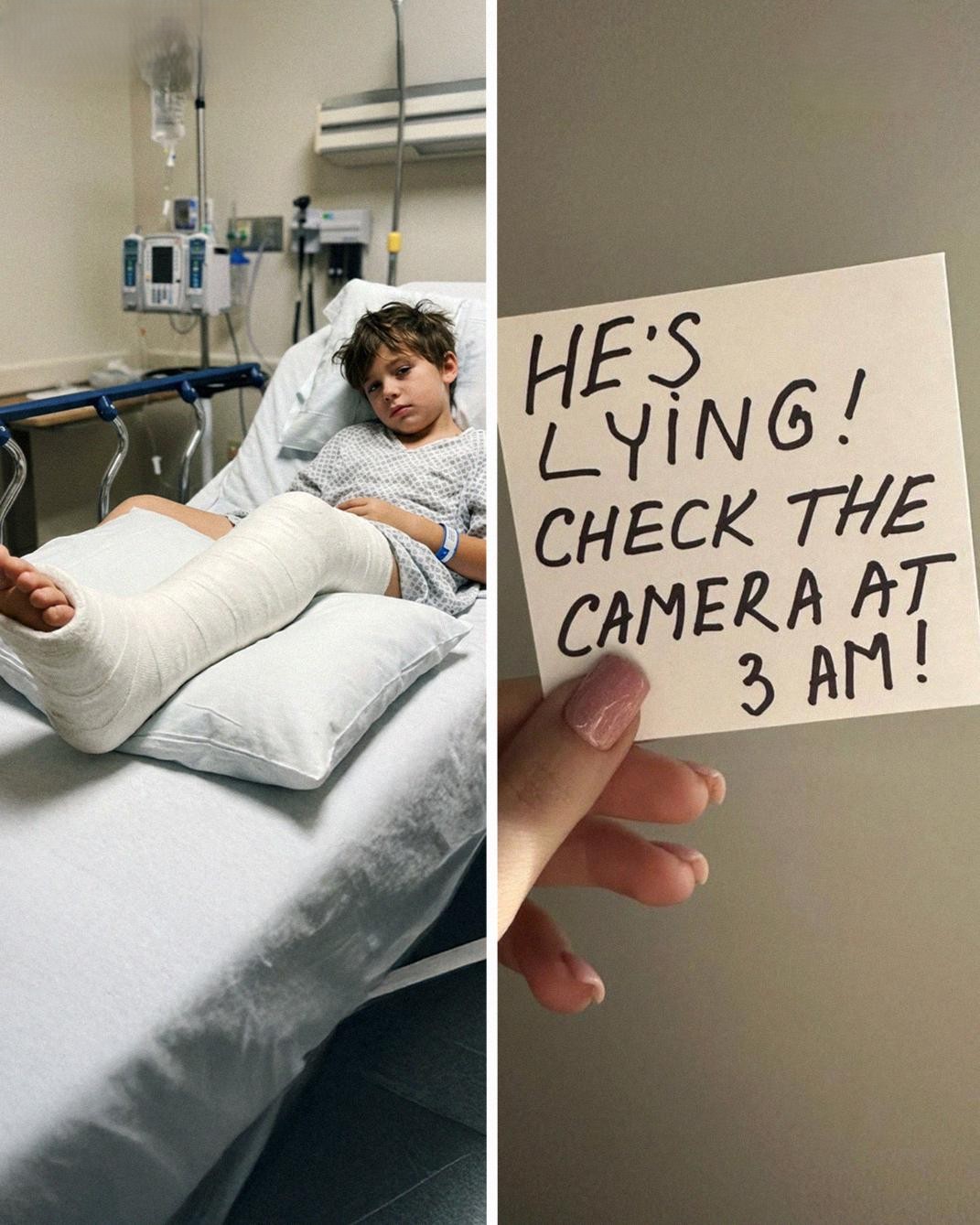
The drive to the hospital is a blur of red lights I barely registered and the frantic, cold sweat on my palms as I gripped the steering wheel. When I finally burst into the pediatric ward, the sight of him broke my heart. Howard looked impossibly small in the hospital bed, his slight frame swallowed by the sterile white sheets and the buzzing fluorescent lights. A bright blue fiberglass cast ran from his ankle to his knee, a stark, colorful weight on his thin leg.
“Hey, buddy,” I whispered, leaning down to press a kiss to his forehead. “You gave me a real scare.”
“I’m sorry, Mom,” he said, his eyes rimmed with red, refusing to meet my gaze.
“For what? Accidents happen, Howard.”
“For falling. For messing up.”
I frowned, sensing a strange undercurrent of shame that didn’t fit a simple tumble. “Were you trying those tricks again? The ones we talked about being careful with?”
“I told you,” Jasper interrupted, stepping forward from the corner of the room. “He just slipped. No tricks involved. I was standing right there on the driveway.”
Howard glanced briefly at his father, then immediately looked at the floor. It was a micro-expression—a flicker of hesitation—that set off every maternal alarm bell I possessed. Something about the narrative felt coached, but I swallowed my suspicions. This wasn’t the time or the place for a parental interrogation.
Later that night, a charge nurse entered the room. She was the embodiment of clinical grace—calm, efficient, with steady hands that moved with practiced ease as she checked Howard’s vitals and adjusted his blankets. As Jasper reached out to smooth Howard’s hair in a show of fatherly affection, I saw my son flinch. It was a tiny movement, almost imperceptible, but the nurse’s eyes sharpened. She saw it, too.
As she turned to leave, she brushed past me in the narrow space between the bed and the wall. Without breaking her stride or changing her expression, she pressed a small piece of paper into my palm. I waited until Jasper was distracted by his phone before I unfolded it. It was a yellow Post-it note with five words that turned my blood to ice: HE’S LYING. CHECK THE CAMERA AT 3 A.M.
My throat went bone-dry. I waited until the hallways grew quiet and Jasper had settled into the recliner to “doze.” At exactly 2:55 a.m., I slipped out and found the nurse at the station. “What does this mean?” I whispered, showing her the note.
Without looking up from her charts, she spoke in a low, steady tone. “We record all pediatric rooms for safety—audio and video. Go to the security office at the end of the hall. Channel 12. Watch what happened earlier.”
The security guard didn’t ask questions. He seemed to recognize the look of a mother who had just been handed a match in a dark room. He pulled up the feed from earlier that evening.
On the screen, Howard lay beneath the thin hospital blankets. The chair beside him—the one Jasper claimed to have occupied all night—was empty. At 3:00 a.m. sharp, the door opened. Jasper walked in, but he wasn’t alone. A woman followed him, a woman I didn’t recognize, closing the door softly behind them. Jasper was still wearing his coat; he hadn’t been in the hospital. He’d been out.
Howard stirred as the light hit his eyes. “Dad?”
Jasper pulled the chair close, adopting that same false, comforting tone I’d heard on the phone. “Hey, buddy. You okay?”
The woman, whom I would later find out was named Kelly, stood back against the wall, looking uncomfortable. “We need to make sure we’re telling the story right, Howard,” Jasper said, his voice dropping an octave.
“I told everyone I fell,” Howard whispered, his voice small and trembling.
“Right,” Jasper nodded quickly. “The scooter. I was outside, you slipped. That’s what we tell Mom. We have to, Howard. Your mom can’t know I wasn’t there when it happened. She’ll overreact, and it’ll turn into a whole thing. You don’t want to make things harder, do you?”
“But Dad… I don’t want to lie to Mom.”
I felt something fundamental crack inside my chest. To hear my ex-husband weaponize our son’s loyalty to cover his own negligence was a level of betrayal I wasn’t prepared for.
“But you just went to the store,” Howard continued, trying to make sense of the deception. “Kelly was there…”
Kelly stepped forward then, her voice defensive. “I was only inside for a second to get my phone, Howard. You were fine.”
“But I tried the curb jump,” Howard whispered. “You weren’t watching.”
Jasper waved it off dismissively. “It doesn’t matter. We stick to the story. Understand? It’s our secret.”
The feed cut to black as they left the room again. My son had been left alone in a hospital bed, not just with a broken bone, but with a lie far too heavy for a ten-year-old to carry. He had been coached to protect a father who hadn’t bothered to protect him.
By morning, the hospital’s social worker had reviewed the footage. The official report cited an “inconsistent statement” and the “coaching of a minor.” When I walked back into the room at 8 a.m., Jasper was sitting in the chair, looking for all the world like the devoted parent.
“Get some sleep?” he asked.
“I know everything, Jasper,” I said, my voice devoid of the “agreeable” tone I had spent years perfecting. “I watched the footage. I know you weren’t there. I know about Kelly. And I know you told our son to lie to me.”
His face drained of color, then flushed with a defensive anger. “It was ten minutes! You’re acting like I left him in the middle of a highway.”
“You left him alone, he got hurt, and then you made him carry the guilt for it,” I said. “That is what you don’t get to minimize.”
The legal battle that followed was grueling, but for the first time, I didn’t care about being the “difficult” ex-wife. I realized that my desire to keep the peace had inadvertently created a space where my son wasn’t safe. Being vigilant wasn’t “crazy”—it was necessary.
A month later, as we left the hospital after Howard’s final check-up, he stopped halfway to the car. He still had a slight limp, but the haunted look in his eyes had vanished. “Mom?”
“Yeah, honey?”
“I don’t like keeping secrets. It makes my tummy hurt.”
I knelt down on the pavement, ignoring the damp ground, and held his face between my hands. “You don’t ever have to keep a secret like that again. Not for your dad, not for me, not for anyone. The truth is always safe with me.”
He nodded, a massive weight visibly lifting from his shoulders. As I watched him in the rearview mirror on the drive home, I saw him looking out the window, finally at peace. The truth had been ugly, and it had dismantled the last remnants of the relationship I had with his father, but it had saved my son. And that was a trade I would make every single time.