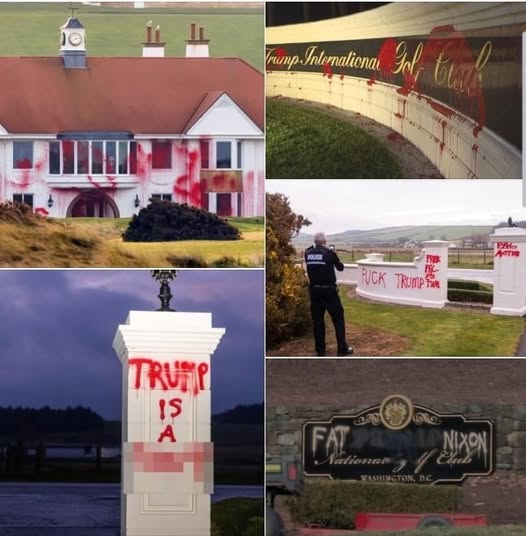
The rugged, wind-swept coastline of Ayrshire, Scotland, has long been home to the iconic Trump Turnberry resort, a bastion of luxury and high-stakes golf that often serves as a lightning rod for international political sentiment. This week, the serene landscape was jarred by an act of targeted aggression as the estate fell victim to a significant incident of vandalism. Under the cover of a pitch-black Scottish night, unidentified individuals descended upon the property, leaving behind a trail of crimson paint and provocative graffiti that has sparked an intensive investigation by Police Scotland and reignited a global conversation about the intersection of private property and political dissent.
The discovery was made in the early hours of a damp February morning when staff arrived to find the grand, white-washed exterior of the historic hotel and several outbuildings defaced. The vandals did not stop at the architecture; prominent entrance features and stone signage that welcome international guests to the legendary Ailsa course were similarly targeted. The imagery, which quickly migrated from the stone walls to the digital screens of millions, showed a stark contrast between the pristine, high-end aesthetic of the resort and the raw, visceral nature of the red paint. For supporters of the former U.S. President, the act was a cowardly desecration of a local landmark and economic engine; for critics, it was a symbolic manifestation of the deep-seated tensions that follow the Trump brand wherever it anchors itself.
Police Scotland acted with immediate urgency, cordoning off the affected areas to allow forensic teams to begin the painstaking process of evidence collection. Officers have been seen scouring the grounds for discarded canisters or physical clues, while a specialized digital task force has begun the arduous task of reviewing hundreds of hours of CCTV footage. The estate, known for its high-level security protocols, is equipped with a comprehensive network of cameras, but the sprawling nature of the coastal grounds offers numerous points of entry for those determined to avoid detection. Authorities are currently treating the incident as a serious case of criminal damage, though they have stopped short of officially labeling it a political hate crime until the specific nature of the graffiti is fully analyzed and suspects are brought into custody.
The Turnberry resort occupies a unique space in the Scottish consciousness. On one hand, it is a vital employer in the South Ayrshire region, providing hundreds of jobs and funneling significant tourism revenue into the local economy. On the other hand, it has remained a focal point of controversy since Donald Trump purchased the property in 2014. From the disputes over environmental impact to the massive protests that greeted his official visits during his presidency, the resort has never been just a hotel. It is a physical manifestation of a political ideology, making it a recurring target for those who wish to strike at the Trump legacy on international soil. This latest incident is perhaps the most brazen physical breach the property has seen in years, suggesting a heightening of local or perhaps coordinated international tensions.
The timing of the vandalism is particularly noteworthy, occurring against a backdrop of shifting geopolitical alliances and renewed domestic debates within the United Kingdom and the United States. While the specific slogans sprayed across the walls have been partially obscured by the estate’s management during the initial cleanup phase, witnesses suggest the messaging was rooted in contemporary social and political grievances. Investigators are looking into whether the act was timed to coincide with specific legislative movements or international announcements, searching for a pattern that might lead them to a specific activist group or a lone wolf perpetrator.
As the forensic teams work, the management of Trump Turnberry has moved into a phase of rapid restoration. Specialized contractors were brought in within hours to begin the delicate process of removing the paint without damaging the historic masonry of the century-old buildings. The goal is to return the resort to its five-star standards as quickly as possible, ensuring that the visual evidence of the attack is erased before the spring golf season reaches its peak. However, while the paint can be washed away, the security implications of the breach are likely to have a more permanent impact. The incident has prompted an immediate and thorough review of the resort’s perimeter defenses, with discussions underway regarding the implementation of more advanced motion-sensing technology and increased night patrols.
The public reaction has been as polarized as the political climate itself. In the local community, there is a palpable sense of frustration; many residents, regardless of their personal politics, view the vandalism as an attack on their own backyard and a threat to the stability of a major local employer. Social media, however, has served as a chaotic forum for a much broader debate. Some users have characterized the vandalism as a form of “guerrilla art” or a necessary expression of resistance, while others have called for the full weight of the law to be brought down on the perpetrators, arguing that such acts only serve to undermine peaceful democratic processes.
This incident at Turnberry also highlights the broader challenges faced by high-profile, politically-linked properties in an era of intense social volatility. From Mar-a-Lago in Florida to the Trump Tower in New York and the various international holdings in the Trump portfolio, these locations are no longer seen by the public as mere businesses. They are perceived as extensions of a political figure, and as such, they are increasingly vulnerable to the spillover of political anger. The Scottish authorities are acutely aware that their handling of this case is being watched on a global stage, as it touches upon sensitive issues of diplomatic security and the protection of foreign investment.
As the sun sets over the Firth of Clyde, the red paint may be fading under the pressure of the cleanup crews, but the questions raised by the incident remain vivid. Police Scotland continues to urge anyone who was in the vicinity of the A719 or the Turnberry coast on the night of the attack to come forward with dashcam footage or observations of suspicious activity. The search for the vandals is not just about holding individuals accountable for property damage; it is about understanding the motivations behind a crime that targeted one of the most visible symbols of American influence in the United Kingdom.
Ultimately, the defacing of the Turnberry mansion is a reminder that in 2026, the boundaries between the private sector and public policy have largely dissolved. A luxury golf resort can become a canvas for protest in a matter of minutes, turning a quiet Ayrshire evening into a subject of international news. While the estate works to project an image of “business as usual,” the scars of the vandalism serve as a stark reminder of the deep divisions that continue to define the current era. The investigation remains ongoing, and as the forensic evidence is processed, the world waits to see if this was a random act of mischief or a calculated opening salvo in a new chapter of political unrest.