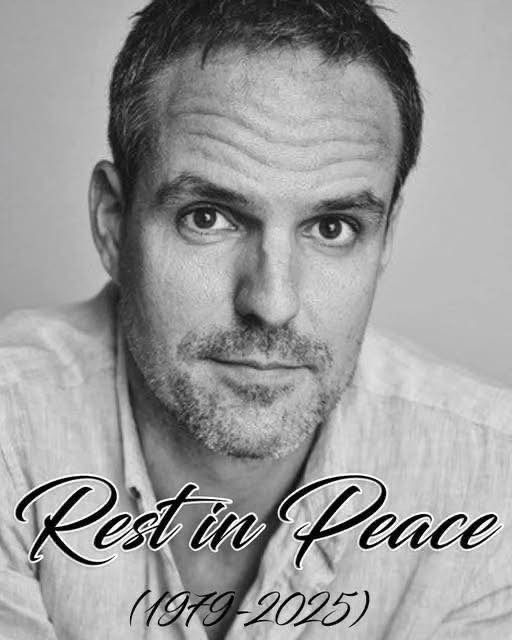
The world of musical theater is mourning the loss of a titan whose voice once filled the grandest halls of London and Sydney, but whose greatest performance was found in the quiet, grueling devotion he showed behind the scenes. Ben Lewis, the Australian-born baritone who redefined the role of the Phantom for a new generation, has passed away at the age of 46. His death follows a courageous and public battle with bowel cancer, a diagnosis that cut short a brilliant career and silenced a man known as much for his immense character as for his staggering vocal range.
Ben Lewis was a man born into the marrow of the arts. The son of classically trained opera singers, he was raised in an environment where music was the primary language. He honed his craft at the prestigious Royal College of Music in London and the Western Australian Academy of Performing Arts, developing a technique that was both technically flawless and emotionally raw. His early years on the Australian stage saw him tackle diverse roles in productions like Urinetown, A Little Night Music, and Priscilla, Queen of the Desert. However, it was his transformation into the masked protagonist of Andrew Lloyd Webber’s universe that would cement his legacy.
In 2011, Lewis took on the Herculean task of originating the role of the Phantom in the Australian production of Love Never Dies, the sequel to the legendary Phantom of the Opera. It was a role that required a rare combination of vulnerability and menace, and Lewis delivered a performance that won him the Judith Johnson Award for Best Actor in a Leading Role. His portrayal was so definitive that Universal filmed the production for a global audience, ensuring that his interpretation of the character would be preserved forever. Years later, he would bring that same gravitas to the West End, haunting Her Majesty’s Theatre in London during the 2017 and 2018 seasons.
The news of his passing was confirmed by his close friend and Australian television personality Todd Woodbridge, who took to social media to pay tribute to a man he described as “one of the greats.” Woodbridge’s words painted a picture of Lewis that went far beyond the spotlight. He spoke of a man who was funny, deeply caring, and a tireless mentor to younger performers. He reminisced about shared holidays in Scotland and quiet moments in dressing rooms, highlighting a life lived with a richness that no stage credit could fully capture. For those who worked alongside him, Ben Lewis was the anchor of the company—a professional who led by example and treated every member of the crew with the same respect he afforded his directors.
However, the final years of Ben Lewis’s life were defined by a tragedy that tested the very limits of human endurance. In 2021, his wife, the talented actress Melle Stewart, suffered a catastrophic stroke at the age of 40. The medical emergency was later linked to the Oxford-AstraZeneca COVID-19 vaccine, a rare but life-altering complication that left her hospitalized for nine months and facing a permanent disability. In an instant, the West End star shifted roles, becoming Melle’s primary caregiver. He stepped away from the glitz of the theater to dedicate himself to her grueling rehabilitation, proving that the love he sang about on stage was something he practiced with ironclad resolve in his private life.
The cruelty of fate struck again in February 2024, when Ben was diagnosed with bowel cancer. What initially seemed like a hurdle to be cleared through surgery and chemotherapy soon evolved into a terminal prognosis. Despite a successful operation to remove the primary tumor and an aggressive regimen of treatment, the cancer proved to be exceptionally resilient. By April, scans revealed that the disease had metastasized to his liver, lungs, and pelvis. The tumors were too numerous for further surgical intervention or radiation, leaving him with a diagnosis that was declared incurable.
Even as his own body failed him, Lewis’s primary concern remained the well-being of his wife. A GoFundMe page, established to provide financial security for Melle and to assist with Ben’s soaring medical costs, became a testament to the community’s love for the couple. It chronicled Ben’s “determination and resilience,” noting that even in the face of an aggressive illness, his spirit remained unbroken. He faced his mortality with the same grace he brought to his curtain calls, ensuring that his final months were spent surrounded by the people and the music that had defined his existence.
The loss of Ben Lewis is felt deeply across two continents. In London, the lights of the West End seem a bit dimmer without the resonance of his baritone; in Australia, the theater community has lost a brother and a pioneer. His journey was one of immense highs and devastating lows, yet he navigated both with a dignity that inspired everyone who crossed his path. He was a man who understood the power of a story, and though his own story has ended far too soon, the chapters he wrote on the stage will continue to be read and admired for decades to come.
As the theater world reflects on his life, the focus remains on his legacy of kindness. Beyond the awards and the standing ovations, Ben Lewis left behind a blueprint for how to be a “great human.” His devotion to Melle, his mentorship of young actors, and his bravery in the face of a terminal diagnosis provide a narrative of strength that transcends the arts. He showed that while a voice can fill a theater, a soul like his can fill the hearts of everyone who heard him sing.
Ben is survived by his wife, Melle, and an extended family of performers and friends who continue to champion his memory. The “Phantom” has finally found his peace, leaving the mask behind but taking the love of thousands with him. In the end, Ben Lewis proved that while fame is fleeting and health is fragile, the impact of a life well-lived and a person well-loved is truly immortal. His voice may have fallen silent, but the echoes of his talent and his heart will linger in the rafters of the theaters he loved, reminding us all that even in the face of the most tragic endings, the music of a beautiful life never truly dies.