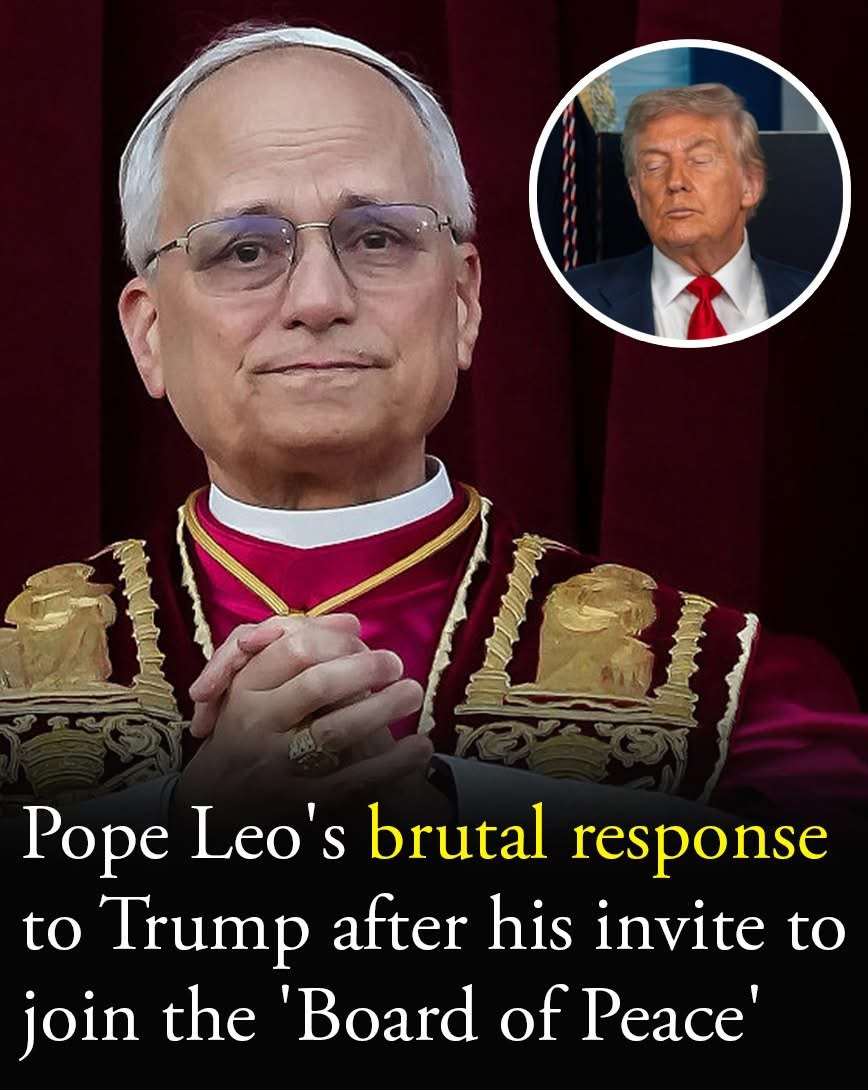
There has been no official record that Donald Trump established a body known as the “Board of Peace” requiring $1 billion for permanent membership. No credible government release, multilateral institution statement, or major international outlet has confirmed such a structure. Similarly, there is no current pope named “Pope Leo.” The present pontiff is Pope Francis, and the Vatican has not issued any statement declining participation in such an initiative.
Given this, it is important to clarify the facts while also understanding the broader context of how the Vatican approaches global peace efforts. The Holy See has long positioned itself as a moral and diplomatic voice on issues such as war, human rights, migration, and humanitarian crises. Rather than joining exclusive coalitions led by a single nation, the Vatican historically supports multilateral institutions such as the United Nations, where it holds Permanent Observer status.
Pope Francis has consistently emphasized that lasting peace requires multilateral cooperation, respect for international law, protection of civilians, and dialogue over unilateral action. If any government were to propose a new peace initiative outside established international systems, the Vatican would carefully evaluate whether participation aligned with its principles of neutrality, inclusivity, and global cooperation.
The Vatican’s Diplomatic Tradition
The Holy See maintains diplomatic relations with more than 180 countries and regularly participates in international discussions through its diplomatic leadership, including the Secretary of State. Historically, the Vatican has supported peace initiatives by offering mediation, hosting interfaith dialogue, advocating ceasefires, and promoting humanitarian assistance.
However, the Vatican generally avoids aligning itself too closely with initiatives led exclusively by one government, as doing so could compromise its neutrality. The Catholic Church operates globally, across diverse political systems, and its diplomatic approach reflects a commitment to universality rather than alignment with individual national agendas.
Global Conflicts and Peace Advocacy
In ongoing global conflicts, including those in the Middle East, the Vatican has repeatedly called for ceasefires, humanitarian corridors, and protection of civilians. It encourages solutions facilitated through established international mechanisms such as the United Nations and regional diplomatic channels.
Peace initiatives that require significant financial contributions or are controlled by a single country would likely be carefully examined by the Vatican to ensure fairness, legitimacy, and inclusiveness.
U.S.–Vatican Relations
Diplomatic relations between the United States and the Vatican have existed for decades, and interactions between American presidents and the pope are common. During Trump’s first term, he met Pope Francis to discuss issues such as migration, religious freedom, and global peace. However, differences in policy priorities have sometimes highlighted contrasting perspectives, particularly on immigration and humanitarian concerns.
The Vatican’s diplomatic decisions are guided by Catholic social teaching, which emphasizes solidarity, human dignity, and the common good. These principles shape how it evaluates international proposals and peace initiatives.
The Importance of Verification
The article emphasizes the importance of verifying information before accepting or sharing dramatic claims. Narratives suggesting strong or confrontational responses from the Vatican should be carefully examined, as official Vatican communications are typically measured and diplomatic in tone.
Conclusion
There is no verified evidence that Donald Trump created a “Board of Peace,” nor that a pope named “Pope Leo” declined an invitation to join such a body. The current leader of the Catholic Church is Pope Francis, and no official Vatican statement supports these claims. The Vatican continues to support peace initiatives primarily through established international institutions and emphasizes dialogue, neutrality, and humanitarian principles.