The Seattle Seahawks walked away from Super Bowl Sunday with a decisive 29–13 win over the New England Patriots at Levi’s Stadium. But while the game settled one competition on the field, a much louder and messier one unfolded off it.
This year’s Super Bowl halftime became something more than a musical break. It turned into a cultural split-screen, with two rival productions vying for attention, meaning, and online dominance.
On the NFL’s official stage, global pop star Bad Bunny delivered the league’s sanctioned halftime show. Running parallel to it, Turning Point USA launched a livestreamed alternative branded as the “All-American Halftime Show,” pitching itself as a counterweight to what organizers described as a mainstream entertainment culture that no longer represents their audience.
The result was not just two shows, but two versions of America playing out in real time.
The alternative event, backed by conservative donors and promoted heavily online in the days leading up to the game, featured a lineup aimed squarely at country and rock fans. Performers included Brantley Gilbert, Lee Brice, and Gabby Barrett, artists with solid followings but little presence in the NFL’s modern halftime ecosystem.
The show was marketed as unapologetically patriotic, traditional, and resistant to what organizers framed as political messaging in popular culture. It promised straightforward music, familiar aesthetics, and performers who aligned more closely with its audience’s values.
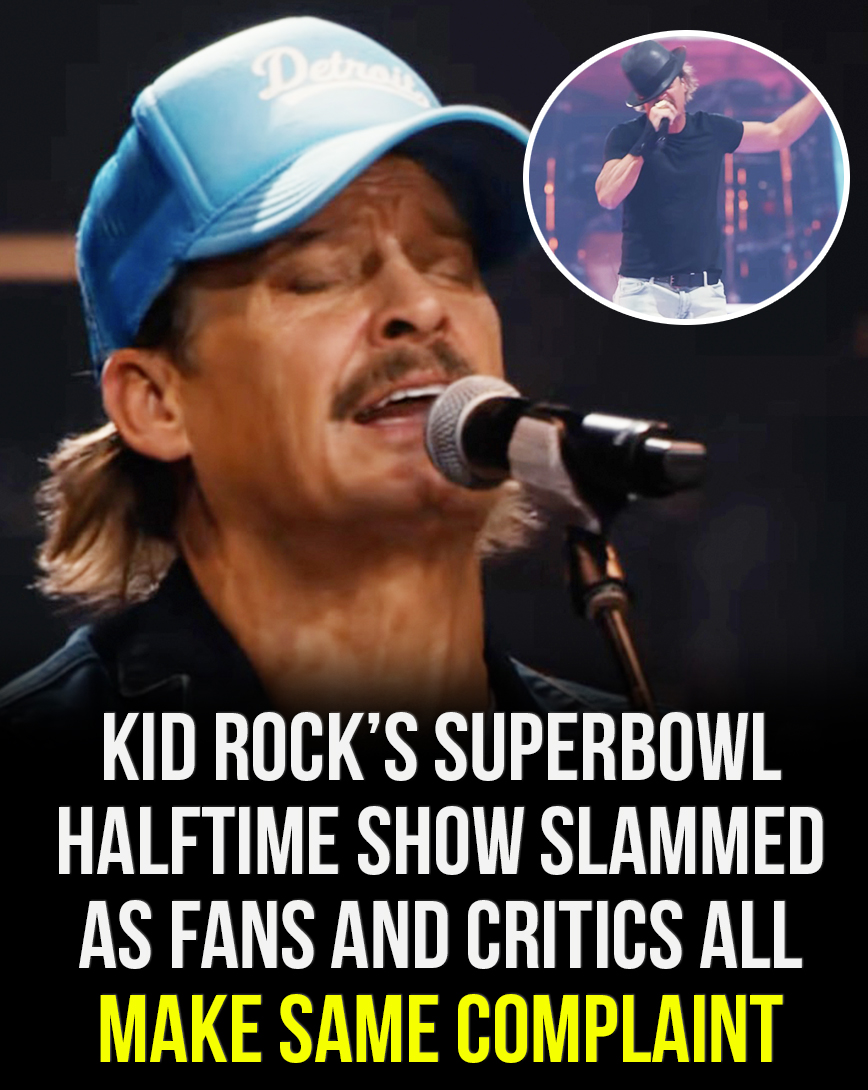
Closing the livestream was Kid Rock, a choice that immediately drew attention and controversy. At 55, the musician remains a lightning rod—embraced by supporters as a rebel outsider and criticized by detractors as a relic whose shock value long ago outpaced his relevance.
Almost as soon as his performance began, the internet reacted.
Viewers across social media platforms began questioning whether Kid Rock was actually singing live. Accusations of lip-syncing spread rapidly, with clips circulating that appeared to show his vocals continuing even when his microphone was lowered or dropped. Others pointed out moments where the timing between his mouth movements and the audio seemed off.
Some viewers speculated that the issue could have been related to livestream delays or technical glitches. Others were less charitable, calling the performance staged, edited, or outright fake.
The length of the segment also became a target. Several commenters joked that the performance felt abruptly cut short, lasting barely more than a minute before transitioning away. The staging was described as awkward, the energy uneven, and the execution lacking the polish expected of a headline act.
What was meant to be a triumphant closing moment quickly became the most mocked portion of the entire alternative broadcast.
As criticism mounted, old controversies resurfaced.
Lyrics from Kid Rock’s 2001 song “Cool, Daddy Cool” began circulating widely, drawing renewed scrutiny for references to underage girls. The resurfacing wasn’t accidental; critics framed the lyrics as evidence of a long-standing pattern that made his selection as a centerpiece performer especially questionable.
At the same time, a clip from a 2001 appearance on Saturday Night Live began trending again. In it, Kid Rock made remarks about Mary-Kate and Ashley Olsen while they were still teenagers. The comments were condemned at the time and reignited backlash more than two decades later.
For critics of the All-American Halftime Show, the resurfaced material reinforced their argument that the event wasn’t just offering a musical alternative, but doubling down on figures and attitudes they view as outdated or inappropriate.
Turning Point USA did not immediately respond to the renewed criticism, and Kid Rock himself remained silent as clips and commentary continued to spread.
Still, the reaction was far from one-sided.
Supporters pushed back against the mockery, arguing that the criticism was politically motivated rather than performance-based. Many praised the inclusion of Kid Rock’s hit “Bawitdaba,” describing it as a nostalgic crowd-pleaser that delivered exactly what the audience wanted.
Others defended the All-American Halftime Show more broadly, saying it succeeded in creating space for viewers who feel alienated by mainstream entertainment. They praised the focus on country and rock, the absence of overt social messaging, and the decision to offer an alternative rather than complain about the NFL’s choices.
According to early reports, the livestream peaked at roughly five million concurrent viewers, a significant number for an independently produced online broadcast. Viewership dipped slightly during Kid Rock’s segment but rebounded afterward. By the time the archived stream settled on YouTube, it had surpassed 18 million total views.
Those numbers became a talking point of their own, with supporters citing them as proof of demand and critics questioning how much of the traffic was driven by controversy rather than enthusiasm.
Meanwhile, Bad Bunny’s official halftime show followed a familiar NFL formula: high production value, elaborate choreography, global appeal, and a celebration of Latin pop culture. Predictably, it drew its own share of criticism from fans who complained it didn’t align with their musical tastes.
Taken together, the reactions to both shows revealed something deeper than differing opinions about music.
They exposed a widening gap in how audiences experience shared cultural moments.
The Super Bowl halftime show was once a near-universal reference point, watched and debated by a largely unified audience. This year, viewers didn’t just disagree about whether the show was good or bad. Many watched entirely different shows, consumed through different platforms, framed by entirely different narratives.
Entertainment has become fragmented along ideological lines, and Super Bowl Sunday offered a clear snapshot of that reality.
For some, Bad Bunny represented the present and future of American pop culture: global, multilingual, and unapologetically modern. For others, the All-American Halftime Show represented resistance to that shift, an attempt to preserve a version of culture they feel is slipping away.
Neither side watched passively. Both reacted loudly, instantly, and with the confidence that their version was the one that mattered.
In the end, the Seahawks’ victory may fade into the record books, but the dual halftime shows will be remembered as a moment when entertainment stopped pretending to be neutral.
This year, halftime didn’t just entertain. It took sides—whether intentionally or not—and millions of viewers chose exactly which side they wanted to see.