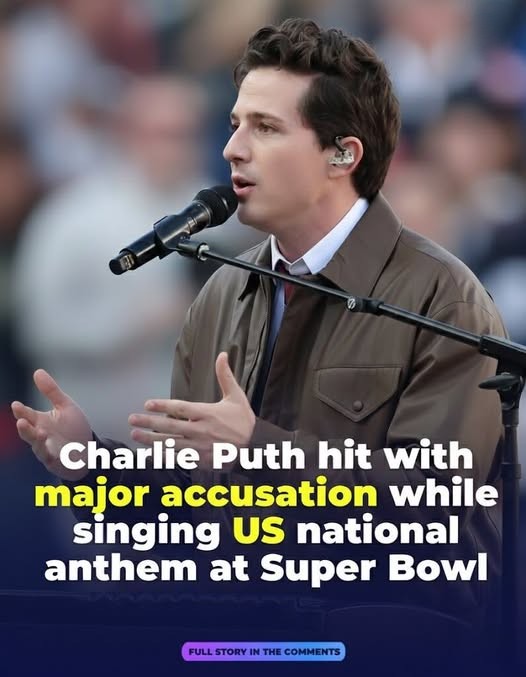
Charlie Puth stepped onto the field at Super Bowl LX carrying a burden few performers ever truly understand. Singing the U.S. national anthem is not just another gig. It is a cultural ritual, a moment treated as sacred by some, scrutinized by others, and judged relentlessly by millions watching in real time. There is no choreography to distract, no band to share the weight, no spectacle to hide behind. Just a microphone, a stadium, and expectations that are almost impossible to satisfy.
For Charlie Puth, the stakes were especially high. Known for his technical precision, perfect pitch, and meticulous approach to music, he is an artist whose strengths lie in control and accuracy. On paper, that should make him an ideal choice for an anthem performance. In reality, it placed him directly in the crosshairs of a modern audience that has grown deeply suspicious of anything that sounds too good.
From the opening notes, Puth delivered a version of the anthem that was calm, restrained, and technically flawless. His pitch was unwavering. His phrasing was clean. The transitions between notes were smooth and confident. The performance lacked showmanship by design, favoring respect and clarity over vocal gymnastics. It was exactly what the anthem traditionally demands.
And that, oddly enough, was the problem.
Almost immediately, social media lit up with accusations. Clips of the performance were reposted, slowed down, zoomed in on. Comment sections filled with claims that the vocals were pre-recorded or supported by a backing track. The word “lip-syncing” trended alongside his name, with viewers insisting that the sound was too pristine to be real in a live stadium environment.
The irony was hard to miss. Puth is one of the few mainstream pop artists whose musical abilities make such precision entirely plausible. He has built a reputation on his ear for detail, often showcasing his ability to identify and recreate notes instantly. Yet in an era saturated with auto-tune, pitch correction, and studio manipulation, technical excellence has become suspect. To many viewers, perfection no longer signals skill. It signals deception.
The timing didn’t help. Super Bowl LX unfolded in a cultural atmosphere already primed for controversy. The halftime show, led by Bad Bunny, had ignited familiar debates about representation, genre, and who the event is “for.” Elsewhere in the night, Green Day drew their own wave of reactions, praised by some for raw energy and criticized by others for being out of step with the moment.
By the time Puth appeared, audiences were no longer passive listeners. They were alert, divided, and ready to judge. Every performance that night was filtered through a lens of cultural tension rather than musical appreciation.
As the anthem concluded, the debate overshadowed the moment itself. Instead of discussing tone, interpretation, or emotional impact, the conversation fixated on authenticity. Viewers treated the performance less like music and more like evidence, combing through it for signs of manipulation.
No credible proof ever emerged to support the accusations. Audio engineers and musicians were quick to point out that live broadcast compression, microphone quality, and stadium acoustics can significantly alter how a performance sounds on television. What reaches viewers at home is not raw audio but a heavily processed feed designed to balance crowd noise, wind, and environmental interference.
Still, the suspicion lingered.
The backlash revealed something deeper than dissatisfaction with one performance. It exposed a cultural contradiction performers now face. Audiences claim to want excellence, but react with distrust when they receive it. Flaws are praised as “real.” Precision is treated as artificial. In this environment, artists are punished both ways: criticized for mistakes and doubted for mastery.
The national anthem, more than almost any other song, magnifies this tension. It is unforgiving in structure, exposed in delivery, and emotionally loaded. Singers are expected to honor tradition while still making the performance their own, to sound powerful but not indulgent, expressive but not self-centered. Deviate too far in either direction and backlash is guaranteed.
Puth’s decision to deliver a restrained, technically clean rendition placed him squarely in the line of fire. Had he cracked a note, critics would have called it sloppy. Because he didn’t, they called it fake.
The episode also highlights how modern audiences consume live events. Performances are no longer fleeting moments meant to be felt and then remembered. They are digital artifacts, endlessly replayed, paused, and analyzed. A three-minute song becomes hours of debate, stripped of context and dissected for perceived inconsistencies.
In that environment, trust erodes quickly. The assumption is no longer that artists are performing live unless proven otherwise. It is the reverse. Authenticity must now be defended, not assumed.
For Puth, the controversy eventually faded, absorbed into the broader swirl of Super Bowl discourse. He did not publicly escalate the debate, nor did organizers suggest any impropriety. Official broadcasts treated the performance as live, and no follow-up corrections were issued.
Yet the moment lingered as a quiet symbol of where live music now stands.
Super Bowl LX was not short on spectacle, talent, or technical achievement. But it also revealed how fractured audience expectations have become. One artist is criticized for excess, another for restraint. One is accused of being too political, another of being too polished. The common thread is distrust.
The backlash against Charlie Puth’s anthem performance was less about him and more about a cultural climate that struggles to believe in excellence without a catch. In a world saturated with digital enhancement, sincerity is measured not by quality but by visible imperfection.
That may be the most uncomfortable takeaway of the night. Not that a singer was accused unfairly, but that doing something well has become grounds for suspicion.
In the end, Puth stood alone on the field, sang the anthem with precision and respect, and walked off to applause and controversy in equal measure. Whether history remembers the performance itself or the reaction to it says more about the audience than the artist.