In the polarized theater of modern American life, silence is a rare commodity, and verbal restraint is rarer still. For years, the professional relationship between Donald Trump and Savannah Guthrie was defined by high-stakes tension, televised sparring matches, and the sharp-edged friction inherent in the collision of a populist leader and a seasoned journalist. Yet, when the news cycle pivoted from political theater to a visceral human tragedy—the disappearance of Guthrie’s eighty-four-year-old mother, Nancy—the world witnessed a rare moment where the noise of partisanship fell away, replaced by the somber gravity of shared humanity.
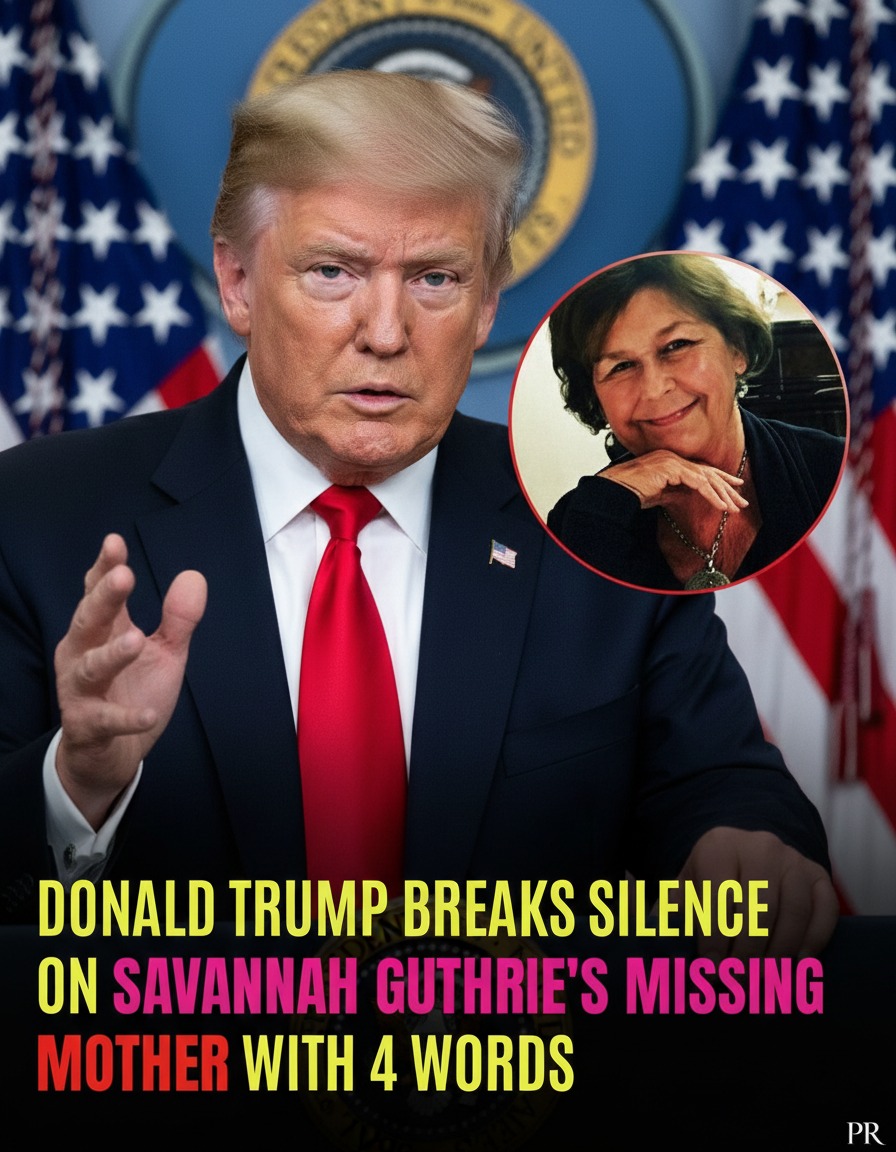
When asked by a reporter for his thoughts on the ongoing investigation in Tucson, Trump did not reach for his usual arsenal of expansive adjectives or political counter-attacks. Instead, he offered four words that resonated with a stark, quiet power: “Very sad. Very troubling.”
For a public accustomed to his lengthy rallies and unfiltered social media presence, this brevity was a message in itself. There was no redirection, no attempt to settle old scores, and no insertion of a political agenda. The restraint suggested an acknowledgment of a situation so grave that grandiosity would have been an affront to the family’s suffering. In those four words, the former president pivoted from being a political figure to a witness of a tragedy that transcends the boundaries of red and blue states.
The disappearance of Nancy Guthrie has gripped the nation since early February, evolving from a local missing-person alert into a high-intensity federal investigation. Nancy, described by those who knew her as a woman of routine and quiet dignity, vanished from her home in the Tucson area under circumstances that immediately alarmed authorities. The desert terrain surrounding her residence is unforgiving, yet an exhaustive search involving hundreds of volunteers, K-9 units, and thermal imaging drones yielded no evidence of her walking away on her own. The investigation rapidly moved past the possibility of a medical wandering; it became clear that her absence was involuntary.
As the days turned into weeks, the FBI intervened, offering a $50,000 reward for information leading to her recovery. The case took a darker turn with reports of ransom-related communications, some of which were dismissed as cruel hoaxes perpetrated by digital predators, while others remain under the meticulous scrutiny of federal forensic analysts. Throughout this agonizing process, Savannah Guthrie has remained a figure of quiet, desperate strength, using her platform not to demand celebrity treatment, but to beg for a shred of truth in a landscape of terrifying uncertainty.
The resonance of Trump’s comment lies largely in the context of the history between the two individuals. Many observers recalled the 2020 town hall event where Guthrie’s rigorous questioning of Trump became a flashpoint for media debate. Given that history, many expected either a stony silence or a comment laden with subtext. By choosing a path of simple empathy, Trump inadvertently highlighted a fundamental truth: there are some weights too heavy for politics to carry. The “humanity of the moment” became the headline, signaling that even in an age of deep division, the abduction of an elderly mother is a horror that silences the roar of the arena.
The public reaction to the four-word statement was, predictably, a microcosm of the national mood. On social media, the debate flickered briefly between those who praised the tone as a necessary show of respect and those who analyzed it through a lens of strategic calculation. However, these debates felt increasingly secondary as the reality of the situation took center depth. Whether the comment was a moment of genuine reflection or a masterclass in situational restraint, the result was the same: it kept the focus where it belonged—on Nancy Guthrie and the harrowing void her absence has left behind.
In many ways, the investigation in Arizona has become a test of the nation’s ability to handle a high-profile tragedy without succumbing to the toxic lure of speculation. Law enforcement officials have repeatedly urged the public to refrain from “online sleuthing,” which often results in the harassment of innocent parties and the clogging of tip lines with unverified rumors. The sheriff’s department emphasized that while no one—including family members—can be formally cleared until a case is closed, the focus remains on following the forensic trail left by the suspects who disrupted Nancy’s peace. The investigation is a methodical, grinding process, one that requires a level of patience that is difficult for a digital audience to maintain.
Behind the updates and the police briefings is a family living in the “space between.” It is a landscape defined by the ringing of a phone that brings no news and the rising of a sun that illuminates an empty chair at the breakfast table. Savannah Guthrie’s occasional public statements, delivered with the raw vulnerability of a daughter in pain, have reminded the public that the “prominent media figure” is, first and foremost, a person whose world has been upended. The four words offered by Trump—”Very sad. Very troubling”—echoed the sentiment of a million other Americans who have watched this story unfold with a sense of helpless dread.
There is a moral lesson embedded in this brief interaction. In an era where every event is commodified for content and every tragedy is mined for political leverage, the choice to say less can be an act of profound respect. Not every serious situation requires a deep dive into policy or a reminder of past grievances. Sometimes, the most honest response to the unthinkable is to simply name it. By calling the situation “troubling,” Trump acknowledged the violation of safety and the breach of the social contract that occurs when a vulnerable person is taken from their home.
As the search for Nancy Guthrie continues, the focus remains on the pursuit of proof of life and the hope for a safe return. The investigation has transitioned into a complex game of forensic chess, with authorities working to outmaneuver a suspect who has managed to evade capture despite the national spotlight. The breakthrough earlier this week—the identification of a primary suspect—has brought a new intensity to the manhunt, turning the desert into a theater of tactical pursuit.
Ultimately, the four words from Donald Trump did not find Nancy Guthrie, nor did they provide a roadmap for the FBI. But they served as a brief, significant ceasefire in the cultural wars. They reminded a divided public that beneath the layers of professional titles, political affiliations, and public personas, there is a shared vulnerability to loss. As the Guthrie family continues their long watch, they do so with the awareness that the entire country—regardless of how they feel about the news or the people who report it—is looking toward Arizona, waiting for the moment when the silence of the desert is finally broken by the truth. Until then, the four words remain an apt summary of a nation’s collective concern: it is indeed very sad, and it is undeniably very troubling.