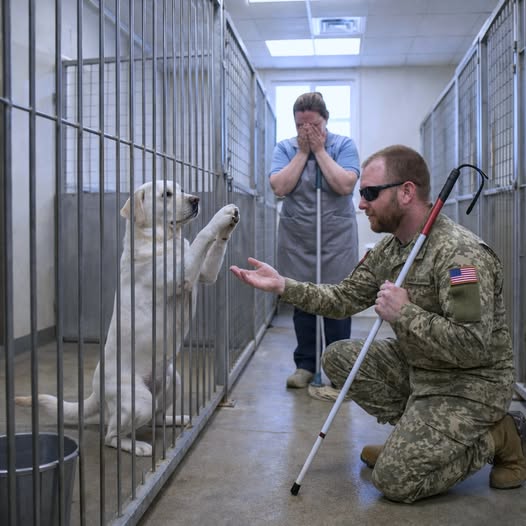
The rhythmic, hollow tapping of a white cane against the linoleum floor announced Ethan Walker’s arrival long before he stepped into the light of the intake lobby. He moved with the deliberate, cautious fluidity of a man who had spent the last three years navigating a world of absolute shadows. His left hand trailed lightly along the cool plaster of the wall—a grounding anchor—while his right hand gripped the cane, his primary lifeline in the void.
Ethan was a decorated veteran, a former Army sergeant who had survived ambushes, night raids, and the concussive, chaotic deafness of explosions. Yet, walking into the Canine Rehabilitation and Adoption Center felt heavier than any patrol he had ever led. The air here was a thick, complex cocktail of industrial disinfectant, cold metal, and the unmistakable, earthy musk of wet fur. It hit him in a wave, signaling that he had reached the front lines of a different kind of war: the battle against his own isolation.
His heart hammered against his ribs, a frantic thudding that seemed louder than his heavy boots on the polished floor. He wasn’t here to fight an enemy. He was here to battle the crushing silence that had followed him home from the desert—the emptiness that sat in the corner of his living room like a permanent, unwanted guest.
“Mr. Walker?” A woman’s voice broke his concentration. It was warm, steady, and approached from his two o’clock. “You made it. Welcome.”
Ethan halted, shifting his weight. He offered a faint, practiced smile. “Please, just call me Ethan.”
“I’m Karen,” she replied. “I’ll be guiding you through the evaluation. We have several calm, well-trained service dogs ready for pairing. Goldens, Labs—exceptional animals specifically bred for guidance.”
Ethan’s fingers tightened around the rubber grip of his cane. “I’m not looking for perfect,” he murmured, his voice rough with disuse. “Just someone who understands what it’s like to lose the light.”
As Karen led him deeper into the facility, the ambient noise shifted. The muffled sounds of barks grew sharper, bouncing off steel doors and concrete floors in a chaotic symphony. Ethan didn’t just hear the noise; he dissected it. He cataloged every yip and howl through the filter of his own trauma. He heard fear, agitation, and a profound, echoing loneliness.
Suddenly, a sharp, jagged snarl ripped through the hallway, shattering the atmosphere. It was followed by a barking so explosive, so full of concussive force, that Ethan could feel the vibrations traveling through the soles of his boots. Karen stopped dead in her tracks, her breath hitching.
“Let’s keep moving,” she said, her voice pitching up with nervousness. “That is Thor. He’s one of our more… difficult cases. A retired police canine with severe behavioral issues. He’s in permanent isolation.”
Ethan tilted his head, his ear angling toward the source of the chaos. That guttural growl hadn’t just assaulted his ears; it had reached straight into his chest. There was a frequency in that bark that he recognized—a jagged, mourning edge. It wasn’t just anger. It was raw, wounded, and agonizingly familiar.
“What happened to him?” Ethan asked, ignoring Karen’s attempt to usher him toward the “gentle” wing.
Karen sighed, her pace slowing as she realized she couldn’t hide the story. “Thor was the best police dog in the city. Elite tracking, explosive detection, apprehension. But a year ago, there was an explosion during a warehouse raid. His handler, Officer Daniel Reeves, didn’t make it. Thor survived, but when they tried to pull him away from Daniel’s body, he snapped. He’s been in a state of perpetual war ever since. He’s attacked staff, broken bars… he’s a ticking time bomb.”
Ethan stood rooted to the spot. The handlers nearby were huddling, whispering about “the monster in the cage” and discussing tranquilizer protocols. But Ethan felt a magnetic pull. He knew grief. He knew exactly how it could twist a protector into a shadow.
“I want to see him,” Ethan said.
The objections were immediate and frantic. The staff erupted in a chorus of “no” and “absolutely not.” They warned him that Thor didn’t just bark; he hunted. But Ethan ignored the noise, focusing instead on the silence that had suddenly fallen over Thor’s kennel. The dog was listening.
Ethan stepped toward the secured wing, his cane tapping a lonely rhythm. As he approached the steel bars, the snarling erupted again—a violent, tooth-rattling sound that would have sent any other person sprinting for the exit. Metal clanged as the massive German Shepherd slammed against the mesh.
“Ethan, stop!” Karen screamed. “He will go through those bars!”
But Ethan didn’t retreat. He planted his feet and did something no one else had done: he stayed still. He tuned out the frantic shouting of the handlers and the rattling of the tranquilizer poles. He listened to Thor’s breathing. It was rapid and desperate—not the breath of a killer, but the gasping of a drowning victim.
Then, the impossible happened. The snarling fractured. Between two savage barks, a low, trembling whine escaped the dog’s throat. It was high-pitched, broken, and agonizingly sad. The handlers froze. Thor—the “monster”—had never made that sound.
“Open the door,” Ethan commanded.
“Are you insane?” a handler shouted. “He’ll tear your throat out!”
“He won’t,” Ethan replied, his voice a calm anchor in the storm. “He senses what’s inside me. Pain recognizes pain.”
Against every regulation in the book, propelled by a connection they couldn’t explain, Karen signaled the handler to unlock the safety gate. The heavy metal clanked open with a sound like a gunshot. Ethan stepped into the small, cold enclosure, leaving his cane at the door. He was defenseless, blind, and standing inches away from eighty pounds of trained muscle and raw grief.
Thor tensed, his muscles coiling like steel springs. A deep, warning rumble started in his chest. The handlers readied their poles, sweat beading on their foreheads.
Ethan slowly lowered himself to one knee. He didn’t reach out for the dog’s head; he simply opened his hand, palm up, and waited. “Easy, boy,” Ethan whispered. “I’m not here to replace him. I’m just here to sit in the dark with you.”
Thor stepped forward. One heavy paw, then another. The growl broke, dissolving into a ragged breath. The dog leaned in, his wet nose pressing into the rough canvas of Ethan’s field jacket. He sniffed with a desperate, frantic intensity, his tail giving a single, hesitant flick against the concrete.
Then, the beast collapsed.
Thor didn’t lunge; he leaned. He pressed his entire weight against Ethan’s chest, burying his head in the crook of the veteran’s neck. A low, vibrating purr of sorrow escaped him, a sound of total surrender. Ethan wrapped his arms around the dog’s thick neck, feeling the heat and the trembling.
The hallway was silent. Karen was leaning against the wall, tears streaming down her face. The handlers lowered their poles, looking at one another in stunned disbelief. They had warned the veteran about the dog, telling him it was a monster. They didn’t realize that sometimes, it takes someone who has lived through the explosion to find the survivor in the wreckage.
“He’s not a monster,” Ethan said, his voice thick with emotion as he felt Thor’s tongue lick his cheek. “He’s just been waiting for someone to tell him the war is over.”
That day, the center didn’t just find a home for a difficult dog. They found a lifeline for a man who thought he was destined for silence. As Ethan walked out of the facility, his cane in one hand and Thor’s harness in the other, the tapping was replaced by the steady, confident click of claws on pavement. The shadows were still there, but for the first time in three years, neither of them had to walk through them alone.