The search for a good night’s sleep is often approached like a numbers game. Many people track the exact number of hours they sleep, monitor their “deep sleep” percentages on wearable devices, and calculate the ideal bedtime needed to reach the famous eight-hour mark. But in focusing so heavily on duration, we often overlook another important factor: the way the body is positioned during sleep. Rest is not a passive state. While the mind drifts through dreams, the body is actively repairing tissues, circulating fluids, and processing nutrients. The effectiveness of these processes can be strongly influenced by something as simple as sleeping posture. Among the various positions the body can take, lying on the left side has been increasingly recognized as a posture that works particularly well with the body’s natural design and the pull of gravity.
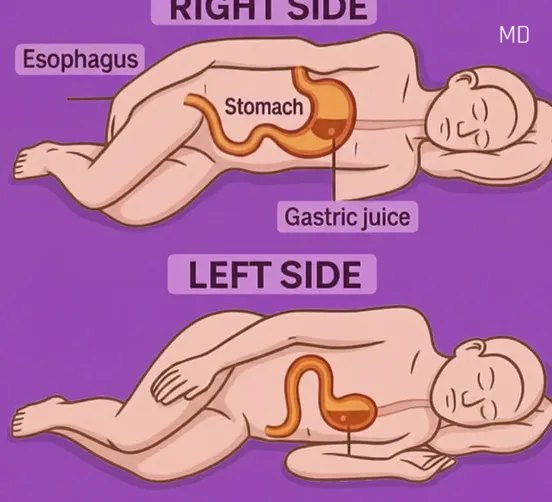
To understand why the left side can make such a difference, it helps to consider how the internal organs are arranged. The organs inside the torso are not perfectly symmetrical; instead, they occupy specific positions that favor certain orientations. The stomach, for example, sits primarily on the left side of the abdomen. When you lie on your left side, the stomach remains below the esophagus, allowing gravity to help keep stomach acid from flowing upward. For people who struggle with acid reflux or nighttime heartburn, this simple adjustment can significantly reduce discomfort. In contrast, sleeping on the right side can raise the stomach above the esophagus, making it easier for acid to move upward and irritate the throat, sometimes leading to what is known as silent reflux.
Beyond helping digestion, sleeping on the left side may also support the body’s waste-processing systems. The point where the small intestine connects to the large intestine lies on the right side of the body. When lying on the left side, gravity can assist the natural movement of digestive waste from the small intestine into the colon. From there, the waste travels through the descending colon on the left side of the body. This downward flow may help promote more regular bowel movements and reduce feelings of bloating or heaviness in the morning. For people with slower digestion, this simple shift in posture can provide gentle, natural support for the body’s digestive rhythm.
The benefits may also extend to the body’s lymphatic and detoxification systems. The lymphatic system plays a key role in immune defense and fluid balance, and a large portion of its drainage occurs on the left side of the body. The thoracic duct—the largest lymphatic vessel—empties into a vein near the left side of the neck. Sleeping on the left side can help lymph fluid move more efficiently through this pathway. This process is also connected to brain health. Research into the brain’s glymphatic system, which clears metabolic waste during sleep, suggests that side-sleeping can be more effective for removing certain toxins than sleeping on the back or stomach. When combined with the left-side orientation, this may help the body’s overnight “clean-up” processes work more efficiently.
Heart health may also benefit from this position. The heart pumps blood into the aorta, which curves toward the left side as it carries blood to the rest of the body. When lying on the left side, blood flow may move more naturally through this pathway. At the same time, the inferior vena cava—a large vein that carries blood back to the heart—runs along the right side of the spine. Sleeping on the left side reduces pressure from the body’s organs, including the liver, on this important vein. This may help improve circulation and support stable blood pressure during sleep.
These circulatory advantages are particularly important during pregnancy. Doctors frequently recommend that pregnant women sleep on their left side, especially in the second and third trimesters. As the uterus grows, it can place pressure on internal organs and major blood vessels. The left-side position helps relieve this pressure, allowing better blood flow to the placenta and ensuring the baby receives adequate oxygen and nutrients. It can also help reduce swelling in the legs and ankles and prevent dizziness caused by reduced circulation when lying on the back.
Of course, changing sleeping habits can take time. Many people have spent years sleeping on their backs or stomachs, so switching to the left side may feel uncomfortable at first. Making the change easier often requires small adjustments to the sleep environment. For example, placing a body pillow behind the back can help prevent rolling over during the night. A pillow between the knees can also keep the hips aligned and reduce strain on the lower back.
It’s also important to remember that sleep is dynamic. Even people who prefer one position naturally move several times throughout the night. The goal isn’t to remain perfectly still on the left side until morning, but simply to start the night in that position and return to it whenever you wake and notice you’ve shifted. Over time, the body often adapts, and the left-side position can begin to feel more natural and comfortable.
Ultimately, the way we sleep reflects how we care for our body’s basic needs. In a culture that often treats sleep as something to squeeze into busy schedules, paying attention to sleep quality is an important form of self-care. By making a simple adjustment—such as turning slightly to the left—we can help support digestion, circulation, and overall recovery during the night. Small changes like this can transform sleep from a passive activity into a powerful period of healing and renewal. And sometimes, improving how we feel in the morning can begin with nothing more complicated than shifting a few inches to the left.