For as long as humans have existed, we have marked our bodies with meaning. Long before tattoos became mainstream, skin carried stories—of identity, survival, grief, faith, belonging, and transformation. Across cultures and centuries, people have used symbols etched into flesh to say what words could not. Some markings announced adulthood. Others honored the dead. Many were deeply personal, understood only by the wearer.
What makes body art so powerful is that a single image can hold radically different meanings depending on where it appears and who carries it. A shape revered in one culture may be misread in another. A simple line can represent centuries of belief, while an elaborate design might be dismissed as decoration by someone unfamiliar with its roots. Tattoos function as a universal language, but one that requires context to truly understand.
In the modern world, tattoos are everywhere. Some people choose them impulsively, driven by emotion or a moment in time. Others approach them with careful intention, selecting symbols tied to healing, love, loss, rebirth, or spiritual awareness. Every now and then, a particular design appears so often that it sparks curiosity. Why this symbol? Why now? What does it mean beneath the surface?
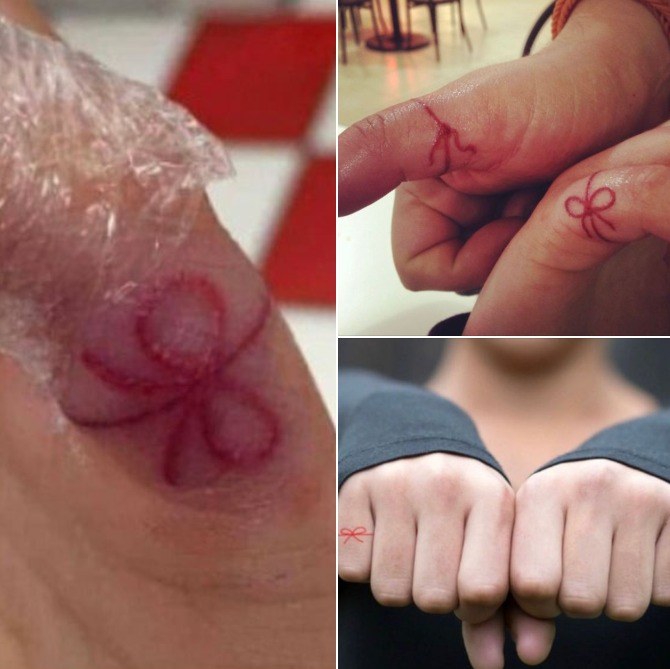
One of the most quietly powerful examples is the red string tattoo, often seen on the hand or finger.
At first glance, it appears almost insignificant—a thin red line tied in a small bow, usually inked around a pinky or thumb. It looks delicate, even decorative, like a ribbon resting lightly on the skin. Many assume it is simply an aesthetic choice, minimalist and subtle. But that simplicity is deceptive. Behind the design lies a story that has traveled across centuries, continents, and belief systems.
For years, people have noticed the red string appearing on strangers, coworkers, commuters, friends. The placement is often consistent, which makes it feel intentional rather than trendy. Something about it signals meaning. And once explored, its origins reveal a mythology far richer than its modest appearance suggests.
The red string tattoo is rooted in ancient East Asian folklore, commonly known as the “red string of fate.” According to legend, every person is connected to another by an invisible red thread. This thread binds two souls destined to meet, influence each other, and remain connected regardless of distance, time, or circumstance. The string may stretch, twist, or tangle, but it can never break.
In many versions of the myth, a supernatural matchmaker is responsible for tying these threads. He alone knows how lives will intersect and ensures that those meant to find one another eventually do. The idea is both romantic and profound: that no matter how lost we feel, some connections are inevitable.
Traditionally, the string is said to be tied to specific fingers—the thumb for men and the pinky for women—mirroring the way fate binds two people together. This imagery is why the tattoo often appears in these locations. While modern interpretations may place the string on wrists, ankles, or elsewhere, the core meaning remains unchanged: connection, destiny, and unseen bonds that guide human lives.
In a world shaped by unpredictability, the red string offers reassurance. It suggests that certain relationships are not random, that some people enter our lives because they are meant to. For many, this belief is deeply comforting—not as a guarantee of happiness, but as a reminder that connection endures even through separation, conflict, or delay.
Importantly, the red string is not limited to romantic meaning. Many people choose the tattoo to honor family bonds, lifelong friendships, spiritual connections, or loved ones who have passed away. In this context, the string represents continuity beyond physical presence. It becomes a symbol of memory, loyalty, and love that transcends loss.
This broader interpretation aligns with similar ideas across cultures. In Greek mythology, human destiny is woven by divine figures who control the threads of life. In some Indigenous traditions, red thread symbolizes protection. In Jewish customs, a red string is believed to guard against negativity. In Western language, being “tied” to someone often implies emotional or spiritual closeness. The symbolism appears again and again, shaped differently but rooted in the same human need to understand connection.
That universality explains the tattoo’s appeal. It is small, but emotionally dense. Minimal, yet layered with meaning. It does not demand attention, but it invites reflection. Its quiet presence makes it deeply personal, even when publicly visible.
Belief in fate varies widely. Some people embrace the idea that relationships are guided by forces beyond our control. Others believe destiny is shaped entirely by choice and circumstance. Yet the red string holds power regardless of where one falls on that spectrum. As a metaphor, it speaks to hope, continuity, and the idea that lives intersect for reasons that may only become clear in hindsight.
In recent years, the red string has also taken on new meaning in a digital age where relationships can feel fleeting and fragile. As connections form and dissolve through screens, the idea of a bond that cannot be severed resonates strongly. The tattoo becomes a quiet declaration of faith in depth, permanence, and emotional truth.
Many who wear the red string say it has nothing to do with romance at all. Instead, it represents people who shaped their lives in subtle but lasting ways: a parent, a childhood friend, a mentor, a sibling, a guide. For some, it marks survival—proof that they remained connected to themselves through illness, trauma, addiction, or loss.
In this sense, the red string becomes a symbol of personal transformation. It links who someone once was to who they are becoming. It acknowledges that life may knot and twist, but continuity remains. The thread carries a person forward.
What makes the symbol especially powerful is its adaptability. It has evolved across cultures without losing its essence. In some traditions, it is romantic. In others, protective. In modern contexts, it is fluid, open, and deeply individual. Its meaning belongs entirely to the wearer.
People at different stages of life read the same symbol differently. For the young, it may represent hope. For parents, the invisible bond to their children. For partners, endurance. For those who have lost, remembrance. For friends separated by distance, loyalty. The design stays the same; the story changes.
That is why its popularity continues to grow. The red string does not shout. It whispers. It does not explain itself. It does not require validation. It allows people to carry their most meaningful connections quietly, etched into skin as a reminder that some bonds are stronger than circumstance.
Ultimately, the red string tattoo makes something invisible visible. It honors the truth that our lives are shaped by others—sometimes dramatically, sometimes quietly, often without us realizing it until much later. It reflects the way people enter our stories at exactly the right moment, stay for reasons we cannot always explain, and leave marks that never fade.
In the end, the red string of fate is not about magic. It is about meaning. About connection. About the human instinct to believe that our lives are not isolated threads, but part of a larger weave. And for those who choose to carry it on their skin, it becomes a personal reminder that even in a vast, uncertain world, we are never entirely alone.