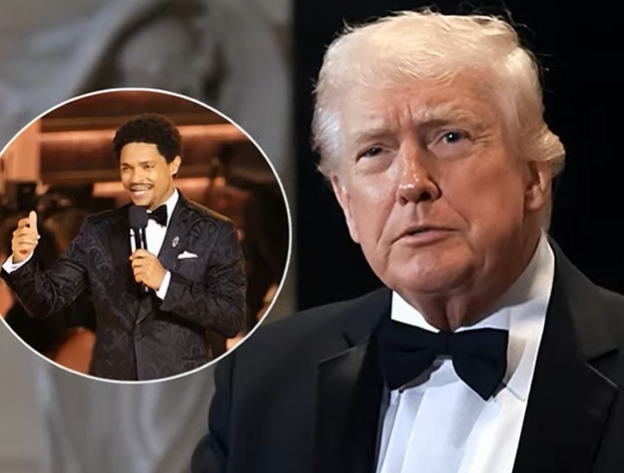
The 2026 Grammy Awards were designed to be a pinnacle of cultural celebration, yet the evening is now defined by a moment that bypassed context and moved straight into the realm of legal warfare. What began as a sharp intake of breath inside the Crypto.com Arena quickly transformed into a digital firestorm, as clips of a monologue by host Trevor Noah circulated globally before the applause in the room had even fully subsided. Within hours, the entertainment value of the night was eclipsed by a burgeoning constitutional and personal conflict, as Donald Trump signaled his intent to pursue legal action. This incident serves as a visceral case study in how power reacts when satire cuts into the most sensitive of political nerves, revealing the increasingly fragile boundary between cultural commentary and litigation.
The ceremony followed a familiar, modern pattern of awards show production: a heavy layer of culture-war commentary woven into the fabric of musical performances. From Chappell Roan’s provocative fashion statements to various artists using their stage time for social advocacy, the air was already thick with ideological tension. However, the atmosphere shifted from festive to volatile when Trevor Noah delivered a joke that touched upon a subject currently dominating the news cycle. Referencing the recent release of unsealed documents related to Jeffrey Epstein, Noah connected the desire for a Grammy to the historical interest elite figures—specifically naming Donald Trump and Bill Clinton—have shown in the Epstein saga.
The remark landed in an environment already saturated with speculation and public distrust. While legal experts and Department of Justice officials have repeatedly emphasized that an appearance in the Epstein-related files does not establish guilt or wrongdoing, the nuance of due process often disappears in the theater of an awards show. Timing, as they say, is everything. What Noah likely intended as a topical piece of satire was interpreted by the former president not as a comedic punchline, but as a defamatory indictment. The response from the Trump camp was both swift and forceful, utilizing Truth Social and official travel briefings to frame the moment as a coordinated character assassination. By naming figures like Michael Wolff and various media organizations alongside Noah, the former president signaled that he viewed the joke as part of a broader, weaponized narrative rather than an isolated moment of levity.
From a deeper sociological perspective, this episode highlights a recurring fault line in contemporary society. In a climate defined by hyper-polarization, humor no longer lands in a neutral or safe space. Instead, comedy is treated as evidence of bias, and laughter is scrutinized as a political act. When a joke is told on a national stage about a sensitive legal matter, it ceases to be mere entertainment and is repurposed as a weapon by all sides of the political spectrum. For the comedian, it is a tool of dissent and accountability; for the subject, it is a tool of provocation and defamation. This leaves very little room for the irony or the “jester’s privilege” that has historically protected satirists from the wrath of the powerful.
The danger in this shift is not found in the humor itself, but in how quickly context is stripped away in favor of outrage. When public figures begin to respond to jokes as existential attacks requiring legal intervention, the nature of the public square changes. It raises a profound question about the future of dissent and ridicule: if a punchline can trigger a multimillion-dollar lawsuit, what space remains for the irreverence that has traditionally kept power in check? The episode at the Grammys tells us less about the quality of the joke than it does about the state of the institutions reacting to it. It reveals a culture where the instinct to control the narrative has become so reflexive that even a momentary lapse in “seriousness” is treated as a threat to be neutralized.
The 2026 Grammys will ultimately be remembered as the night where culture, politics, and power collided in real-time. The loudest reactions to the monologue often revealed more than the original remark ever could, exposing the deep-seated grievances and fears that define our current era. It serves as a mirror for a society where the boundary between a television studio and a courtroom has become porous. When spectacle becomes motive and irony is treated as an indictment, the result is a chilling effect that extends far beyond a single awards show. It challenges the foundational idea that humor can serve as a release valve for societal tension, suggesting instead that in an age of permanent exposure, even our laughter is under surveillance.
As the legal threats loom, the entertainment industry is forced to reckon with its role as a political catalyst. If the goal of an awards show is to reflect the cultural climate, then the 2026 Grammys were a resounding, if uncomfortable, success. They reflected a world where everything is a weapon, where history is constantly being relitigated in the court of public opinion, and where the most powerful people in the world are increasingly unwilling to be the butt of a joke. Whether or not a lawsuit eventually materializes, the damage to the tradition of political satire has already been recorded. The episode stands as a sobering reminder that in the modern world, the most dangerous place to be is at the center of a punchline, as the distance between a microphone and a legal summons continues to shrink.
In the end, what unfolded in Los Angeles was a testament to the volatility of our times. It was a night defined by the realization that context is the first casualty of the digital age. As clips of Noah’s monologue continue to serve as fodder for cable news debates and social media vitriol, the original intent of the evening—to celebrate the best in music—feels like a distant memory. Instead, we are left with the image of a society so on edge that a single joke can trigger a national crisis, proving that the loudest reaction is often the one that tells the truest story about our collective instability.