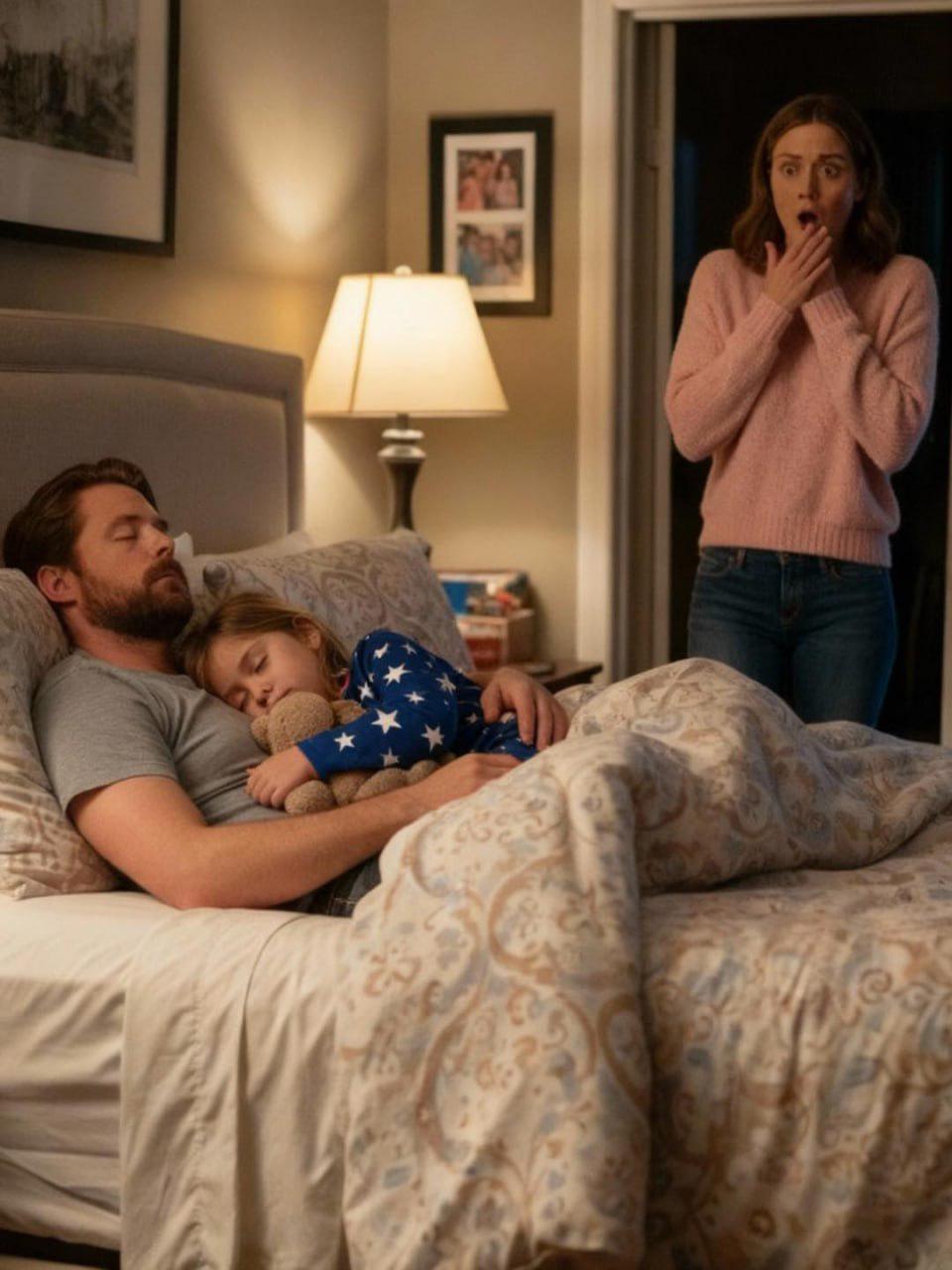
In the quiet architecture of a suburban life, crisis rarely arrives with a fanfare. Instead, it often manifests as a series of subtle anomalies, small ripples in the fabric of a routine that we mistake for the mundane until the pattern becomes undeniable. For my husband, Daniel, and me, the ripple began in the kitchen of our San Jose home. It was a Tuesday morning, and our eight-year-old daughter, Emily, stood by the counter rubbing the sleep from her eyes. She looked up at me and said something that felt entirely inconsequential at the time: “Mom, my bed felt really small last night.”
I smiled, brushed a stray hair from her forehead, and attributed the comment to the vivid, nonsensical logic of a child’s dreams. We had raised Emily to be independent, a choice born of our desire to give our only child a sense of self-reliance and confidence. Her room was a sanctuary of her own making, filled with books, a soft amber nightlight, and a mattress large enough to accommodate her for years to come. I believed her world was secure, bounded by the sturdy walls of our home and the careful planning of our lives.
However, the comment did not remain a one-off remark. It returned the following morning, and the one after that. Emily’s descriptions grew more specific and more unsettling. She spoke of a lack of space, of a “tightness” in the blankets, and eventually, the question that caused the air to leave my lungs: “Mom, did you come into my room last night? Because it felt like someone was lying next to me.”
A mother’s intuition is a finely tuned instrument, capable of detecting the slight shift in tone between a child’s imagination and a child’s observation. Emily wasn’t frightened; she was perplexed. I mentioned it to Daniel, who was perpetually exhausted from his long shifts as a hospital physician. He suggested she was simply experiencing the vivid dreams common to her age group, but the unsettled feeling in my gut refused to subside. To settle my own nerves, I installed a small, inconspicuous camera in the corner of her room—a digital sentry to prove that our house was as still as I believed it to be.
The first night of recording revealed nothing. I went to bed feeling foolish, a parent overreacting to the whims of an eight-year-old. But at 2:14 a.m. the following night, I found myself awake, driven by a nameless compulsion to check the feed on my phone. In the grainy, night-vision glow of the screen, I watched the door to Emily’s room creak open. A figure stepped inside—slight, stooped, and moving with a tentative, gliding gait that suggested a deep unfamiliarity with the current moment.
As the figure approached the bed, the breath caught in my throat. It was my mother-in-law, Margaret. At seventy-eight, Margaret was a woman defined by a lifetime of silent sacrifice. She had been widowed young and had spent her youth working grueling hours in food stalls and laundry services to ensure Daniel’s future. She was a woman who had folded her own needs into the smallest possible space so that others could grow. But in recent months, the edges of her reality had begun to fray. There were moments of sudden disorientation, forgotten names, and a look in her eyes that suggested she was drifting away from us, toward a shore we couldn’t yet see.
I watched as Margaret gently peeled back the edge of Emily’s duvet and lay down. She didn’t speak; she simply curled her fragile frame into the space beside her granddaughter. Emily shifted, instinctively making room in her sleep, and the two of them lay there in a tableau of generational intersection. I stood in my kitchen in the dark, the blue light of the phone illuminating the tears on my face. It was a scene of profound tragedy and exquisite tenderness.
The next morning, I showed the footage to Daniel. The silence in the room was heavy as he watched his mother—the woman who had been his bedrock—wandering through the house in a state of neurological eclipse. He wept, not just for her decline, but for the realization of what she was searching for. He understood it instantly. She wasn’t just wandering; she was returning to the only role that had ever given her a sense of absolute safety. She was returning to the nights decades ago when she had sought comfort in the presence of her own child when the world felt too vast and too cold.
We realized then that Margaret’s “sundowning” was not an act of intrusion, but a desperate, subconscious search for the warmth of family. The “smallness” Emily felt was the physical manifestation of a grandmother trying to anchor herself to the present by clinging to the youngest member of her bloodline.
We transitioned immediately into a new rhythm of care. We didn’t scold Margaret; to do so would have been to punish a shadow for being dark. Instead, we moved her bedroom closer to ours and installed sensors to alert us if she moved in the night. More importantly, we began a ritual of evening companionship. I started spending an hour with her every night before bed, listening to her stories. Sometimes they were the same stories three nights in a row, but I realized that my role was no longer to correct her memory, but to witness it.
Margaret wasn’t looking for a bed; she was looking for an end to the isolation that memory loss imposes on the soul. She was searching for the physical reassurance that she was still part of a “we.” Emily, with the inherent wisdom and grace of a child, accepted the changes without complaint. She understood, in her own way, that her bed hadn’t actually shrunk; it had simply expanded to hold a history she was only beginning to understand.
This experience dismantled my previous notions of independence. I had spent years trying to teach my daughter how to stand alone, but my mother-in-law taught us all the necessity of leaning on one another. Aging is a slow stripping away of the defenses we build throughout our lives, eventually leaving us with nothing but the core human need for touch, recognition, and safety.
Now, our house is still quiet at night, but it is a different kind of stillness. It is the silence of a family that has learned to listen to the messages hidden in the complaints of a child and the wanderings of the elderly. No one in our home wanders alone in the dark anymore. We have learned that the greatest gift we can give each other isn’t the stability of a planned life, but the willingness to make room for one another, even when the bed feels too small and the night feels too long. We are no longer just a collection of individuals living under one roof; we are a circle, holding tight to the ones who are slowly drifting toward the exit, ensuring they are warm until the very end.