I woke up to the sound of a man counting.
Not praying. Not yelling. Counting—steady, hard, like a metronome you couldn’t silence.
“Twenty-seven… twenty-eight… twenty-nine…”
At first my brain refused to connect it to anything real. It was 3 a.m. The house was dark. Then I heard the wet slap of skin against skin and my stomach dropped. I ran down the hall and skidded into the bathroom doorway—and my world shattered.
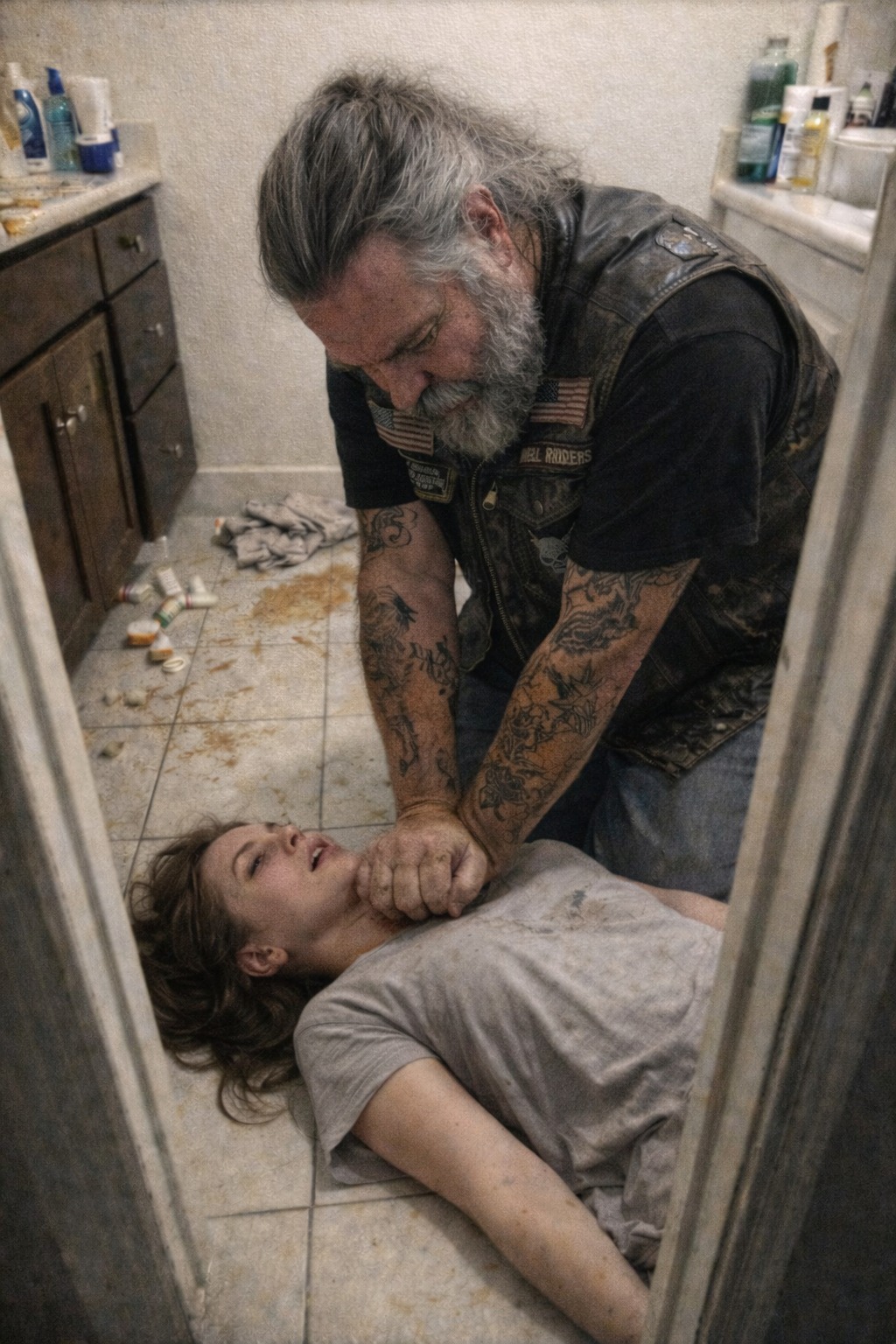
A massive stranger was on his knees on our tile floor. Gray beard. Leather vest. Tattoos crawling down his forearms. He was pressing both hands into my daughter’s chest with brutal precision, locking his elbows, driving down and releasing in a rhythm that looked like violence until you understood what it was.
CPR.
My nineteen-year-old daughter, Emily, lay limp beneath him. Her hair was stuck to her cheek. Her lips were tinged blue. Empty pill bottles littered the floor like confetti from a nightmare.
My body moved before my mind caught up. I grabbed the baseball bat from the closet and swung.
The stranger caught the bat with one hand without even pausing his compressions. His eyes flicked up to mine—sharp, focused, furious.
“Sir,” he barked, voice like gravel, “call 911 right now. Your daughter overdosed. I’ve been doing CPR for four minutes. She has a pulse but she’s not breathing on her own.”
I couldn’t process the words. Stranger. Overdose. My daughter. Bathroom floor.
“Who the hell are you?” I screamed. “How did you get in my house?”
He didn’t stop. Compressions. Release. Compressions. Release.
“Your daughter called me,” he said, still counting under his breath. “She’s been calling me every night for six months. I’m her sponsor. Now call 911 or she dies.”
Sponsor.
That word didn’t belong in my life. Emily wasn’t an addict. Emily was a good kid. Straight A’s at community college. Part-time job at the library. Church with us on Sundays. She was responsible. Quiet. The kind of daughter you trusted without thinking.
“CALL 911!” the biker roared.
Something in his voice cut through the fog. I dropped the bat and fumbled for my phone. My hands were shaking so hard I couldn’t hit the right numbers. When the operator answered, I didn’t speak like a sane person. I yelled our address. I yelled that my daughter wasn’t breathing. I yelled for help as if volume could summon a miracle faster.
Behind me, the man kept working. His arms were huge, but what struck me wasn’t strength. It was discipline. He wasn’t panicking. He was doing the job. He leaned in, delivered breaths, went back to compressions, and kept talking to her like she could hear him through the dark.
“Come on, Emily,” he said. “Stay with me. Don’t you quit now. You didn’t call me just to give up. Fight. Your dad’s here. Fight for him.”
My wife appeared at the end of the hall, hair wild, eyes half asleep until she saw the floor. Then the scream tore out of her like something animal.
“Emily! EMILY!” she shrieked, stumbling forward—and then froze when she saw the stranger.
“What’s happening? Who is that?”
“Ma’am,” he said, still working, “I need you to stay calm. Paramedics are coming. Your daughter’s fighting.”
“What demon?” my wife screamed. “What are you talking about?”
Then Emily gasped.
Her whole body jerked. Her mouth opened and she sucked in air like she’d been drowning. The biker moved instantly, rolling her onto her side. She vomited hard, choking, shaking. He held her hair back with one hand, rubbed her back with the other, murmuring low and steady as if he was talking a panicked child off a ledge.
“That’s it. Get it out. You’re okay. I’ve got you. Your parents are here. You’re not alone.”
Seven minutes later—though it felt like a lifetime—the paramedics burst in. They took over with practiced speed, oxygen mask, IV, monitors. One of them looked at the biker and said, “You do the CPR?”
He nodded. “Found her unresponsive. I’d say she’d been down maybe two minutes before I got here. Compressions about eight minutes total.”
The paramedic’s face tightened. “You saved her life. A few more minutes and we’re talking about a body, not a patient.”
They loaded Emily onto a stretcher. My wife climbed into the ambulance, sobbing. I stayed behind, rooted to the bathroom doorway, staring at the bottles, the mess, the stranger who had been holding my daughter’s heartbeat in his hands.
He sat on the edge of our tub like his bones had suddenly turned to sand. His head dropped into his palms.
And he started crying.
Not quietly. Not politely. He sobbed like a man who’d seen this scene before and knew exactly how it usually ends.
I stepped closer, fury and terror fighting for space in my chest.
“Who are you?” I demanded. “How do you know my daughter?”
He looked up. His eyes were bloodshot. His voice was softer now, as if the adrenaline had drained out and left only grief.
“My name’s Thomas,” he said. “I’m in recovery. Twenty-three years clean. I sponsor people. Emily’s been my sponsee for six months.”
“That’s impossible,” I snapped. “Emily doesn’t use drugs.”
He didn’t flinch. “Prescription pills,” he said. “Started after her wisdom teeth surgery. Oxycodone. It happens fast. She got hooked. By the time she admitted it to herself, she was buying pills off the street.”
The room tilted. My knees weakened. I sat on the closed toilet lid like an old man.
“No,” I whispered. “We would’ve known.”
Thomas wiped his face. “Addicts are world-class liars,” he said. “Not because we’re evil. Because we’re ashamed. Shame makes you hide like your life depends on it.”
He told me Emily came to a meeting six months ago, terrified and shaking. She told him she’d been using for almost a year. She wanted to stop but couldn’t. And she couldn’t tell her parents.
“She said she’d rather die than tell us?” I asked, feeling the words cut through me.
Thomas nodded. “She was convinced you’d disown her. She thought you and your wife were perfect, and she was the disappointment. She thought if you knew the truth, you’d never look at her the same.”
I thought about the past year. The weight she’d lost. The way she’d stopped seeing friends. The dark circles under her eyes. The distance that had grown like a wall. We’d asked if she was okay. She always said it was school stress.
We believed her because believing her was easier than imagining the alternative.
“She called me every night,” Thomas said. “Midnight. Two a.m. Four a.m. Whenever it got bad. I’d talk her through cravings. Ten minutes. Three hours. Whatever it took.”
“Every night?” I repeated, numb.
“Every single night,” he said. “Your daughter’s been fighting the hardest battle of her life by herself, because she was too scared to let you see it.”
My throat closed. Tears came before I could stop them. The humiliation wasn’t just mine. It was hers. My child had been suffering in secret and calling a stranger because she couldn’t call me.
“Tonight was different,” Thomas said, voice breaking. “She called around two. But it wasn’t a craving call. It was a goodbye call. She was thanking me. Saying she was tired.”
He stared at the floor like he could still see her there. “I’ve heard goodbye calls before. I asked where she was. She said home. I drove like a maniac. Your front door was unlocked. I found her in here. I started CPR immediately.”
He looked at me with a kind of blunt sorrow. “I’m sorry I broke into your house. I’m sorry I scared you. But I wasn’t going to let her die.”
“You saved her,” I said, the words feeling too small for what he’d done.
He shook his head. “She saved herself,” he said firmly. “Even at her lowest point, part of her reached out. That part still wants to live.”
The bathroom felt filthy with truth—vomit, pill bottles, and the evidence of a life I didn’t know my daughter had been living.
“How did I not know?” I whispered.
“Because she didn’t want you to,” Thomas said. “And because addiction stays invisible until it can’t.”
He stood slowly like his joints ached. “You need to be with her.”
“Wait,” I said, grabbing his arm. “Why do you do this? Why answer calls at three in the morning? Why drive across town for someone else’s kid?”
He was quiet. Then he took out his wallet and slid a photo into my hand.
A young woman, mid-twenties, bright smile, his eyes.
“My daughter,” he said. “Rebecca. Fifteen years ago. Overdose. She was too ashamed to ask for help. Too scared to tell anyone she was drowning. She died alone because she thought she was unlovable.”
He put the wallet away. His jaw tightened. “I couldn’t save her. But I can answer the phone when someone else calls. I can show up. I can refuse to let shame bury another kid if I can stop it.”
I drove to the hospital in a haze. My wife was in the waiting room, mascara streaked down her face. The doctors told us Emily was stable. There would be evaluations. Treatment. A plan. Words that sounded clinical and unreal.
When we finally went in, Emily was awake. Pale. Hooked to monitors. Her eyes landed on me and immediately filled.
“Daddy,” she whispered, and then the apology poured out of her like blood. “I’m so sorry. I’m so ashamed.”
I sat at the edge of her bed and took her hand. It felt too light. Too fragile.
“Emily,” I said, forcing her to meet my eyes, “I love you. I love you exactly as you are. Not the version you think you have to be. Not the perfect version. You’re my daughter. Nothing changes that.”
She broke. Full-body sobs, like she’d been holding her breath for a year and finally exhaled. My wife climbed onto the bed beside her and wrapped her arms around her. The three of us held each other and cried for what we almost lost and what we didn’t see.
“The biker,” Emily whispered after a while. “Thomas. Is he okay?”
“He’s okay,” I said. “And he saved your life.”
“He’s been saving my life,” she whispered. “Every night.”
Emily spent two weeks in the hospital. Detox, evaluations, planning. We came every day. We brought books. We held her through the worst of withdrawal. We told her we loved her until the words finally stopped sounding like a lie to her.
Thomas visited too. The first time he walked in, Emily clung to him and sobbed like he was a lifeline made human. This intimidating man with leather and tattoos held her like she was precious, not broken.
“Always,” he told her. “That’s what we do. We don’t leave people alone in the dark.”
She went to residential treatment for ninety days. It was brutal. It was messy. But she did it.
Today, she’s two years clean. She finished her degree. She works at a recovery center, helping other young people who are where she once was. She speaks about shame and secrecy and how addiction doesn’t care how “good” you look on paper.
And she still calls Thomas—because he’s family now.
We have dinner together once a month. Thomas and his wife, my wife and me, Emily and the people she trusts with her truth. No pretending. No perfect masks. Just honesty and a kind of gratitude that never gets smaller.
I think about that night all the time: the sound of counting, the blue lips, the bat in my hands, the stranger in my bathroom refusing to let my daughter slip away.
People see leather and tattoos and assume danger. They cross the street. They clutch their bags. They warn their kids.
But that man saved my daughter’s life. He answered the phone when she couldn’t call us. He broke into our house at 3 a.m. and gave us a second chance.
Heroes don’t always look like heroes.
Sometimes they look like the last person you’d ever trust—until you realize they’re the only reason you still have someone to love.