The intersection of fate and humility often weaves a tapestry far more intricate than anyone could imagine, and for Hannah, that tapestry was stitched together with ivory silk and a forty-eight-dollar price tag. At twenty-eight years old, Hannah had spent her life navigating the world through the lens of necessity. After her father’s passing when she was only fourteen, she watched her mother, a resilient woman who worked grueling night shifts at a local diner, transform struggle into a quiet sort of magic. Her mother didn’t just provide; she created, sewing Halloween costumes by hand and teaching Hannah that value wasn’t found in a ledger, but in the effort poured into the people you love.
When Hannah met Thomas, she wasn’t looking for a prince, and he certainly wasn’t looking for a “project.” They met in the most mundane of settings—a car repair shop. While Hannah sat waiting for news on her dying Corolla, Thomas was there for his Tesla. Their connection was immediate and grounded, transcending the obvious disparity in their bank accounts. Thomas was a man of quiet substance, a finance professional who wore his success with a subtle grace rather than a loud roar. However, his world was one of velvet curtains, personal chefs, and high-society expectations—a world personified by his mother, Liliana, a woman whose presence was as polished and sharp as the heels she never seemed to take off.
The engagement brought joy, but it also invited the cruel, low-frequency hum of social judgment. Hannah became “the poor girl who got lucky,” the subject of brunch-table whispers suggesting she had somehow trapped a man who could have “done better.” Hannah met these barbs with a practiced smile, though the words often followed her home like shadows. When it came time to plan the wedding, Thomas’s parents insisted on financing the lion’s share of the event. The result was a grand ballroom affair, complete with crystal chandeliers and a live quartet. Hannah’s family, struggling with the mounting costs of her mother’s chemotherapy, contributed what they could: the cake, the photography, and the dress.
Refusing to let Thomas’s family pay for her gown, and unwilling to divert money from her mother’s medical treatments, Hannah found herself in a small, dusty thrift store she used to frequent as a child. Tucked between layers of garish polyester and faded prom dresses, she found it—a simple, elegant gown of ivory silk with lace sleeves and a high neckline. It possessed a timelessness that transcended trends. In a cramped dressing room under flickering lights, Hannah looked in the mirror and didn’t see a “second-hand” bride; she saw herself. The dress cost forty-eight dollars, and to Hannah, it was perfect.
Despite a “pinky swear” with her sister Jessica, word of the thrift-store find leaked. The days leading up to the wedding were filled with “helpful” texts from acquaintances offering to start a GoFundMe or connect her with high-end boutiques so she could wear a “real” dress. Hannah politely declined them all. She knew what she was wearing, and she knew why she was wearing it.
The wedding day arrived, and the ballroom was a spectacle of wealth and floral arrangements. As Hannah began her walk down the aisle, the atmosphere shifted from celebratory to skeptical. She could feel the weight of two hundred pairs of eyes dissecting the simple silk of her gown. The murmurs weren’t just in her head; they were audible. Then, the tension broke in the worst possible way. Her Aunt Tracy, fueled by a misguided sense of boldness, stood up and shouted a question that silenced the room: “So you snagged yourself a rich husband… why didn’t he buy you a real dress? Walking around in rags from a thrift store?”
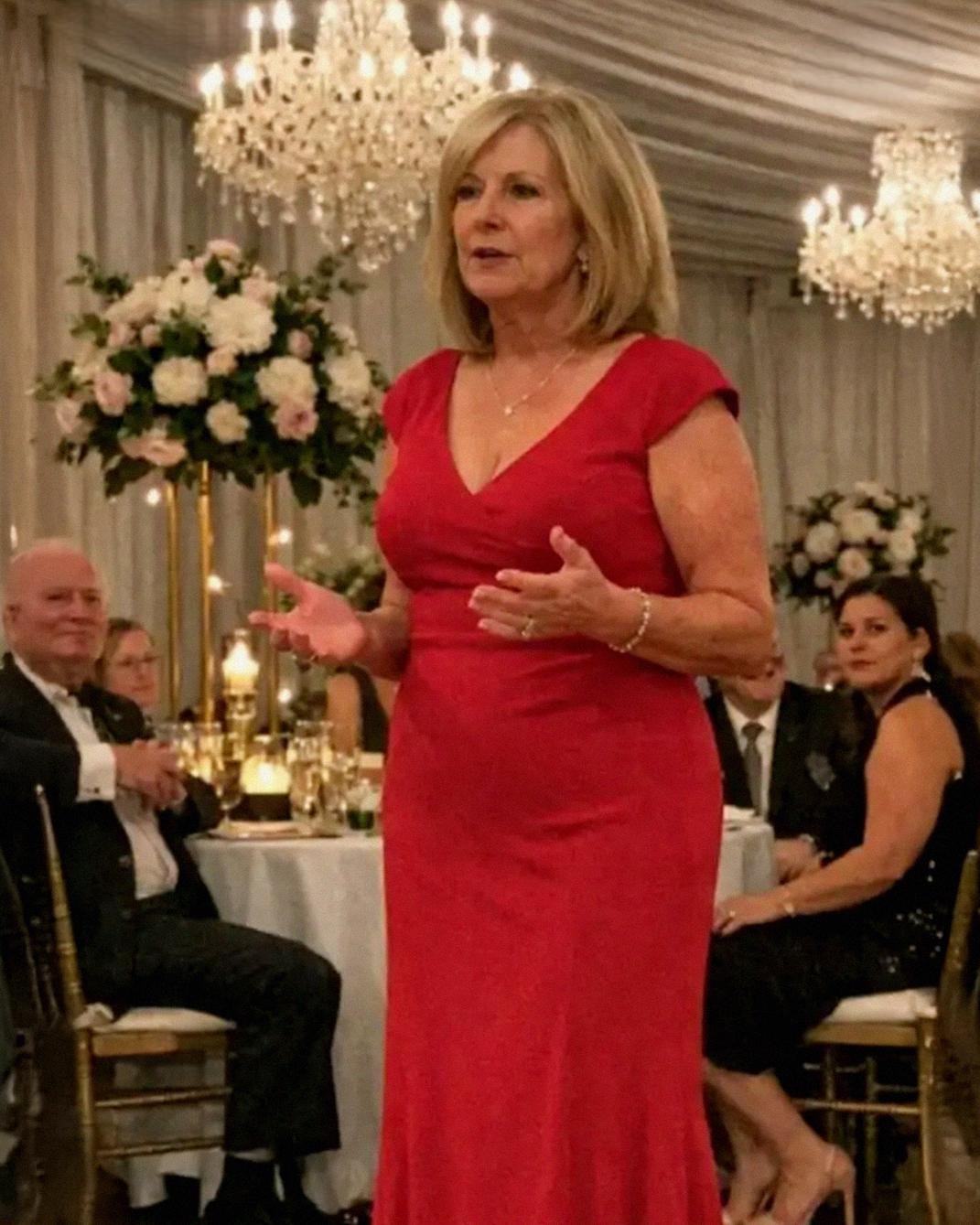
The sting was visceral. Hannah froze, her bouquet trembling in her hands, her face burning with the heat of a thousand humiliations. But before the tears could fall, movement came from the front row. Liliana, the formidable matriarch, stood up slowly. The room grew deathly quiet, expecting a sharp rebuke of the bride or perhaps a graceful exit to avoid the scandal. Instead, Liliana turned to face the guests, her eyes shimmering with a sudden, raw vulnerability.
“When I was your age,” Liliana began, her voice steady but thick with emotion, “I had nothing. Our cupboards were empty, and my wedding dress wasn’t from a boutique. My mother sat at our kitchen table every night, stitching a dress from plain cotton with her own hands. To the world, it was nothing. To me, it was magic.” She paused, looking at Thomas, then back to the crowd. “After the wedding, life remained hard. We fell behind on rent. When our son was born, I had to make a choice I’ve regretted every day since. I sold that dress at a garage sale to buy food and pay bills. I told myself it was just fabric, but I spent the next thirty years searching for it in every flea market and thrift shop I passed, hoping to find a piece of my mother again.”
The air in the ballroom felt heavy, charged with a sudden, profound realization. Liliana stepped toward Hannah, her gaze fixed on the lace sleeves. “And then today, I saw my mother’s stitches. This dress—the one you found in a thrift store—is the very gown I sold three decades ago. It is the heirloom I thought was lost forever.”
A collective gasp swept through the guests. Aunt Tracy sank into her seat, suddenly very small. Liliana reached out and took Hannah’s hand. “This is not a ‘poor girl’ who got lucky,” Liliana proclaimed, her voice ringing with newfound authority. “This is the woman my son was destined to marry. She chose this dress because she put her own mother’s health above her own vanity. She has the heart of the family I feared we had lost.”
Liliana turned back to the room, her protective instinct flaring. “This is the most beautiful bride I have ever seen. If I hear one more whisper or see one more judgmental glance, that person will answer to me.”
The remainder of the ceremony was no longer a display of wealth, but a celebration of providence. The energy had shifted from a social performance to a deeply intimate union of two families. Liliana spent the evening by Hannah’s mother’s side, pledging not just friendship, but the full weight of her resources to ensure she received the best medical care available. The “rich family” and the “poor girl” were no longer categories; they were a singular unit bound by a miraculous coincidence of silk and thread.
By the time the night ended, the whispers of “rags” had turned into stories of “treasures.” When the wedding photos were shared online later that week, Liliana herself wrote the caption, identifying Hannah not as an addition to the family, but as the guardian of their history. Hannah had walked into the ballroom fearing she didn’t belong, only to realize that she was the missing piece that brought the entire family home. In the end, the forty-eight-dollar dress wasn’t just a bargain; it was a map that led her exactly where she was meant to be.