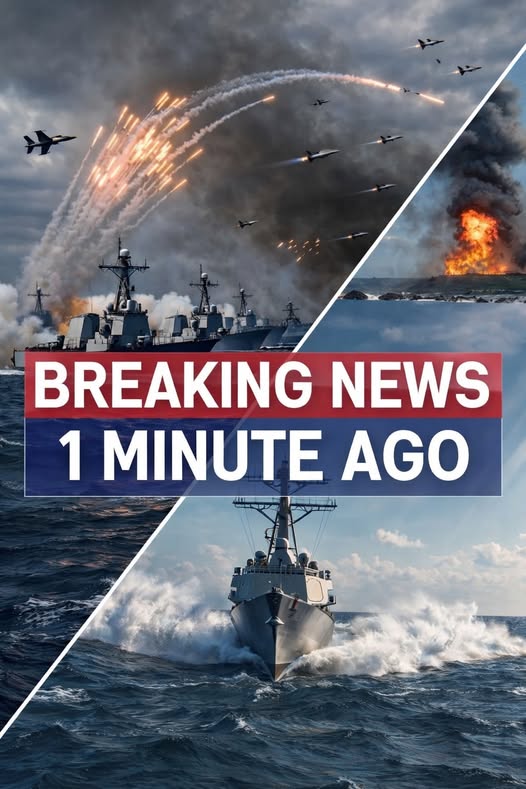
The Red Sea has long been one of the world’s most vital maritime arteries, a narrow corridor through which a significant portion of global trade and energy supplies must pass. However, recent events have transformed these strategic waters into a high-stakes arena for modern naval combat. A dramatic and unprecedented confrontation between United States naval forces and the Houthi movement has sent shockwaves through the international community, signaling a dangerous new phase in Middle Eastern security. The core of this escalation centers on a staggering tactical display: the launch of 36 missiles against a single U.S. destroyer within a window of just 22 minutes. This event represents more than just a skirmish; it is a profound challenge to the established maritime order and a stark illustration of the evolving nature of asymmetric warfare.
At the heart of this engagement was what military strategists refer to as a saturation attack. In naval theory, a saturation attack is not merely about destruction; it is a mathematical attempt to overwhelm the defensive capacity of a target. Every modern warship, regardless of its sophistication, has a finite number of targets its radar can track and its interceptors can engage simultaneously. By launching 36 projectiles in rapid succession, the Houthi forces sought to exceed the ship’s “processing limit.” The goal of such an attack is to create a window of vulnerability where even a single missile might slip through the defensive net. In the compressed timeframe of 22 minutes, the crew of the U.S. destroyer faced a relentless barrage that tested the absolute limits of their layered air-defense systems.
The technology behind these defenses is among the most advanced in the world, involving a coordinated dance between radar arrays, computer-automated firing systems, and physical interceptors like the SM-2 or SM-6 missiles. When a saturation attack begins, the ship’s Aegis Combat System must prioritize threats based on speed, trajectory, and distance, all while the crew operates under the immense psychological pressure of incoming fire. Reports indicate that the American vessel activated its kinetic and electronic countermeasures immediately, creating a wall of defense in the sky above the Red Sea. The fact that the ship was able to withstand such a coordinated volley without sustaining catastrophic damage is a testament to the efficacy of modern U.S. naval engineering, but it also underscores the growing audacity and technical proficiency of the Houthi movement.
The implications of this 22-minute window extend far beyond the immediate tactical survival of a single ship. The speed of the engagement—from the initial detection of the launch to the subsequent retaliatory strikes on hostile infrastructure—highlights a new reality in regional conflict: the timeline for escalation has shrunk from days or hours to mere minutes. As the missiles were intercepted, U.S. and allied forces reportedly moved with near-instantaneous coordination to target the launch sites and command-and-control hubs responsible for the barrage. This rapid “detect-to-engage” cycle is a hallmark of modern theater security, but it also carries the inherent risk of rapid, unmanaged escalation. In a region as volatile as the Middle East, such high-speed exchanges leave little room for diplomatic de-escalation once the first sensor picks up a launch.
The Red Sea’s role as a critical artery for the global economy adds a layer of existential weight to these military clashes. Roughly 12% of global trade passes through the Bab el-Mandeb strait, and persistent instability in these waters forces shipping companies to make a difficult choice: risk the dangerous passage or divert vessels around the Cape of Good Hope. The latter option adds thousands of miles and millions of dollars in fuel costs to every journey, ultimately driving up the price of goods for consumers worldwide. By targeting a U.S. destroyer, the Houthi movement is not just engaging a military adversary; they are effectively holding the global supply chain hostage. This use of “maritime blackmail” serves to pressure the international community and project power far beyond the geographical borders of Yemen.
Furthermore, this clash reveals the shifting nature of regional alliances. The sophistication of the 36-missile barrage suggests a level of logistical and technical support that points toward broader regional influences. Analysts note that the ability to coordinate such a high-volume strike requires advanced reconnaissance and firing data, resources that are often facilitated by regional patrons. This turns the Red Sea into a proxy battlefield where larger geopolitical rivalries are played out through localized actors. For the United States, maintaining a presence in these waters is not just about protecting its own assets, but about reassuring allies and maintaining the principle of freedom of navigation—a cornerstone of international maritime law that has been in place since the end of World War II.
As the operational environment in the Middle East continues to shift, the 22-minute clash stands as a sobering case study in the risks of miscalculation. When 36 missiles are in the air, the margin for error is non-existent. A single technical failure on a defensive system or a slight delay in response could result in a successfully struck U.S. vessel, which would almost certainly trigger a massive, theater-wide military response. This “tripwire” effect means that the global community is constantly one small mechanical or human error away from a much larger conflict. The encounter in the Red Sea proves that the balance of power in the region is no longer a static thing; it is a dynamic, minute-by-minute reality that requires constant vigilance and overwhelming technological superiority to maintain.
Looking ahead, the international community must grapple with the reality that the Red Sea may remain a “contested space” for the foreseeable future. The traditional methods of maritime security, which relied on the deterrent effect of a large naval presence, are being challenged by the low-cost, high-volume nature of modern missile and drone technology. It is far cheaper to build and launch a dozen drones than it is to build the multimillion-dollar interceptor needed to shoot one down. This economic asymmetry is a fundamental challenge for Western navies, forcing a rapid evolution in defensive strategies, including the development of directed-energy weapons and more cost-effective point-defense systems.
Ultimately, the Red Sea escalation is a reminder that in the 21st century, the sea remains the most important and most vulnerable frontier of global stability. The 36 missiles launched in 22 minutes did more than just light up the radar screens of a U.S. destroyer; they illuminated the fragility of our interconnected world. As long as these waters remain a flashpoint, the global economy and regional peace will remain tethered to the split-second decisions made by sailors and commanders on the front lines. The clash of March 2026 was a warning: the rules of the game have changed, and the time to adapt is measured in seconds, not years.
Leave a Reply